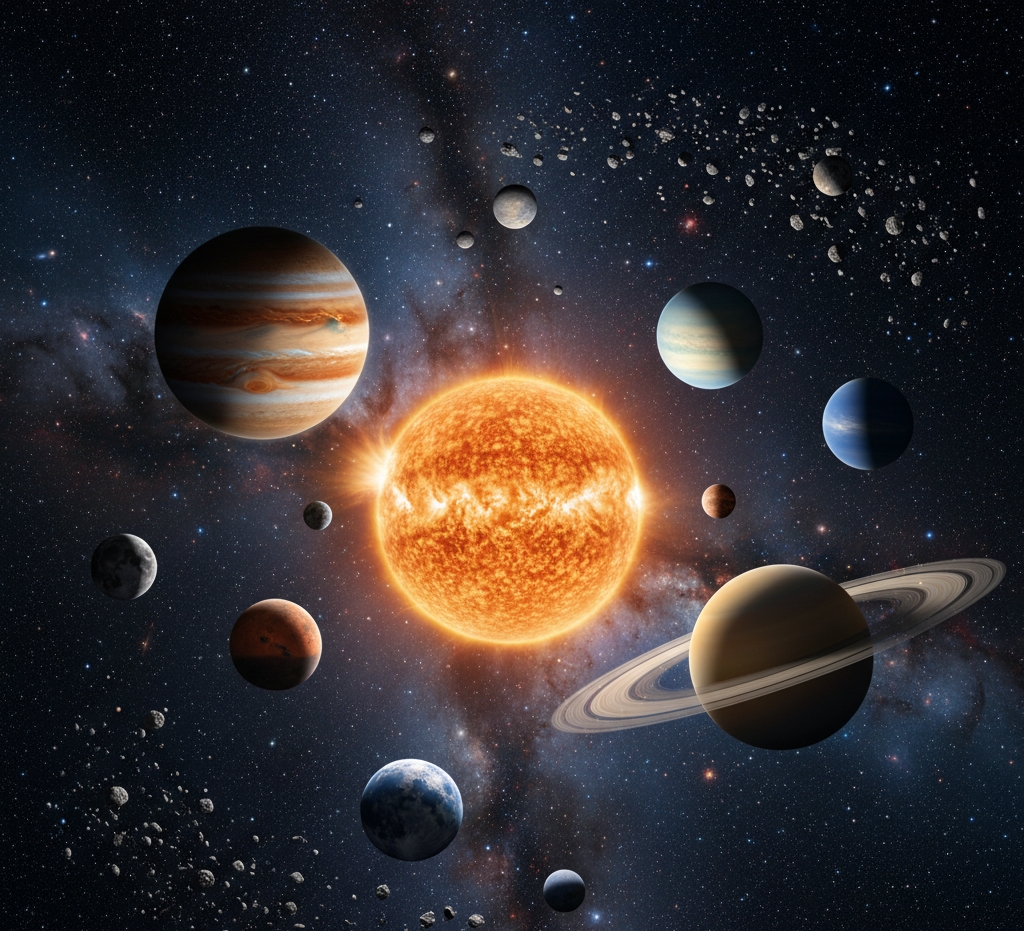
The Solar System is a gravitationally bound system consisting of the Sun and all celestial bodies that orbit it, either directly or indirectly. This includes eight planets, their moons, dwarf planets, small Solar System bodies (SSSBs), and the interplanetary medium of gas and dust. The Solar System is our cosmic neighborhood and the only planetary system known to support life ¹.
*Components of the Solar System*
- *The Sun*: A G-type main-sequence star at the center of the Solar System, accounting for 99.86% of the total mass. It provides energy and light to the planets.
- *Planets*: Eight recognized planets, including four terrestrial planets (Mercury, Venus, Earth, Mars) and four gas giants (Jupiter, Saturn, Uranus, Neptune).
- *Inner Planets*: Mercury, Venus, Earth, and Mars, which are rocky and have solid surfaces.
- *Outer Planets*: Jupiter, Saturn, Uranus, and Neptune, which are gas giants with massive atmospheres.
- *Dwarf Planets*: Pluto, Eris, Haumea, Makemake, and others, which are smaller and more irregular in shape.
- *Moons*: Over 190 known moons orbiting the planets and dwarf planets.
- *Asteroids*: Small rocky objects found primarily in the asteroid belt between Mars and Jupiter.
- *Comets*: Icy bodies that release gas and dust as they approach the Sun.
- *Kuiper Belt Objects (KBOs)*: Small, icy bodies beyond Neptune's orbit.
- *Oort Cloud*: A distant, spherical shell of icy bodies surrounding the Solar System.
*Formation of the Solar System*
The Solar System formed approximately 4.6 billion years ago from a giant molecular cloud that collapsed under its own gravity. The Sun formed at the center, and the planets and other objects formed from the remaining material. The process involved:
1. *Collapse*: The molecular cloud collapsed, and the Sun began to form.
2. *Accretion*: Small particles stuck together, forming larger bodies called planetesimals.
3. *Planetary Formation*: Planetesimals merged to form planets, which eventually cleared their orbits.
*Key Features of the Solar System*
- *Age*: Approximately 4.6 billion years old.
- *Structure*: The Solar System is divided into inner and outer regions, with the asteroid belt separating the terrestrial planets from the gas giants.
- *Habitability*: Earth is situated in the habitable zone, where liquid water can exist, making life possible.
- *Galactic Context*: The Solar System is part of the Milky Way galaxy, a barred spiral galaxy containing hundreds of billions of stars ¹ ² ³.
*Importance of the Solar System*
Understanding the Solar System offers insights into planetary formation, orbital mechanics, and the potential for extraterrestrial life. It serves as a model for understanding other stellar systems and the universe as a whole