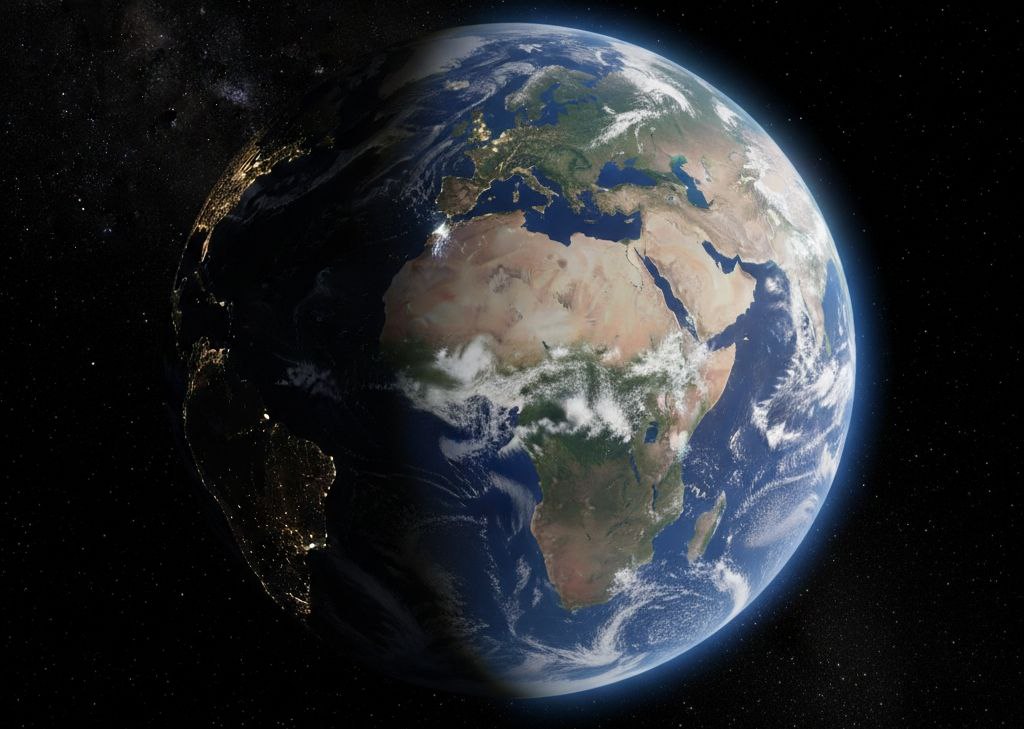
The circle of illumination is an imaginary line on Earth's surface. It's not a fixed geographical feature but rather a dynamic, constantly moving line.
Key Characteristics
* Great Circle: It's a great circle, meaning it's the largest possible circle that can be drawn on the surface of a sphere, dividing it into two equal halves. On Earth, this means it divides the planet into the half facing the Sun (day) and the half facing away (night).
* Perpendicular to Sun's Rays (Approximately): At any given moment, the plane of the circle of illumination is essentially perpendicular to the incoming parallel rays of sunlight.
* Dynamic Boundary: Because Earth rotates, the physical location of the circle moves across the surface, bringing sunrise to areas that were in darkness and sunset to areas that were in light.
Earth's Movements and the Circle of Illumination
The behavior and location of the circle of illumination are intrinsically linked to Earth's two primary movements: rotation and revolution.
1. Earth's Rotation
Rotation is the spinning of Earth on its own axis. This rotation is what causes the daily cycle of day and night.
* Speed: Earth rotates approximately once every 24 hours (a sidereal day is slightly shorter).
* Effect on the Circle: As Earth spins from west to east, the circle of illumination sweeps across the surface. A location moves from the dark side, crosses the circle of illumination (experiencing sunrise), and moves into the light side (day). Later, it crosses the circle again (experiencing sunset), and moves back into the dark side (night). The rotation ensures that every part of the globe, except near the poles during certain seasons, crosses the circle of illumination twice daily.
2. Earth's Revolution
Revolution is the orbit of Earth around the Sun, which takes approximately 365.25 days (one year).
* Effect on the Circle: Earth's axis is tilted at approximately 23.5^{\circ} relative to the plane of its orbit (the plane of the ecliptic). This axial tilt, combined with the revolution, is what causes the seasons. The tilt means that the circle of illumination does not usually coincide with the Earth's axis of rotation or the poles, except during the equinoxes. The angle at which the circle intersects the meridians and parallels changes daily throughout the year.
Relationship to the Axis of Rotation and Seasons
The angle between the circle of illumination and the Earth's axis of rotation determines the length of day and night, leading to the seasonal changes observed globally.
Equinoxes (Vernal and Autumnal)
The equinoxes (around March 20th and September 23rd) occur when Earth is positioned such that the Sun's rays are directly overhead at the Equator (0^{\circ} latitude).
* Coincidence with the Axis: On these two days, the circle of illumination passes directly through both the North and South Poles.
* Day and Night Length: This alignment means the circle of illumination bisects (divides equally) all parallels of latitude. Consequently, day and night are of nearly equal length (12 hours each) everywhere on Earth, hence the name equinox, which means "equal night."
Solstices (Summer and Winter)
The solstices (around June 21st and December 22nd) represent the maximum tilt of the Earth's axis toward or away from the Sun.
Summer Solstice (Northern Hemisphere)
* Tilt: The Northern Hemisphere is tilted toward the Sun. The Sun's rays are directly overhead at the Tropic of Cancer (23.5^{\circ} N).
* Circle's Position: The circle of illumination does not pass through the North Pole. Instead, it includes the entire area north of the Arctic Circle (66.5^{\circ} N) in daylight for 24 hours. The North Pole experiences continuous daylight.
* Day and Night Length: Days are longest and nights are shortest in the Northern Hemisphere. Conversely, days are shortest and nights are longest in the Southern Hemisphere.
Winter Solstice (Northern Hemisphere)
* Tilt: The Northern Hemisphere is tilted away from the Sun. The Sun's rays are directly overhead at the Tropic of Capricorn (23.5^{\circ} S).
* Circle's Position: The circle of illumination does not pass through the North Pole. Instead, it excludes the entire area north of the Arctic Circle from daylight for 24 hours. The North Pole experiences continuous darkness.
* Day and Night Length: Days are shortest and nights are longest in the Northern Hemisphere. Conversely, days are longest and nights are shortest in the Southern Hemisphere.
Geographical Significance
The circle of illumination is critical for understanding several fundamental geographical concepts.
Time Zones
The continuous motion of the circle of illumination is directly related to the concept of time. Local time is determined by a location's position relative to this circle.
* Solar Noon: When a meridian is exactly perpendicular to the circle of illumination in the middle of the light side, it is solar noon for all locations on that meridian.
* Prime Meridian and UTC: The global system of time zones is standardized based on the Prime Meridian (0^{\circ} longitude) and Coordinated Universal Time (UTC), which simplifies the continuous movement of the circle of illumination into manageable 15^{\circ} longitudinal slices (since Earth rotates 360^{\circ} in 24 hours, 360/24 = 15).
Twilight and Atmospheric Effects
The actual transition from light to dark is not instantaneous due to the Earth's atmosphere.
* Refraction: The atmosphere bends (refracts) sunlight, allowing light to reach areas that are theoretically just past the circle of illumination. This effect is known as twilight (or dawn/dusk).
* Duration: The duration of twilight depends on latitude. Near the Equator, the Sun sets or rises nearly vertically, and twilight is short. Near the poles, the Sun sets or rises at a shallow angle, leading to extended periods of twilight.
Conclusion
The circle of illumination is a central concept in physical geography. It is the dynamic boundary marking the divide between day and night, directly caused by Earth's rotation. Its relationship to the axial tilt and revolution governs the changing lengths of day and night and is the ultimate cause of the seasons. This imaginary line constantly sweeps across the globe, defining the rhythm of solar time and light distribution that shapes virtually all life and weather patterns on Earth.