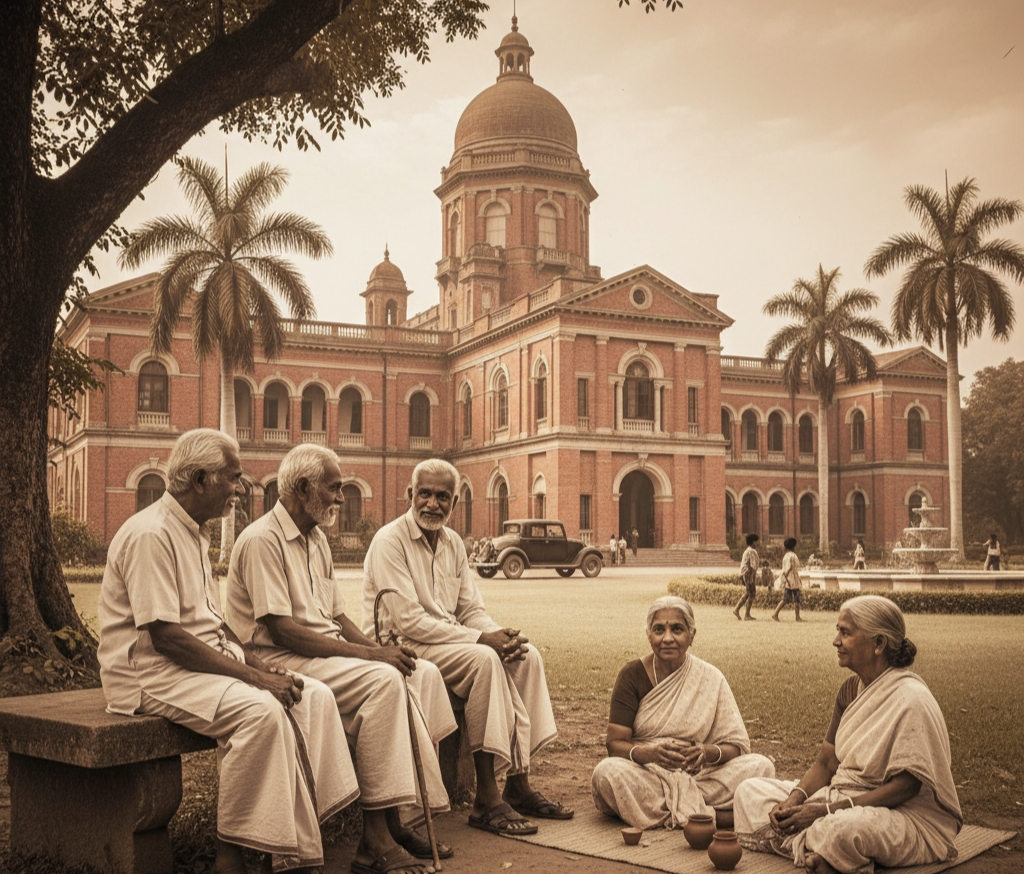
A Comprehensive History of Cooch Behar
Cooch Behar, a city and district in the Indian state of West Bengal, holds a rich and distinctive history that primarily revolves around the rise, glory, and eventual integration of the Koch Kingdom (also known as the Kamata Kingdom in its early stages). It was the only princely state in undivided Bengal, maintaining its distinct identity throughout centuries of turmoil until its merger with independent India.
The history of Cooch Behar can be broadly divided into four major periods: the rise of the Koch Dynasty and the zenith of the kingdom, the era of Mughal and Bhutanese conflicts and decline, the consolidation as a British princely state, and finally, the integration into the Dominion of India.
I. Origin and the Zenith of the Koch Kingdom (c. 1515 – 1587 CE)
The Antecedent: Kamarupa and the Khen Dynasty
The region of present-day Cooch Behar has ancient historical roots, being a part of the legendary kingdom of Pragjyotisha and later, Kamarupa. By the 15th century, the western part of Kamarupa was ruled by the Khen Dynasty, whose kingdom, Kamata, was centered at Kamatapur. The fall of the Khen king Nilambar around 1498 CE, following an invasion by Alauddin Hussain Shah, the Sultan of Gaur (Bengal), created a political vacuum in the region. Although the Sultanate forces briefly occupied the area, they were unable to consolidate their rule due to the resistance of local chieftains (Bhuyans) and the Ahom King.
The Rise of Biswa Singha and the Foundation of the Koch Dynasty
The power vacuum was skillfully exploited by a charismatic local leader named Haria Mandal, a chief of the Mech (a Tibeto-Burman tribe) or Koch community in the Chikna Hills. His son, Bisu, rose through the ranks of the local chiefdoms and tribal groups (Koch and Mech) by unifying them under his banner.
Around 1515 CE, Bisu established an independent kingdom, adopting the name Maharaja Viswa Singha (r. c. 1515–1540 CE). This marked the foundation of the glorious Koch Dynasty. Viswa Singha consolidated his rule over a vast territory, initially centered around Kamatapur. He adopted Hindu customs and traditions, a common practice for tribal rulers in the region, to legitimize and popularize his rule among the wider population, marking a significant cultural and political transformation of the Koch people into the Rajbanshi community.
The Golden Age under Nara Narayan and Chilarai
The true zenith of the Koch Kingdom was reached under Viswa Singha's son, Maharaja Nara Narayan (r. c. 1540–1587 CE). His reign is considered the Golden Age of Cooch Behar history.
* Military Expansion: Nara Narayan's campaigns were largely spearheaded by his younger brother, Shukladhwaj, who earned the famous epithet 'Chilarai' (meaning 'kite king') for his lightning-fast military movements. Chilarai defeated the Ahoms (1562 CE), the Sultans of Gaur, and other regional powers, extending the Koch Empire from the Sankosh River in the west to the Brahmaputra Valley in the east, encompassing parts of present-day Assam, North Bengal, and Bangladesh.
* Cultural Patronage: Nara Narayan was a great patron of learning and culture. It was during his reign that the renowned Assamese saint and reformer Sankardeva composed many of his major works under the royal protection of the Koch court, influencing the religious and cultural landscape of the entire northeastern region.
The Division of the Kingdom
The vast and powerful Koch Kingdom, however, was not destined to remain united. The seeds of its decline were sown in 1581 CE when Nara Narayan, in a political arrangement, divided the kingdom.
* Koch Bihar (Cooch Behar): The western portion, which lay west of the Sankosh River, was retained by Nara Narayan and later inherited by his son, Lakshmi Narayan. This part became the princely state that eventually coalesced into the Cooch Behar of modern times.
* Koch Hajo: The eastern portion, between the Sankosh and Bhareli rivers, was granted to Raghudev, the son of Chilarai. This split significantly weakened the overall Koch power structure, leaving both halves vulnerable to external threats.
II. Conflicts, Fragmentation, and Vulnerability (1587 – 1773 CE)
Following the death of Nara Narayan in 1587 CE, the history of Cooch Behar became a struggle for survival against increasingly powerful external forces: the Mughal Empire and the Dharma Rajas of Bhutan.
Mughal Incursions and Loss of Sovereignty
The partition came at a time when the Mughal Empire, under Emperor Akbar and later Jahangir, was aggressively expanding into the east. Lakshmi Narayan (r. 1587–1621 CE), the ruler of Koch Bihar, was unable to withstand the Mughal pressure.
* Tributary Status: Faced with constant attacks and territorial losses to the Mughal commanders, Lakshmi Narayan was compelled to seek Mughal protection and accepted their sovereignty, becoming a tributary state. This marked the official end of Cooch Behar's independent imperial status.
* Territorial Shrinkage: The Mughals gradually annexed large portions of the Koch territory. For example, in 1661 CE, during the reign of Maharaja Pran Narayan, the Mughal governor of Bengal, Mir Jumla, briefly conquered Cooch Behar, renaming the capital Alamgirnagar. Although Pran Narayan managed to regain control shortly after, the kingdom’s power and extent were permanently curtailed.
The Rise of Bhutanese Influence
As the power of the Mughals waned in the early 18th century, another threat emerged from the north: the Bhutanese (Bhutiyas). Over the decades, Bhutanese influence, both through alliances and aggression, began to dominate the politics of Cooch Behar.
* Instability and Abduction: The political situation was highly unstable. During the reign of Maharaja Dharjendra Narayan, the Bhutanese forces grew powerful enough to directly intervene, leading to the abduction of the Maharaja by the Bhutanese king. This period saw Cooch Behar effectively turned into a vassal state of Bhutan, its internal affairs often dictated by its Himalayan neighbour.
III. The Era of British Protection and Princely State (1773 – 1947 CE)
The Bhutanese dominance became the catalyst for the next major turning point in Cooch Behar's history: the entry of the British East India Company.
The Anglo-Koch Treaty of 1773
In 1772, Maharaja Dhairyendra Narayan's minister, facing the complete collapse of the kingdom under Bhutanese pressure, appealed for assistance from the British East India Company, then operating from Calcutta (Kolkata).
* Intervention: Warren Hastings, the first Governor-General of Bengal, dispatched Company troops to Cooch Behar. The combined forces successfully repelled the Bhutanese, securing the release of the Maharaja.
* The Treaty: The subsequent Anglo-Koch Treaty of 1773 formalized Cooch Behar's new status. Under its terms, Cooch Behar became a feudatory state of the British, agreeing to pay an annual tribute (initially half the state's revenue) to the Company in exchange for military protection and internal autonomy. This treaty guaranteed the state's existence, transforming the once-powerful empire into a protected princely state under the British Raj.
Modernization and Development
The 19th century witnessed a significant phase of modernization, particularly under Maharaja Nripendra Narayan Bhup Bahadur (r. 1863–1911 CE). Having received a Western education, the Maharaja, upon attaining majority, oversaw rapid development that earned Cooch Behar the reputation of being one of the most advanced native states in South Asia.
* Administration and Infrastructure: The state’s administration, judiciary, and revenue systems were reformed on the British model.
* Architectural Heritage: He commissioned the construction of magnificent structures, including the iconic Cooch Behar Palace (modeled on the classical European style, similar to the Buckingham Palace), administrative buildings, libraries, and clubs, transforming the capital into a modern city.
* Social and Cultural Change: Maharaja Nripendra Narayan's marriage to Maharani Sunity Devi, the daughter of the famous Brahmo Samaj leader Keshab Chandra Sen, was a defining moment. Sunity Devi championed women's education and social reform, gaining international recognition and becoming the first Indian queen to travel abroad. This period fostered a blend of Indian and Western culture in the royal family and the state's elite.
The British placed Cooch Behar under the Bengal States Agency, and later under the Eastern States Agency, confirming its status as a major princely state with a Salute of 13 Guns.
IV. Integration into the Indian Union (1947 CE onwards)
The history of Cooch Behar’s centuries-long independent identity came to a close with India's independence.
Accession and Merger
With the Indian Independence Act of 1947, British paramountcy over the princely states lapsed. Maharaja Jagaddipendra Narayan (r. 1922–1949), the last ruling Maharaja of Cooch Behar, decided to accede to the newly independent Dominion of India.
* Instrument of Accession (August 1947): Initially, the Maharaja signed the Instrument of Accession, granting the Dominion Government control over Defence, External Affairs, and Communications.
* Merger Agreement (August 1949): Due to administrative and political challenges following Partition, and with an eye on the long-term stability and development of the region, the Maharaja later signed an agreement on August 20, 1949, ceding "full and exclusive authority, jurisdiction and power" of the state to the Government of India.
* Transfer of Administration (September 1949): The administration of Cooch Behar was officially transferred to the Government of India on September 12, 1949, and it was governed as a Chief Commissioner's Province.
Integration with West Bengal
The final political integration occurred in 1950. On January 1, 1950, Cooch Behar was officially merged with the state of West Bengal, becoming the Cooch Behar District of the state. This decision, spearheaded by Sardar Vallabhbhai Patel, was taken based on geographical proximity and administrative convenience, concluding the 435-year-long rule of the Koch Dynasty and integrating the region fully into the modern Indian Republic.