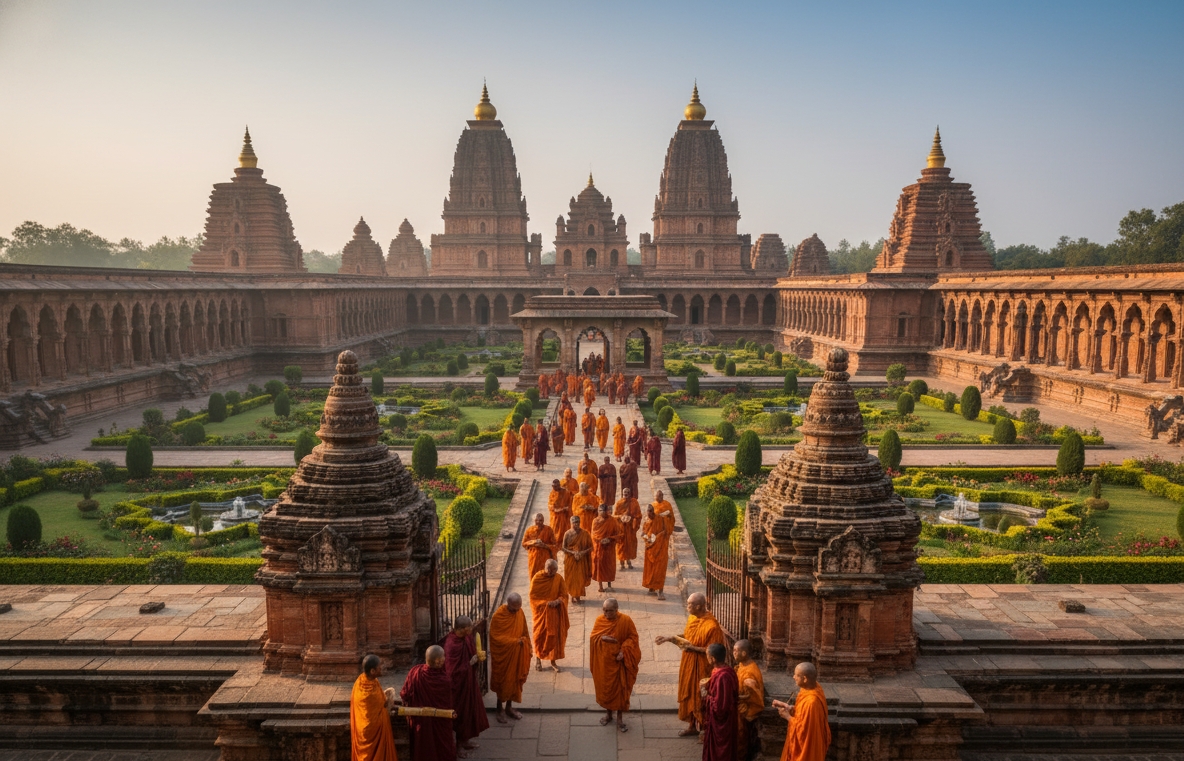
The Jewel of the Sangha: A Detailed History of Nalanda Mahavihara
Nalanda Mahavihara, often hailed as the world's first true residential university, was not merely a monastic college; it was an intellectual powerhouse, a spiritual citadel, and a beacon of knowledge that illuminated the world for over seven centuries. Located near the present-day city of Bihar Sharif in Bihar, India, its influence stretched across Asia, shaping the culture, religion, and philosophy of nations from Tibet to Indonesia.
I. The Dawn: Foundation and Early Growth (5th Century CE)
The history of Nalanda is rooted in the fertile Gangetic plains, an area long associated with spiritual awakening. The Buddha himself is said to have visited and lectured in a nearby village, planting the seeds of its future importance.
A. Myth and Early Patronage
The name "Nalanda" itself is steeped in legend. One popular derivation suggests it comes from Na ālam dā, meaning "no stopping of the gift" (of knowledge), signifying its charitable and ceaseless dedication to learning.
While the site was likely a modest monastic center for centuries, its transformation into a grand university began in the Gupta period, the "Golden Age" of India. The traditional founder is identified as Kumāragupta I (reign c. 415–455 CE).
* The Gupta Era Catalyst: The Gupta rulers were renowned patrons of the arts, sciences, and philosophy. They provided the initial land grants and endowments that enabled the first major architectural expansions. These early structures were characterized by the classical Gupta style: solid, majestic, and durable.
* The Hinayana to Mahayana Shift: In its earliest phase, Nalanda may have catered to different Buddhist schools, but by the time of its greatest expansion, it became the preeminent center for Mahayana Buddhism, particularly the Mādhyamaka and Yogācāra schools.
B. The Testimony of Xuanzang
The crucial historical confirmation of Nalanda's grandeur comes from the accounts of the illustrious Chinese pilgrim, Xuanzang (Hsuan-tsang), who arrived in India in the 7th century CE. His vivid travelogue, The Great Tang Records on the Western Regions, paints the earliest detailed picture of the university at its zenith.
Xuanzang spent several years at Nalanda (c. 637-641 CE) as a student and teacher under the guidance of the revered Sthavira Śīlabhadra, the then-head of the university. He described Nalanda as:
* "Brightly decorated with towers and pinnacles, covered with the glaze of the morning mist."
* "A continuous series of courts and viharas (monasteries), adorned with richly carved wood and stone."
* He noted the presence of ten thousand monks (scholars) and the rigorous intellectual life.
II. The Golden Age: Structure and Academic Life (7th - 9th Centuries CE)
The 7th and 8th centuries CE, spanning the reigns of the post-Gupta King Harsha and the early Pala Dynasty, marked the undisputed zenith of Nalanda's glory. During this period, it became a standardized, globally recognized academic institution.
A. Architecture and Layout
Nalanda was not a single building but a sprawling Mahavihara (Great Monastery), meticulously planned and organized. Its layout adhered to a specific monastic and academic design:
* Viharas (Monastic Residences): A series of magnificent monasteries (monastic colleges), typically built in a rectangular, quadrangular plan around a central courtyard. These served as both living quarters and classrooms. Archaeological evidence reveals at least eleven major Viharas aligned north-to-south.
* Chaityas (Temples/Shrines): Dominant stupas and temples, notably the massive Sariputra Stupa (Site 3), which served as major spiritual foci.
* The Library – Dharmagañja (Treasury of the Dharma): This was the heart of the intellectual complex. It was a massive, multi-story structure comprising three enormous buildings:
* Ratnasāgara (Ocean of Jewels): The largest building, nine stories high, specializing in religious sutras.
* Ratnodadhi (Sea of Jewels): Dedicated to philosophy and logic.
* Ratnarañjaka (Jewel-adorned): Held grammar and miscellaneous texts.
The library housed countless manuscripts, making Nalanda the global repository of Buddhist and non-Buddhist knowledge.
B. The Rigor of Admission
Entrance to Nalanda was exceptionally competitive, making it the academic equivalent of an elite modern university.
* The Gatekeeper Scholars: The university's gates were manned by learned scholars, known as the Dvārapaṇḍita (Gate Pundit).
* The Oral Examination: New students had to pass a difficult oral examination on the spot. Xuanzang noted that "seven or eight out of every ten failed to gain admission." This ensured that only the most dedicated and intellectually prepared students were accepted.
* The Students: The student body was international, including seekers from China (Xuanzang, Yijing), Korea, Japan, Tibet, Mongolia, Persia, and Southeast Asia. They represented a true confluence of global thought.
C. The Curriculum: A Blend of Sacred and Secular
Nalanda's curriculum was remarkably broad, extending far beyond the purely religious and reflecting an age of scientific inquiry.
| Category | Subjects Taught | Significance |
|---|---|---|
| Pāramārthika (Ultimate Truth) | Mahayana and Hinayana Doctrines, Madhyamaka, Yogācāra | Core philosophical and religious study. |
| Logic & Epistemology | Hetu-vidyā (Science of Reasoning), Pramāṇa-vidyā (Epistemology) | Essential for rigorous debate and defending philosophical positions. |
| Grammar & Language | Śabda-vidyā (Sanskrit Grammar), Linguistics, Literature | Mastery of Sanskrit was foundational for all advanced studies. |
| Fine Arts & Craft | Śilpa-karma-vidyā (Arts and Crafts), Painting, Sculpture | Integral to monastic and ritual practice. |
| Medicine | Cikitsā-vidyā (Medical Science/Ayurveda) | Monks were often tasked with healing the local populace. |
| Secular Subjects | Astronomy, Mathematics, Vedas (Hindu Texts), Law, Economics | Showing its commitment to sarva-vidyā (all knowledge). |
D. Eminent Teachers of Nalanda
The university's reputation rested on its galaxy of intellectual stars. Its teachers were legendary figures whose works fundamentally shaped Asian philosophy.
* Dignāga (c. 480-540 CE): The "Father of Buddhist Logic," whose work created a revolution in the field of Indian epistemology (Pramāṇa).
* Dharmakīrti (c. 7th Century CE): Dignāga's successor, arguably the most influential logician of all time in India. His Pramāṇavārttika became the definitive text on Buddhist epistemology.
* Śāntarakṣita (c. 725-788 CE): Philosopher and abbot who integrated the Mādhyamaka and Yogācāra schools. He was invited to Tibet, where he helped establish the first monastery (Samye) and laid the foundation for Tibetan Buddhism.
* Āryadeva and Nāgārjuna: Though their primary teaching period predates the full establishment of the university, their philosophical systems (Mādhyamaka) formed the bedrock of the Nalanda curriculum.
III. The Pala Era and Global Influence (9th - 12th Centuries CE)
With the decline of the Guptas, the Pala Dynasty (c. 750 – 1174 CE) emerged in Bengal and Bihar. The Pala kings were ardent Buddhists and patrons of learning, ensuring the financial and political security of Nalanda for centuries more.
A. The Viharas Network
Under the Palas, Nalanda operated as the central node of a vast network of Buddhist universities, including Vikramashila, Odantapura, and Jagaddala. The scholars often moved between these institutions, creating a unified academic environment.
B. The Role in Tibetan Buddhism
The most enduring legacy of Nalanda lies in its impact on Tibet. From the 8th century onward, a continuous stream of Nalanda masters travelled to Tibet, and Tibetan scholars came to Nalanda.
* Ātisa Dīpaṃkara Śrījñāna (c. 980-1054 CE): The last great scholar of the Pala age and the abbot of Vikramashila (a sister university to Nalanda), who travelled to Tibet and spearheaded the "Second Diffusion" of Buddhism, fundamentally reforming and shaping the religion into what is known today as Tibetan Buddhism (Vajrayana). Every major lineage of Tibetan Buddhism traces its intellectual roots back to the professors and texts of Nalanda.
C. The Rise of Vajrayana (Tantra)
While Mahayana philosophy remained central, Nalanda also became a crucial center for the development of Vajrayana Buddhism (Esoteric/Tantric Buddhism). The famous 84 Mahāsiddhas (Tantric masters) of India were often associated with the Nalanda-Vikramashila complex, bridging the gap between scholastic philosophy and intense meditative practice.
IV. Decline and Destruction (12th - 13th Centuries CE)
The eventual downfall of Nalanda was a cumulative tragedy, resulting from internal pressures, changing political landscapes, and, ultimately, a devastating foreign invasion.
A. Internal Pressures and Competition
By the 11th and 12th centuries, new intellectual trends began to challenge Nalanda's dominance:
* The Rise of Vedanta: The revival of Brahmanical Hindu philosophy, championed by figures like Adi Shankara, introduced rigorous, centralized institutions (like the mathas), which presented stiff competition to the Buddhist intellectual centers.
* Shift in Patronage: The Pala Dynasty eventually waned, replaced by the Sena Dynasty, who were patrons of orthodox Hinduism, leading to a reduction in royal funding for Buddhist universities.
B. The Catastrophic Invasion (c. 1193 CE)
The final, fatal blow came from external forces—the Turkic-Afghan military incursions into North India. The most infamous account of Nalanda’s destruction comes from the Persian historian Minhaj-i-Siraj Juzjani in his work, the Tabaqat-i-Nasiri.
* The Commander: The destruction is attributed to Bakhtiyar Khilji, a general under Qutb al-Din Aibak, who led a raid into Bihar.
* The Burning of the Library: The account states that Khilji's forces attacked a major fortified structure (identified as Odantapura or Nalanda). When the soldiers inquired about the contents of the huge library, they were told it contained "only books." The invaders systematically burned the Dharmagañja library, which is said to have burned for months.
* The Slaughter of the Monks: The monks (scholars) were massacred, and the surviving ones fled to Nepal and Tibet, taking invaluable manuscripts with them, which is why much of Nalanda's literature survives today only in Tibetan translation.
The sheer scale of the intellectual loss—the irreplaceable manuscripts, the systematic dismantling of the teaching structure, and the murder of the paṇḍitas—was irreparable. Nalanda never recovered. Though some attempts were made to revive it in the 13th century, the political and spiritual climate of the region had irrevocably changed.
V. Epilogue: Rediscovery and Legacy
Nalanda lay in ruins for over 700 years, a forgotten mound of rubble and baked brick, its identity often confused with other nearby sites.
A. Rediscovery
The site was finally identified in 1861 by Alexander Cunningham, the father of Indian Archaeology, using the detailed descriptions left behind by the Chinese pilgrims Xuanzang and Yijing.
* Archaeological Excavations: Extensive excavations began in the early 20th century and continue to this day, revealing the vast scale of the university—the Viharas, Chaityas, and Stupas that once housed one of the world's most impressive educational complexes.
B. The Eternal Legacy
Despite its physical destruction, the legacy of Nalanda is eternal:
* Repository of Knowledge: It preserved and transmitted the classical intellectual tradition of India (including philosophy, logic, and medicine) at a critical time.
* Architectural Blueprint: Its quadrangular monastic layout influenced the design of monasteries across Asia, from Central Asia to Indonesia.
* The Spine of Tibetan Buddhism: Nalanda is revered in Tibetan Buddhist culture as the mother institution from which their entire spiritual and philosophical tradition flows.
* Symbol of Universal Education: In 2016, the ruins of Nalanda were declared a UNESCO World Heritage Site, recognizing its contribution as a symbol of early, structured, residential education—a prototype for the modern university.
* The New Nalanda University: In 2010, the Indian government, with support from several East Asian nations, established the Nalanda University (often called the Nalanda International University) near the ancient site. This modern institution aims to revive the spirit of its ancient predecessor as a center for global learning, ecology, and philosophy in the 21st century.
Nalanda Mahavihara was more than just a university; it was a civilization's commitment to the pursuit of truth, proof that the greatest empires are those built not with armies, but with ideas.