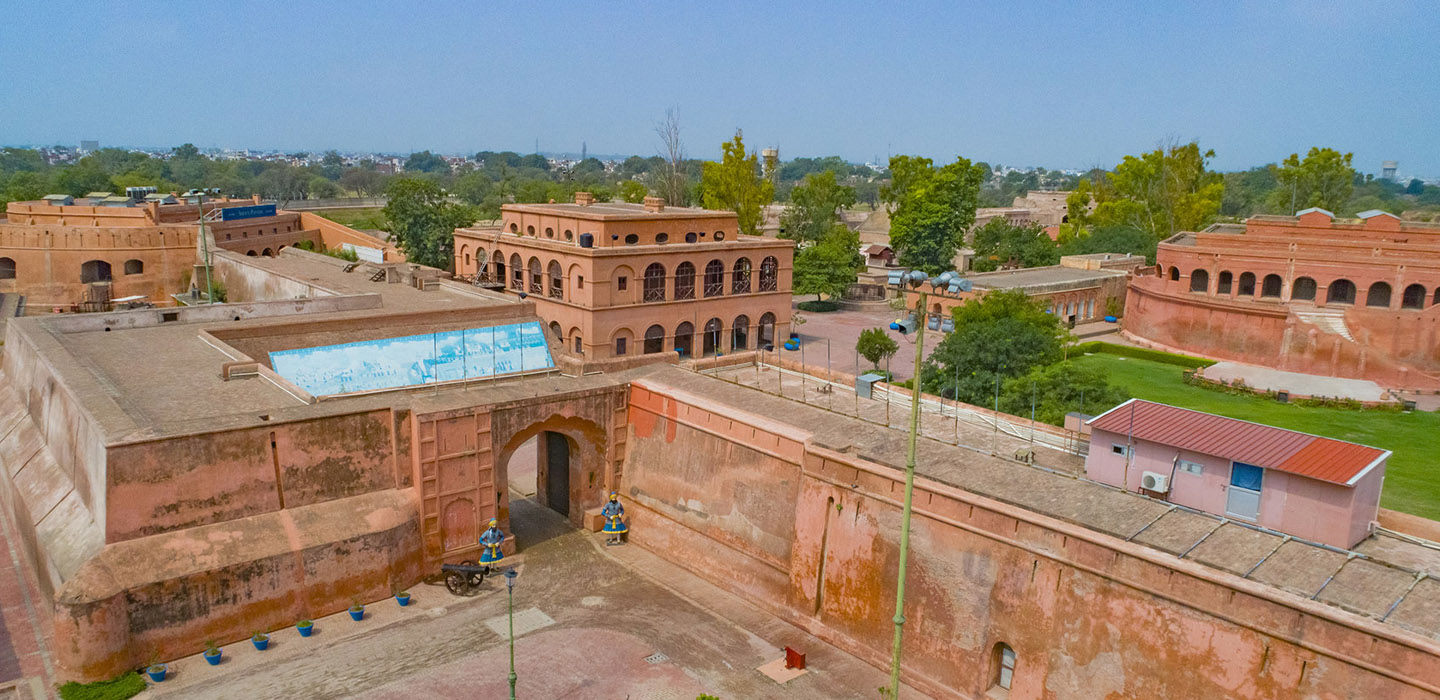
The Story of Govindgarh Fort: A Citadel of Punjab's History
Govindgarh Fort, spanning 43 acres in the heart of Amritsar, is more than a mere structure; it is a profound symbol of Punjab's resilience, strategic importance, and golden era under the Sikh Empire. With a history stretching over 250 years, the fort has served as a mud fortress, an imperial treasury, a British cantonment, and a modern military base, finally transforming into a celebrated heritage site open to the public.
The Origin: Bhangian Da Qila (Mid-18th Century)
The fort's story begins in the fragmented political landscape of the 18th-century Punjab region, which was then divided among several Sikh sovereign states, known as Misls.
* Builder and Name: The original structure was a simple mud fortress built around the 1760s by Sardar Gujjar Singh Bhangi, the chieftain of the powerful Bhangi Misl. Due to its builders, it was originally known as "Bhangian Da Qila" (The Fort of the Bhangis).
* Purpose: The initial fortress was built to secure the Bhangi Misl's territory and control over the strategic city of Amritsar, which was a vital center of trade and pilgrimage.
* The Zamzama Cannon: The fort's connection to legend began with the acquisition of the enormous Zamzama cannon ("Bhangian di Tope"). This 14.3-foot-long artillery piece was a prized possession, adding to the fort's reputation and military significance during the Bhangi rule, which lasted for nearly 49 years.
The Golden Era: Maharaja Ranjit Singh's Transformation (1805–1839)
The destiny of the fort changed dramatically with the rise of Maharaja Ranjit Singh, the founder of the Sikh Empire (Khalsa Raj).
* Conquest and Renaming (1805): In the early 1800s, the fort's control became crucial to Ranjit Singh's ambition of unifying Punjab. A dispute over the legendary Zamzama cannon became the pretext for a siege. After capturing the fort from the Bhangi rulers (Gurdit Singh Bhangi and his mother, Mai Sukhan), Maharaja Ranjit Singh immediately renamed it "Gobindgarh Fort" in honor of the tenth Sikh Guru, Guru Gobind Singh Ji.
* The "Lion of Punjab's" Stronghold: Ranjit Singh understood the strategic importance of the fort. Located outside the walled city but shielding the revered Harmandir Sahib (Golden Temple), he transformed the mud fortress into an impregnable military bastion of brick and lime.
* Architectural Enhancement (1805–1809): Under the supervision of his governor and foreign minister, Fakir Azizuddin, significant expansion and fortification efforts took place. The fort was reinforced with strong walls, four well-designed bastions, a deep surrounding moat, and a complex layout influenced by French military architecture, thanks to the European officers in the Maharaja's service.
* The Imperial Treasury: Govindgarh Fort became the secure repository for the Sikh Empire’s immense wealth. The fort's Toshakhana (treasury) famously housed the legendary Koh-i-Noor diamond, along with vast quantities of gold, silver, and precious jewels, cementing its status as the economic and military heart of the Sikh Kingdom.
* A Hub of Power: The fort served as a key administrative, military, and minting center. Silver rupees bearing the inscription "Zarab Sri Amritsar" were coined here. In 1837, the fort hosted the grand wedding of Prince Nau Nihal Singh, Maharaja Ranjit Singh's grandson, underscoring its role as a royal residence.
The British Occupation (1849–1947)
Following the death of Maharaja Ranjit Singh and the subsequent decline of the Sikh Empire, the fort's control passed to the British.
* Capture after the Anglo-Sikh War: The British East India Company captured the fort in 1849 after the Second Anglo-Sikh War, marking the final collapse of the Khalsa Raj.
* Transformation into a Cantonment: The British recognized the fort's enduring strategic value, converting it into a military cantonment. They made numerous defensive and structural additions, including the construction of the Darbar Hall and the 'Anglo Sikh Bungalow', and even a 50-meter-tall watchtower (later demolished).
* The Phansi Ghar: During the British Raj, the fort was also used as a prison, and it houses the infamous 'Phansi Ghar' or hanging tower, a somber reminder of the colonial-era justice system.
* Military Secrecy: For the entirety of the British rule and the subsequent decades, the fort remained an active military preserve, inaccessible to the public.
Post-Independence and Restoration (1947–Present)
After India gained independence, the fort transitioned to the hands of the Indian Army in 1947, which continued to use it as a military base for decades.
* Handover and Restoration: The fort was finally handed over to the Punjab State Government in 2006. A massive restoration and conservation project was initiated to convert the military base into a cultural heritage site.
* Opening to the Public (2017): Govindgarh Fort was officially opened to the public in February 2017. It is now managed as a "living museum" and theme park, dedicated to preserving and showcasing the history and culture of Punjab.
* Current Attractions and Significance: Today, the fort's grounds feature several museums and exhibitions, including:
* The Toshakhana: Now a museum displaying replicas of the fort's treasures, including the Koh-i-Noor diamond.
* The Warfare Museum: Exhibits weapons, armor, and the replica of the Zamzama cannon.
* Sher-e-Punjab: A popular 7D show detailing the life and times of Maharaja Ranjit Singh.
* Enduring Legacy: Govindgarh Fort now serves as a dynamic tourist and educational destination, providing a crucial link between modern Punjab and its magnificent, turbulent, and storied past, standing as a permanent sentinel guarding the history of the Golden Temple and the city of Amritsar.