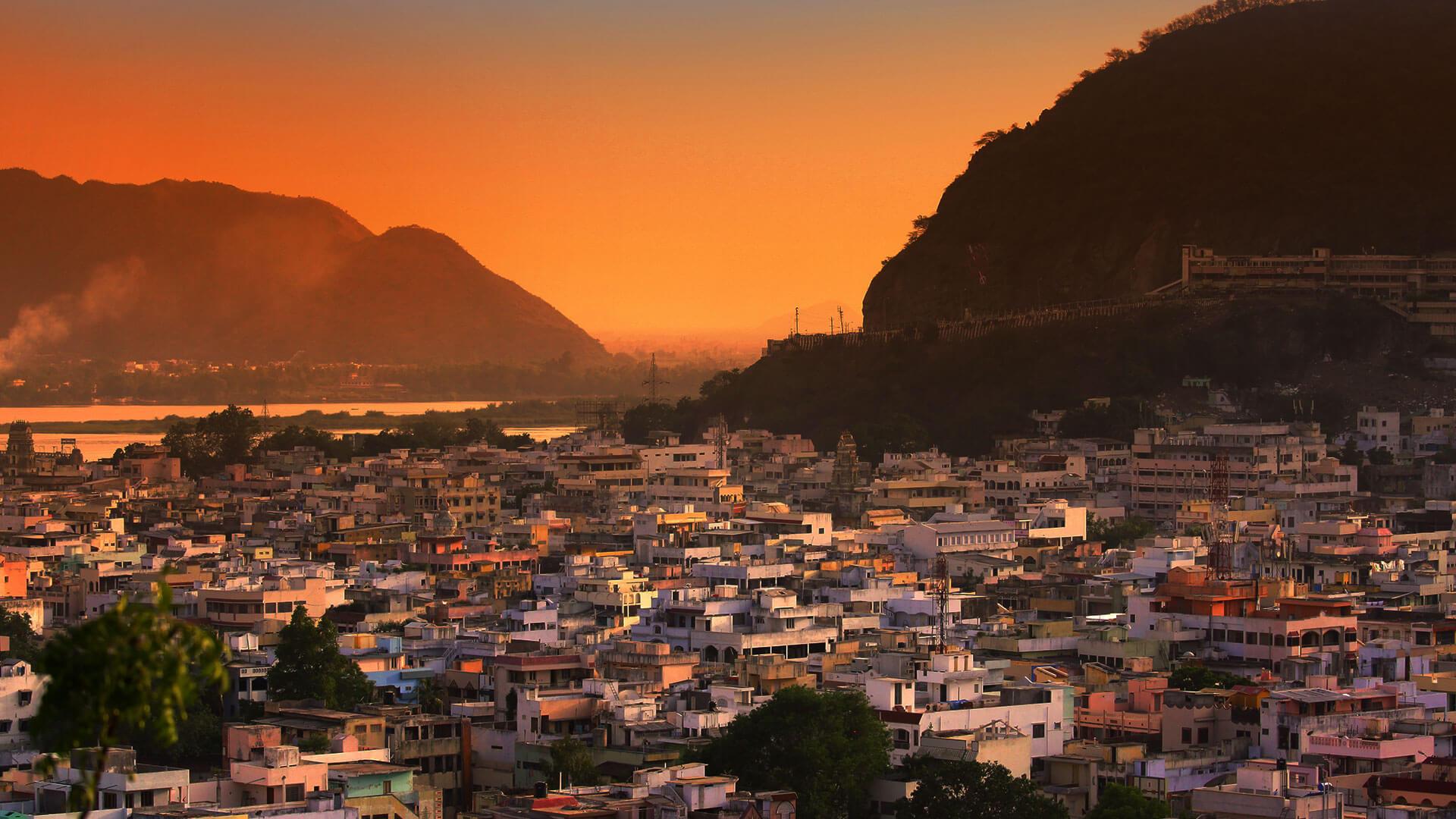
Vijayawada, historically known as Bezawada, is a city with a profound and continuous history, rooted in mythology and solidified by its strategic location on the banks of the River Krishna. Its story is a tapestry woven with ancient spiritual traditions, powerful dynastic rule, and transformation into a bustling modern commercial and transport hub.
The Ancient & Mythological Origins of Vijayawada
The history of Vijayawada begins in the realm of mythology and is attested by ancient archaeological findings, notably Stone Age relics along the banks of the River Krishna.
The Legends Behind the Name
The current name, Vijayawada (meaning "The Place of Victory"), and its former name, Bezawada, are steeped in local folklore:
* The Victory of Durga (Vijayawada): A popular legend states that Goddess Durga defeated the demon Mahishasura and, being victorious (Vijaya), rested at this place (wada or vatika). The place was thus named Vijayavatika, which later evolved into Vijayawada. The famous Kanakadurga Temple on Indrakeeladri Hill commemorates this victory.
* **Arjuna's Penance (Vijayawada/Vijayavata): Another tale, drawn from the epic Mahabharata, recounts that Arjuna, one of the Pandava brothers, performed severe penance atop Indrakeeladri Hill and was blessed by Lord Shiva, from whom he received the powerful weapon, the Pasupatastra. The place was named Vijayavata (or Vijayawada) to celebrate his victory (Vijaya).
* The 'Bejjam' (Bezawada): The former name, Bezawada, is believed to have originated when the River Krishna (Goddess Krishnaveni) requested Arjuna to create a passage for her to merge into the Bay of Bengal. Arjuna, it is said, made a 'Bejjam' (meaning a hole or passage) through the mountains, leading the place to be called Bejjamwada, which later became Bezawada.
The Dawn of Civilization and Early Empires (c. 3rd Century BCE – 6th Century CE)
Vijayawada's strategic location made it a focal point for early South Indian empires and a major center for both Hinduism and Buddhism.
* Mauryan and Satavahana Influence: Archaeological records suggest the city was part of the Kalinga Empire, which was conquered by Emperor Ashoka around 260 BCE. The region, including the nearby famous Buddhist sites like Amaravati, Ghantasala, and Bhattiprolu, was a significant hub for Buddhism. Vijayawada itself was likely the capital of the country of Dhanyakataka at one point. The area was later ruled by the Satavahanas (c. 230 BCE – 227 CE), including King Chandra Sri Satakarni (c. 208 CE).
* The Vishnukundina Dynasty (c. 5th-6th Century CE): In the 5th and 6th centuries, Vijayawada became a major center for the Vishnukundina rulers. King Madhava Varma I of this dynasty is noted for his religious fervor, claiming to have performed numerous Vedic sacrifices. The rock-cut architecture of the Mogalrajapuram Caves (4th–9th centuries) and the Akkana Madanna Caves are often attributed to this dynasty, showcasing early Hindu temple architecture.
* The Chinese Traveler's Account: The famous Chinese Buddhist scholar and traveler, Xuanzang (Hiuen Tsang), visited the city around 637–640 AD. He stayed for a few years, dedicating his time to copying and studying Buddhist scriptures, a testament to the city's importance as a center of learning and Buddhist culture.
⚔️ The Medieval Dynasties and Cultural Zenith (c. 7th Century – 17th Century)
The medieval period was marked by the rule of influential dynasties, which shaped the region's political, architectural, and religious landscape.
Eastern Chalukyas and Rashtrakutas (c. 7th – 12th Century)
* Establishment and Conflicts: Vijayawada (then Bezawada) was formally founded around 626 AD by the Paricchedi Kings. It soon fell under the control of the Eastern Chalukyas of Vengi (c. 615 AD – 1070 AD). The city's strategic position meant it was frequently contested between the Eastern Chalukyas and the Rashtrakutas. Inscriptions at the Malleswara Temple, located at the foot of Indrakeeladri Hill, record the rule of various kings, including Yudhamalla I and II of the Eastern Chalukyas.
The Kakatiya Empire (c. 12th – 14th Century)
* Expansion and Conquest: The Kakatiya dynasty, with its capital at Warangal, expanded its territory significantly into Coastal Andhra. The great Kakatiya ruler, Ganapati Deva (r. 1199–1262), conquered Bezawada around 1201 AD during his Coastal Andhra Campaign.
* A Woman's Rule: Ganapati Deva was succeeded by his daughter, Rudrama Devi (r. 1262–1289/1295), one of the few queens in Indian history. Her rule brought stability and prosperity, a fact noted by the Venetian traveler Marco Polo in the late 13th century. The region around Vijayawada, including the nearby Mandadam village, was culturally and politically significant during her reign.
Later Dynasties and Regional Powers
Following the decline of the Kakatiyas in the early 14th century, the region passed through the hands of several powerful kingdoms:
* Reddy Kingdom and Vijayanagara Empire: The Reddy dynasty briefly held sway, building the fort at Kondapalli. Subsequently, the area became part of the glorious Vijayanagara Empire. Under rulers like Krishnadevaraya, Vijayawada was designated as a significant religious and cultural capital.
* The Qutb Shahi Dynasty (Golconda Sultanate): The area later passed to the Qutb Shahi rulers in the early 16th century. It was during this time that diamond mines, including the famous Kollur Mine (rumored to be the source of the Koh-i-Noor diamond), were found near Vijayawada on the banks of the Krishna River. The city gained further importance as the office of the influential ministers Madanna and Akkana was established here due to their reverence for Goddess Kanaka Durga.
???? The Colonial Transformation (c. 18th Century – 1947)
The arrival of European powers and the eventual establishment of the British Raj brought about a massive transformation in Vijayawada's role, shifting it from a dynastic outpost to a key commercial and transport center.
* From Qutb Shahis to the British: The region, being part of the larger Krishna District, initially fell under the control of the Nizams of Hyderabad after the Qutb Shahi rule. The British East India Company secured the Northern Circars, including the Vijayawada region, after supporting the Nizam in the 18th century.
* Infrastructure Development: The British rule was a period of significant infrastructural growth, which permanently altered the city's economic profile:
* The Prakasam Barrage: The most vital project was the construction of the barrage (initially a anicut) across the Krishna River in the mid-19th century. This project provided crucial irrigation to the rich delta region, making Vijayawada an agricultural trade hub. The present-day Prakasam Barrage was completed in 1957.
* Railway Junction: A major milestone was the construction of the railway bridge over the Krishna River around 1900. This connected the northern and southern parts of the region, transforming Vijayawada into one of the busiest and largest railway junctions in South India and solidifying its position as a central transport and commercial node.
* A Center for the Freedom Movement: The city became a notable center for political and social activity during the Indian independence movement. The Gandhi Hill in the city holds the distinction of having the first Gandhi Memorial in India to be constructed on a hillock.
???? The Modern Era: From State Capital to Business Hub (1947 – Present)
Post-independence, Vijayawada rapidly emerged as a dominant center for commerce, education, and politics in Andhra Pradesh.
* Post-Independence Growth: The city saw a rapid development of infrastructure and industry. Major developments in the mid-20th century included:
* The establishment of the Hindustan Shipyard nearby (originally the Scindia Shipyard) in 1949.
* The city was granted Municipal Corporation status in 1979.
* The Economic Powerhouse: Due to its exceptional road and rail connectivity, proximity to the rich Krishna delta, and central location, Vijayawada earned the moniker "The Business Capital of Andhra Pradesh." It boasts some of Asia's largest agricultural markets for cotton, tobacco, and chillies, as well as one of the biggest wholesale textile and garment markets in South Asia.
* Educational and Political Center: Vijayawada is also widely recognized as an educational hub in Southern India. Politically, its central location has often made it the nucleus of regional politics.
* Recent Political Significance (2014-2020): Following the bifurcation of Andhra Pradesh and the creation of Telangana in 2014, Vijayawada took on a new, high-profile role. It served as the temporary capital of Andhra Pradesh from 2014 until 2020 while the new state capital, Amaravati, was being established in its immediate vicinity. This period further boosted the city's infrastructure and global recognition. Today, it remains a key component of the Andhra Pradesh Capital Region Development Authority (APCRDA) region.
In conclusion, Vijayawada's history is a remarkable journey from the mythological Vijayavatika of Goddess Durga and Arjuna, to the Buddhist-Hindu confluence of the Vishnukundins and Chalukyas, to the diamond-rich outpost of the Qutb Shahis, and finally to its current status as a highly strategic, modern commercial and political capital.
The Vishnukundina Dynasty and Early Architecture
The Vishnukundina dynasty played a crucial, though sometimes overlooked, role in establishing Vijayawada as a center of religious and political authority in the early medieval period (c. 5th to 7th Century CE).
Rise and Rule
* Origin: The Vishnukundins were powerful rulers whose kingdom, at its peak, extended across the modern Guntur, Krishna, Godavari, and Visakhapatnam districts. Their name is often associated with the region of Vinukonda.
* A Pious King: King Madhava Varma I is the most renowned ruler of this line. Inscriptions and records highlight his strong adherence to Vedic Hinduism, claiming that he performed numerous grand sacrifices, including eleven Aśvamedha (horse sacrifices) and a thousand other rituals, demonstrating the dynasty's significant political and economic power.
* Political Context: The Vishnukundins were contemporaries of the powerful Pallavas and fought successfully against the Gangas of Kalinga (modern Odisha). Their rule in Coastal Andhra lasted until they were eventually conquered by the Western Chalukya ruler, Pulakesin II, around 624 CE.
Architectural Legacy: The Rock-Cut Caves
The most enduring contribution of the Vishnukundins to Vijayawada is their promotion of rock-cut architecture, reflecting an early transition from Buddhism to Hindu temple construction in the region.
* Mogalrajapuram Caves: Located in the Mogalrajapuram hills, these caves date back to the 4th–9th centuries CE, with some confidently attributed to the Vishnukundina era. They house some of the earliest examples of Hindu rock-cut temples in South India. One cave notably contains an image of Ardhanarishvara (a composite form of Shiva and Parvati), showcasing the Shaivite influence of the time.
* Akkana Madanna Caves: Situated at the foot of the Indrakeeladri Hill, these caves are a Monument of National Importance. While they were later modified during the Qutb Shahi period (where Akkana and Madanna, two ministers, had their office), the original rock-cut architecture is believed to belong to the Vishnukundina style. They are part of the broader artistic evolution that flourished in the Krishna river valley.
The Kakatiya Dynasty and Regional Hegemony
The Kakatiya period (c. 12th – 14th Century CE) saw Vijayawada incorporated into one of the most powerful empires of the Telugu region, bringing it into a centralized political and military structure.
The Conquest and Annexation
* Ganapati Deva's Campaign: The coastal region of Andhra, including Vijayawada (Bezawada), was controlled by the waning Chalukya-Chola power and local feudal lords. The Kakatiya ruler Ganapati Deva (r. 1199–1262), aiming to unify all Telugu-speaking areas, initiated a major campaign.
* Capture of Bezawada (1201 AD): Ganapati Deva began his campaign by attacking Bezawada, which was strategically located on the eastern edge of the Kakatiya kingdom. An inscription near the Kanakadurga Temple, dating to 1201 AD, records the presence of the Kakatiya-allied Natavadi princes and confirms that a battle took place. Bezawada was quickly captured, marking a crucial step in the Kakatiya conquest of the rich Velanadu region (Coastal Andhra).
* Unification and Patronage: The Kakatiyas were great patrons of the Telugu language and culture. Integrating Vijayawada into their empire ensured political stability, facilitating trade and cultural exchange between the inland capital of Warangal and the coastal trade routes.
Rudrama Devi’s Association
* A Symbol of Power: Ganapati Deva's successor, his daughter Rudrama Devi (r. 1262–1289), was a formidable warrior and administrator. The region around Vijayawada was politically significant to her.
* Mandadam Inscription: The nearby village of Mandadam holds a huge stone inscription from 1261 AD, jointly issued by Ganapati Deva and Rudrama Devi, commemorating her birthday and recording the gift of land to a local temple. It is rumored that Rudrama Devi received military training, including archery, in this vicinity, linking the city to her martial prowess.
The British Colonial Era: The Making of a Modern Hub
The British period (c. 18th to 20th Century) was the most transformative in terms of the city's physical structure and economic function, fundamentally changing its identity from a religious center to a transport and commerce hub.
The Great Irrigation Project
* The Anicut/Barrage: The most decisive factor in Vijayawada's rise was the construction of an anicut (a check dam) across the Krishna River in 1855, later replaced by the modern Prakasam Barrage (completed in 1957).
* Delta Prosperity: This massive irrigation work channeled the Krishna river waters into a vast network of canals, turning the dry surrounding plains into the fertile Krishna Delta. This agricultural revolution instantly made Vijayawada the central collection and distribution point for rice, tobacco, and other cash crops, cementing its status as the commercial heart of Coastal Andhra.
The Railway Junction
* Strategic Connectivity: The construction of the railway bridge over the Krishna River around 1900 was the final piece of the puzzle. This bridge was critical in linking the colonial Madras Presidency (South India) with the Northern Circars and the rest of the eastern coast.
* "The Gateway": This junction transformed Vijayawada into a crucial intersection on the Indian railway map. Its role as a major interchange for freight and passengers solidified its position as "The Gateway to South India" and a logistical powerhouse for the entire Deccan region. This is why today, the Vijayawada Railway Junction remains one of the busiest in the world.
Administrative and Political Shift
* Commercial Capital: The robust infrastructure and trade volume earned Vijayawada the reputation of being the state's commercial capital, outpacing older administrative centers.
* Nationalist Awakening: The city’s large, diverse population and strategic location made it a prominent center for political activity, including the Indian independence movement, hosting various national leaders and rallies. The building of the Gandhi Hill Memorial is a powerful symbol of this political engagement.
These three periods—Vishnukundina architecture, Kakatiya consolidation, and the British infrastructural revolution—were essential in shaping Vijayawada into the multifaceted city of today.