The Full Story of Hampi: From Kishkindha to the City of Ruins
Hampi, or the Group of Monuments at Hampi, is more than just a collection of spectacular ruins in the state of Karnataka, India. It is a palimpsest of history, where layers of mythology, imperial grandeur, devastating war, and quiet renaissance have been inscribed on the boulder-strewn landscape along the Tungabhadra River. The name "Hampi" itself is a local anglicised version of "Pampa," the ancient name of the river Tungabhadra, which in turn is derived from Pampa Devi, an aspect of the Hindu Goddess Parvati.
I. ????️ The Primeval and Mythological Roots (Pre-14th Century CE)
The history of Hampi stretches back far beyond the empire for which it is most famous.
The Sacred Landscape
The unique topography of Hampi—a wide valley cradled by ancient granite hills and bisected by the Tungabhadra River—has made it a sacred site for millennia. Archaeological evidence, including Neolithic and Chalcolithic artefacts, suggests human habitation in the area dating as far back as the 2nd and 3rd centuries BCE. The region was under the influence of various dynasties, including the Mauryas (as suggested by Ashokan epigraphy), the Chalukyas, and the Hoysalas, who all recognised the spiritual significance of the area.
The Myth of Kishkindha
Perhaps the most resonant early story is its connection to the Hindu epic, the Ramayana. Local folklore and geography strongly identify the Hampi region with Kishkindha, the mythical kingdom of the Vanaras (monkey-men).
* Anjanadri Hill is believed to be the birthplace of Hanuman, the devout general of Lord Rama.
* The nearby Rishyamuka Hill is mentioned as the place where the monkey-kings Sugreeva and Bali took shelter.
* The union of Lord Rama and Lakshmana with the monkey army, culminating in the quest to rescue Sita, is central to the area's ancient narrative, pre-dating its imperial history by centuries.
The Pampa-Virupaksha Legend
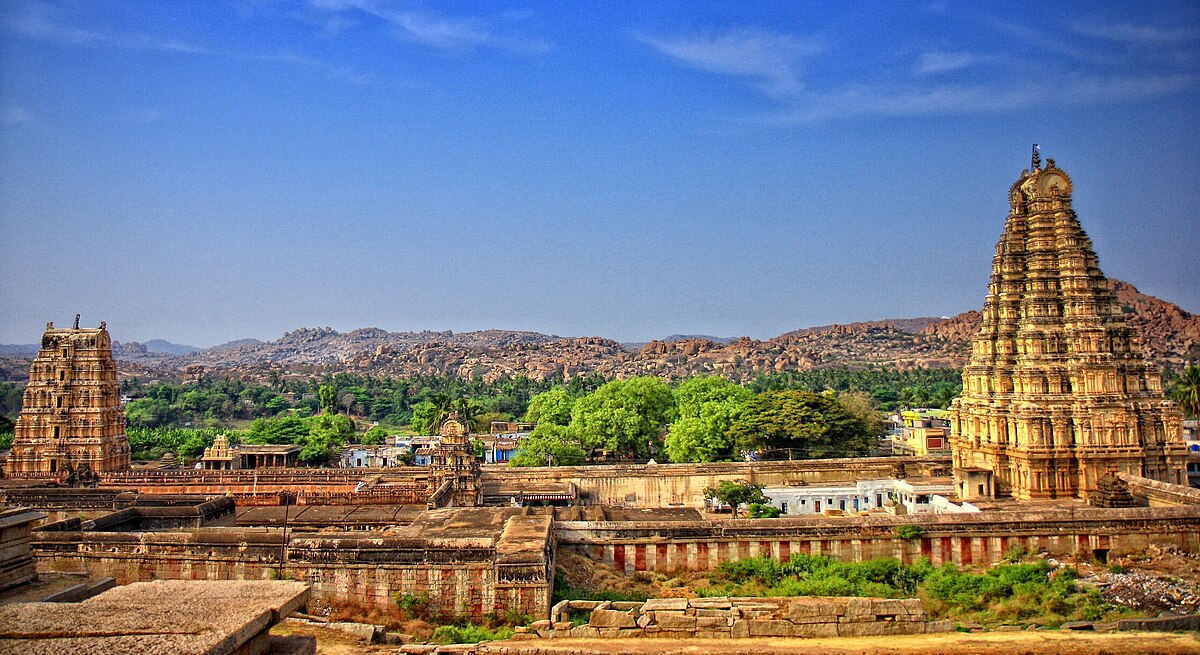
The site's name is intrinsically linked to the goddess Pampa, an avatar of Parvati. Legend says that Pampa performed intense penance on the nearby Hemakuta Hill to win the hand of Lord Shiva. Pleased with her devotion, Shiva married her and became known as Pampapati. The Virupaksha Temple, which stands today as the oldest and only continuously functioning temple in Hampi, is considered the sacred spot of their marriage and marks the nucleus of the future capital. The temple complex existed as a place of worship continuously since at least the 7th century CE.
II. ???? The Rise of the Vijayanagara Empire (1336–1565 CE)
The 14th century marked the start of Hampi’s Golden Age, as it became the capital of a powerful, burgeoning empire.
The Foundation: Harihara and Bukka
The rise of the Vijayanagara Empire, or the Karnata Kingdom, was a direct response to the political instability and Muslim incursions from the north that had devastated the preceding South Indian kingdoms (Yadavas, Kakatiyas, Hoysalas, and Pandyas).
In 1336 CE, two brothers, Harihara I (Hakka) and Bukka Raya I, who were generals previously serving the Kakatiya and Kampili chiefs, established a new kingdom. The traditional account states they were inspired and guided by the sage Vidyaranya to establish a Hindu bulwark against the Sultanates of the Deccan. They chose the sacred Pampa-kshetra, surrounded by protective hills and the river, as their capital, which they named Vijayanagara—the "City of Victory."
They belonged to the Sangama Dynasty, named after their father, Sangama.
Dynasties and Consolidation
Over the next two centuries, Vijayanagara grew from a regional kingdom into an expansive empire that dominated almost all of South India. The city of Hampi, or Vijayanagara, served as the administrative, economic, and cultural heart of this vast realm.
| Dynasty | Reign (Approximate) | Key Ruler | Significant Contribution |
|---|---|---|---|
| Sangama | 1336 – 1485 CE | Deva Raya II | Consolidated the empire; significant early temple and fortification works. |
| Saluva | 1485 – 1505 CE | Saluva Narasimha Deva Raya | Restored stability after internal strife; laid the foundation for future expansion. |
| Tuluva | 1505 – 1567 CE | Krishna Deva Raya | Golden Age of the empire; maximum territorial extent; most magnificent architectural works. |
| Aravidu | 1567 – 1646 CE | Tirumala Deva Raya | Shifted capital after the fall of Hampi; oversaw the final decline. |
???? The Golden Age under Krishna Deva Raya (1509–1529 CE)
The reign of Emperor Krishna Deva Raya of the Tuluva Dynasty is widely acknowledged as the zenith of the empire’s power and culture. He was a brilliant general, a scholarly patron of the arts (especially Telugu literature), and a prolific builder.
* Wealth and Trade: Foreign travelers, particularly Portuguese chroniclers like Domingo Paes and Fernão Nunes, described Vijayanagara as one of the richest and largest cities in the world, second only to Beijing by 1500 CE. Its bazaars were famed for trading gold, spices, silks, and even precious gemstones like diamonds and rubies, which were supposedly sold in heaps in the public marketplaces.
* Architecture and Construction: The city reached its ultimate architectural grandeur during this period. Krishna Deva Raya was responsible for building or significantly expanding the most iconic structures, including:
* The Vitthala Temple Complex, a masterpiece of Dravidian architecture, featuring the famous Stone Chariot and the musical pillars.
* The expansion of the Virupaksha Temple.
* The Hazara Rama Temple (the private temple of the royals).
* Numerous gopurams (monumental entrance towers), mandapas (pillared halls), and waterworks.
The Structure of the Capital
Vijayanagara was a vast, fortified city, meticulously planned across an area of over 40 square kilometers. It was functionally divided into three main zones:
* The Sacred Centre: Located around the Tungabhadra River, this zone housed the major temples like Virupaksha and Vitthala, signifying the spiritual authority of the empire.
* The Urban Core: The market areas, craft quarters, and residential districts for the general populace.
* The Royal Centre: The walled citadel that contained the royal palaces, administrative buildings, mint, military headquarters (like the Elephant Stables and the King's Audience Hall), and ceremonial structures (like the Mahanavami Dibba and Queen's Bath). This segregation was a key feature of the city planning.
III. ???? The Fall and Abandonment (1565 CE)
The story of Hampi culminates in a swift and devastating end, which saw the magnificent capital reduced to ruins.
The Battle of Talikota (1565 CE)
Despite its power, the Vijayanagara Empire was in constant conflict with the five neighbouring Muslim Deccan Sultanates: Bidar, Bijapur, Ahmadnagar, Golconda, and Berar.
In January 1565 CE, a coalition of four Sultanates (Berar did not participate) met the forces of the Vijayanagara regent, Aliya Rama Raya, at the Battle of Talikota (Rakkasa-Tangadi). What began as a strategic battle quickly turned into a catastrophic rout for the Vijayanagara army. Aliya Rama Raya was captured and executed, plunging the empire into chaos.
The Sack of Vijayanagara
Following the victory, the Sultanate armies descended upon Vijayanagara. For a period of six months, the city was systematically plundered, pillaged, and destroyed.
* Targeted Destruction: The invaders focused their destruction on the Royal and Sacred Centres, deliberately collapsing palaces, defacing temple sculptures, burning administrative buildings, and destroying the sophisticated water-supply systems.
* Mass Exodus: The royal family and nobility fled south, eventually relocating the capital to Penukonda, but the grandeur of the city of victory was lost forever. The general population abandoned the ruined capital.
A contemporary observer noted that the destruction was so complete that "the very dogs... could not find a piece of bread to eat." The opulent city of victory was left as an "austere, grandiose site" of rubble and broken stone.
IV. ⏳ The Period of Decline and Rediscovery (1565 CE – Modern Era)
For the next four centuries, Hampi remained largely uninhabited, a haunting testament to its former glory.
The End of the Empire
While the Aravidu Dynasty continued the Vijayanagara Empire for another century from various southern capitals, its power was greatly diminished. The once-dominant empire eventually disintegrated into smaller Nayaka chiefdoms (like Mysore, Thanjavur, and Keladi), losing its central authority. Hampi, however, never regained its political status.
The Living Temple
Crucially, not all life vanished. The Virupaksha Temple, due to its immense antiquity and continued religious significance, remained an active place of worship. This continuous function helped preserve the temple from the ultimate level of decay and abandonment that befell the rest of the city. Hampi persisted as a regional pilgrimage site, sustained by the devotion of locals.
European and Archaeological Interest
The extensive ruins of Hampi captured the attention of early British administrators and archaeologists.
* The first extensive surveys were conducted by British engineers like Colonel Colin Mackenzie in the late 18th century.
* The ruins became a crucial site for studying the history, architecture, and political systems of South India, slowly piecing together the story of the lost empire from inscriptions, foreign accounts, and the physical remains.
In 1986, the Group of Monuments at Hampi was designated a UNESCO World Heritage Site, bringing global recognition and critical funding for conservation and archaeological research. This marked the start of the modern-day "rediscovery" and protection of the site.
V. ????️ The Architectural and Cultural Legacy
The enduring significance of Hampi lies in its rich legacy of art and architecture, collectively known as the Vijayanagara Style.
Key Architectural Characteristics
The style is known for its blend of Hindu temple traditions (Dravidian) with unique imperial flourishes:
* Kalyana Mandapas: Large, ornate marriage halls with incredibly detailed, sculpted pillars, often featuring rearing Yalis (mythical lion-like creatures).
* Pillared Corridors: Massive pradakshina-pathas (circumambulatory paths) with hundreds of sculpted pillars, surrounding the main shrine.
* Courtly-Religious Structures: Integration of secular architecture (like the Lotus Mahal and Elephant Stables) within the royal and sacred complexes, showcasing a unique synthesis.
* Monolithic Sculptures: Huge single-stone statues, such as the Ugra Narasimha and the Badavilinga (Shiva Linga).
* Engineering Marvels: The construction of sophisticated water-works and irrigation canals (like the Aquaducts) and massive fortifications that attest to the empire’s advanced engineering.
Major Surviving Monuments
The ruins today are spread over 4,100 hectares, with over 1,600 surviving remains, each telling a piece of the story.
| Site | Significance |
|---|---|
| Virupaksha Temple | Oldest and continuously functioning temple; dedicated to Lord Shiva; its gopuram dominates the sacred centre. |
| Vitthala Temple Complex | The ultimate expression of Vijayanagara art; famous for the Stone Chariot and the Musical Pillars of the Ranga Mandapa. |
| Hazara Rama Temple | The private royal temple, featuring thousands of sculpted panels depicting scenes from the Ramayana. |
| Mahanavami Dibba | A massive stone platform used for royal ceremonies and military parades during the Navaratri festival. |
| Lotus Mahal | An elegant, fusion-style structure that served as a recreational palace for the royal ladies. |
| Queen's Bath | An elaborate, indoor royal bathing structure with arched corridors and intricate stucco work, mixing Indo-Saracenic elements. |
Conclusion: The City of Ruins Today
Hampi stands as a profound symbol—not just of a lost Hindu empire and its glorious artistic achievements, but of the cyclical nature of history. It was a place of deep spiritual significance, an unmatched global commercial hub, and the capital of a militarily dominant power. Its destruction was total, but the scale and ambition of its builders ensure that even in ruin, it remains an awe-inspiring place.
Today, Hampi is a vibrant center for tourism and pilgrimage, drawing millions who wander its rocky paths, trying to hear the echoes of a once-great city that was literally the second largest in the world. It is a spectacular museum without walls, continuously revealing new insights into one of India’s most magnificent historical periods.