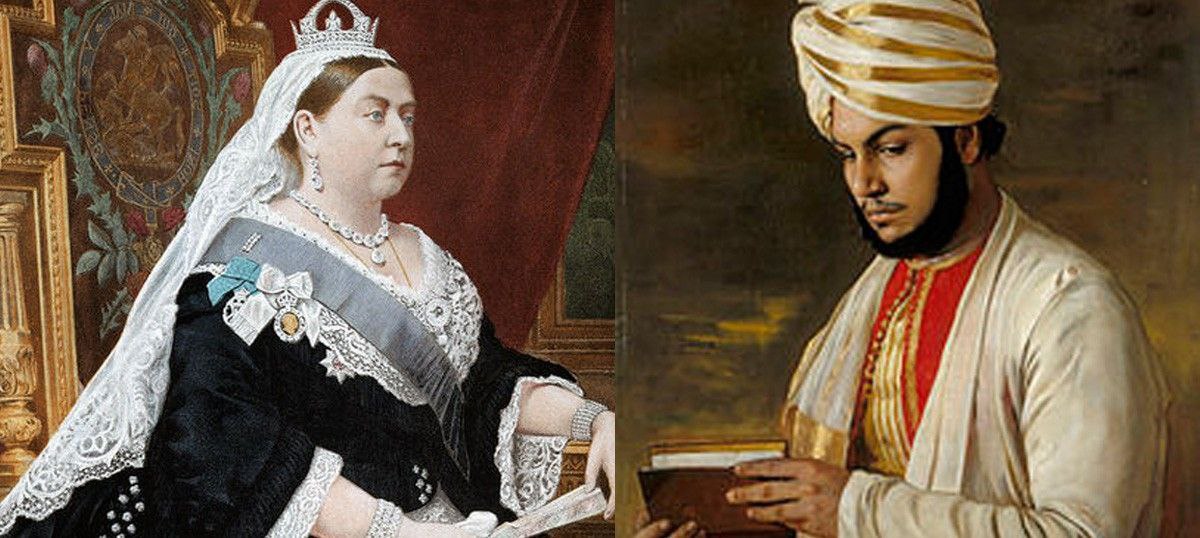
The story of Queen Victoria and Abdul Karim is one of the most unlikely friendships in royal history—a bond that scandalized the British court and remained hidden in the shadows of history for nearly a century.
The Arrival of the "Munshi"
The story begins in 1887, the year of Queen Victoria’s Golden Jubilee. At 68 years old, the Queen was the Empress of India, yet she had never visited the crown jewel of her empire. To bring a taste of India to London, two Indian servants were brought over to wait at the royal table. Among them was Abdul Karim, a tall, 24-year-old clerk from Agra.
Victoria, lonely and grieving the deaths of her husband Albert and her close companion John Brown, was immediately struck by Abdul’s poise. She described him in her journals as "tall with a fine serious countenance."
What began as a simple service role quickly transformed. Victoria was fascinated by his culture. Within weeks, she began taking lessons in Hindustani (Urdu) from him. She gave him the title of "The Munshi"—her teacher.
A Bond Beyond Borders
As the years passed, Abdul’s influence grew, much to the horror of the Royal Household. He wasn't just a servant; he became her closest confidant.
* The Teacher: He taught her how to write in Urdu and discussed Indian politics and philosophy.
* The Companion: He traveled with her to Europe, stayed in the finest royal residences, and was given a private cottage on the grounds of Windsor Castle.
* The Cultural Ambassador: Through Abdul, the Queen developed a love for "authentic" curry, which became a staple at the royal table.
The Queen, in her letters to him, signed off with maternal and deeply affectionate phrases like "your loving mother" and "your closest friend." While historians debate whether the relationship was romantic, it was undeniably an "affair of the heart"—an emotional intimacy that filled a void in the Queen's isolated life.
The Court’s Rebellion
The "Munshi" was loathed by the Queen’s family and her staff. The reasons were rooted in the rigid social structures of the time:
* Class & Race: The courtiers could not stomach a "common" Indian man being treated as a gentleman and an equal to English aristocrats.
* Jealousy: They feared his political influence, especially when he spoke to the Queen about the tensions between Hindus and Muslims in India.
* The "John Brown" Echo: The staff had already lived through the Queen's controversial closeness to her Scottish ghillie, John Brown, and they were determined not to let it happen again.
The household even threatened to resign en masse, accusing Abdul of being a spy. Victoria, ever the defiant monarch, stood her ground. She accused her staff of "race prejudice" and fiercely protected her Munshi, even awarding him the Commander of the Victorian Order (CVO).
The Bitter End
The friendship lasted 14 years, until Victoria’s death in 1901.
As soon as the Queen’s body was cold, the Royal Family took their revenge. Led by her son, King Edward VII, the household raided Abdul’s cottage. They gathered every letter the Queen had ever written to him and burned them in a bonfire on the lawn while he was forced to watch.
Abdul was evicted and sent back to India. He lived out the rest of his days in Agra, passing away in 1909. His story was largely forgotten, dismissed as a footnote of "the Queen's madness," until his private journals were rediscovered in 2010, confirming the depth of their extraordinary connection.