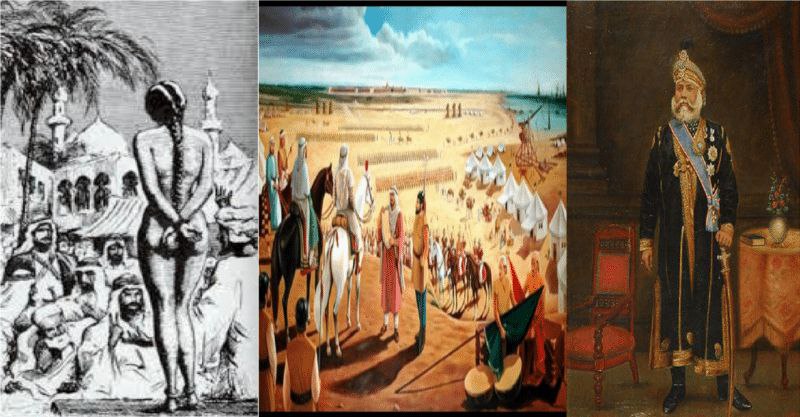
The story of Suriya Devi and Premala Devi is one of the most haunting and debated chapters in the history of the Indian subcontinent. It is a tale that blends the fall of a kingdom, the tragedy of capture, and a final, desperate act of vengeance that allegedly changed the course of the Umayyad Caliphate.
While historical accounts—primarily the Chachnama—provide the framework for their lives, the story is often seen as a symbol of resistance and the high cost of the 8th-century Arab conquests of Sindh.
The Fall of Alor
The story begins in 712 CE in the lush, river-fed kingdom of Sindh (modern-day Pakistan). Raja Dahir, the last Brahmin king of Sindh, ruled from his capital at Alor. He was a powerful monarch, but he faced a rising storm from the west: the Umayyad Caliphate.
The catalyst for the invasion was the looting of Arab ships by pirates off the coast of Debal. Hajaj bin Yusuf, the governor of Iraq, demanded reparations. When Dahir claimed he had no control over the pirates, Hajaj dispatched his young, brilliant nephew and son-in-law, Muhammad bin Qasim, to conquer Sindh.
Suriya Devi and Premala Devi were Dahir’s daughters, raised in the lap of luxury, surrounded by the philosophy, art, and martial traditions of their dynasty. Their world shattered when Qasim’s forces breached the defenses of Debal and moved toward the heart of the kingdom.
The Battle of Aror
Raja Dahir met the Arab forces at the Battle of Aror. Despite having a massive elephantry and a brave army, the tide turned when a flaming arrow struck Dahir's elephant, causing it to bolt into the Indus River. Dahir was killed in the chaos.
With the King dead, the kingdom collapsed. The princesses’ mother, Queen Ladi, and the two daughters were captured following the fall of the fort at Brahmanabad. As was the custom of the era for conquered royalty, the sisters were viewed as "spoils of war"—but because of their high status and beauty, they were reserved for the highest power in the Islamic world: Caliph Walid I in Damascus.
The Journey to Damascus
The journey from the humid plains of Sindh to the desert heart of Syria took months. Suriya and Premala were transported under heavy guard. Historical narratives suggest that during this journey, the sisters, despite their grief, began to formulate a plan. They had lost their father, their home, and their freedom; all they had left was their wits.
They arrived at the magnificent court of the Umayyad Caliph, a place of immense wealth and power. To the Caliph, they were symbols of a successful expansion into the "Land of Hind." To the sisters, he was the man responsible for the destruction of their lineage.
The Ingenious Revenge
According to the Chachnama, the climax of their story occurred within the walls of the Caliph’s harem.
When the Caliph called for Suriya Devi, she appeared before him in deep sorrow. When he questioned her, she allegedly broke into tears and told a calculated lie. She claimed that Muhammad bin Qasim had kept them for himself for several days before sending them to the Caliph, thereby "defiling" them and insulting the Caliph’s honor by sending him "remnants."
The Execution of Qasim
The Caliph, known for a volatile temper and a strict sense of pride, was enraged. He believed that his general had betrayed his trust. Without a formal trial or investigation, he issued an immediate, brutal order:
> Muhammad bin Qasim was to be sewn into a fresh cowhide and transported back to Syria in a box.
>
The command was carried out. Qasim, the young conqueror who had expanded the empire to the borders of India, died of suffocation within the hide during the journey.
The Final Revelation
When the box containing the remains of Muhammad bin Qasim arrived in Damascus, the Caliph summoned the princesses to show them the price of betraying him. It was at this moment that the sisters revealed their true intentions.
Suriya Devi reportedly looked at the dead general and then at the Caliph. She confessed that Qasim had never touched them. He had treated them with the respect due to royal captives. She explained that they had invented the lie to avenge the death of their father and the ruin of their country. They knew that the Caliph was the only person powerful enough to kill the man who had defeated Sindh.
The Fate of the Princesses
The Caliph’s reaction to being manipulated into killing his most successful general was one of horrific fury. He realized he had destroyed his best military mind over a fabrication.
The accounts of their end vary, but most are grim. Some sources state the Caliph ordered the sisters to be tied to the tails of horses and dragged through the streets of Damascus until they died. Others suggest they were walled up alive.
Regardless of the method, Suriya and Premala Devi died in a foreign land, thousands of miles from the Indus, having successfully executed a suicide mission to decapitate the leadership of the forces that conquered their home.
Historical Perspective and Legacy
Modern historians often debate the accuracy of the Chachnama’s account. Some suggest that Muhammad bin Qasim’s downfall was actually due to a change in political leadership back in the Caliphate (the death of Caliph Walid and the rise of Sulayman, who hated Hajaj bin Yusuf).
However, the story of the daughters of Dahir persists in folk memory.
* Symbol of Resistance: They are seen as icons of "Dharma" and female agency, using their intellect when physical strength was no longer an option.
* The Price of War: Their story highlights the brutal reality for women during medieval conquests.
* Cultural Impact: Their tale has been the subject of numerous plays, poems, and historical novels in India, representing the tragic end of the pre-Islamic era in Sindh.
The story of Suriya and Premala Devi remains a powerful narrative of loyalty to one’s roots and the lengths to which the defeated will go to find justice.
The decision of Caliph Walid I to believe Suriya Devi’s words so instantly was not just a result of "blind rage"; it was deeply rooted in the complex political conspiracies and internal rivalries of the Umayyad Caliphate at that time.
Here is an analysis of the key reasons that set the stage for this tragic end:
1. Hajjaj bin Yusuf and Political Factionalism
Muhammad bin Qasim’s greatest patron was his uncle and father-in-law, Hajjaj bin Yusuf, the Governor of Iraq. Hajjaj was arguably the most powerful (and feared) man in the Umayyad Empire.
* Enmities: Hajjaj had made many enemies within the court, including the future Caliph, Sulayman bin Abd al-Malik.
* Fear of Rising Power: A faction in the Caliph’s court feared the growing influence of Hajjaj and his loyalists, like Qasim. They worried that Qasim’s military victories would make Hajjaj powerful enough to challenge the Caliph himself.
2. The Caliph’s Ego and the Politics of "Honor"
In medieval monarchies, a ruler's greatest asset was his "Iqbal" (prestige and authority).
* Suriya Devi very cleverly struck not at Qasim directly, but at the Caliph’s honor. By claiming Qasim had sent "used" captives, she framed it as a personal insult to the sovereign.
* In the tribal and royal codes of that era, tampering with a gift intended for the Sultan was considered an act of treason. The Caliph felt that Qasim was trying to humiliate him.
3. Transition of Power (Caliph Walid vs. Sulayman)
Many historians believe Qasim’s downfall was linked to the death of Caliph Walid and the ascension of his brother, Sulayman.
* Sulayman harbored a deep-seated hatred for Hajjaj bin Yusuf. Since Hajjaj had already passed away, Sulayman directed his vengeance toward Hajjaj’s family and his most successful general, Muhammad bin Qasim.
* The testimony of Suriya Devi and Premala Devi provided Sulayman (or the anti-Hajjaj courtiers) with the moral and legal excuse they needed to eliminate Qasim.
4. Distance and Communication Gap
There were thousands of miles between Damascus and Sindh. In those days, messages took months to travel.
* The Caliph did not have the patience to seek a clarification from Qasim or conduct an impartial investigation.
* When the princesses made their accusation, Qasim’s rivals at court likely fueled the fire to ensure a death sentence was passed before any defense could be mounted.
Conclusion: The Strategic Brilliance of the Princesses
Suriya Devi and Premala Devi had sensed the internal friction within the Umayyad court. They didn't just tell a lie; they wove a "political trap." They understood two things clearly:
* The Caliph was insecure about his prestige.
* The court was filled with people jealous of Qasim’s success.
By sacrificing their own reputations (claiming they were defiled), they successfully turned the Caliph against his own greatest weapon. This remains one of history’s most striking examples of Psychological Warfare.Psychological Warfare.