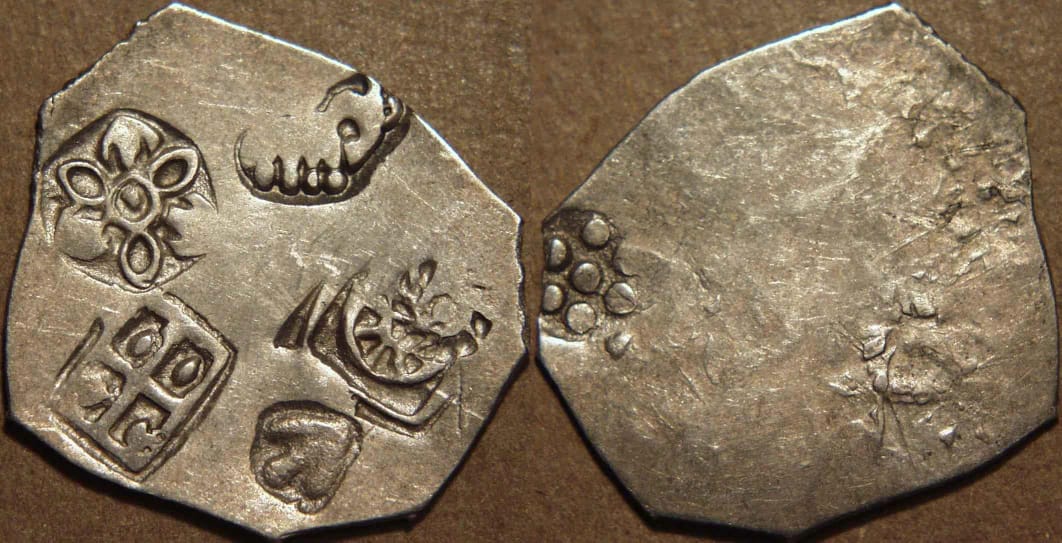
The Birth of the "Rupa" (6th Century BCE)
Our story begins not in a bank, but in the dusty, vibrant marketplaces of the Mahajanapadas (ancient Indian kingdoms). Imagine a merchant in Magadha. He doesn't have a wallet; he has a leather pouch filled with irregular silver pebbles.
These weren't minted by a central bank, but by local guilds. They were Punch-Marked Coins (Puranas or Karshapanas). A merchant would take a piece of silver, hammer it flat, and punch a symbol onto it—a sun, a tree, or a bull—to certify its weight. There was no writing, just symbols. It was a raw, honest form of trade where the value lived inside the metal itself.
The Maurya Consolidation
As Chanakya and Chandragupta Maurya built the first great Indian empire, they realized that a chaotic mix of silver bits wouldn't work for a subcontinent. In the Arthashastra, Chanakya defined the first official currency laws. He introduced the Rupyarupa (made of silver) and the Tamrarupa (made of copper).
> The Etymology: The word "Rupee" finds its roots here, in the Sanskrit word Rupya, meaning "wrought silver" or "shapely."
>
The Golden Age and the Silk Road
Fast forward to the Gupta Empire (320–550 CE). If the Mauryas were about silver, the Guptas were about Gold.
Known as the "Golden Age," this era saw the issuance of the Dinara. These weren't just coins; they were art. They depicted kings playing the lute, hunting lions, or receiving blessings from goddesses. As Indian trade ships sailed to Rome and Southeast Asia, the Indian gold coin became the "US Dollar" of the ancient world—the global standard for trust and luxury.
The Sultanates and the Great Reformer
By the medieval period, the currency landscape became a mosaic of Islamic calligraphy and local designs. But the most pivotal character in our story enters in 1540: Sher Shah Suri.
Sher Shah was a visionary who ruled for only five years, yet he set the blueprint for the modern Rupee. He standardized the weight of the silver coin to 178 grains (about 11.5 grams) and named it the Rupiya.
When the Mughals took over, they were so impressed by Sher Shah’s system that they kept it. Akbar the Great refined it further, creating a "Tri-metallic" system:
* The Mohur: Gold (for high-value savings).
* The Rupiya: Silver (the backbone of trade).
* The Dam: Copper (for the common man’s daily groceries).
The Entry of the "Company"
By the 1600s, the English East India Company arrived. At first, they were just guests using Mughal coins. But as the Mughal Empire weakened, the British began minting their own "Bombay Rupee" and "Bengal Rupee."
For a century, India was a mess of competing currencies. A merchant traveling from Delhi to Madras would have to exchange his coins three times, losing money at every border.
In 1835, the British passed the Coinage Act, forcing a "Uniform Currency" across all of British India. The face of the Mughal Emperor was replaced by the face of King William IV. For the first time, one coin ruled the entire subcontinent.
The Paper Revolution (1861)
The biggest plot twist occurred in 1861: The Paper Currency Act.
Until now, money was heavy. If you wanted to buy a house, you needed a wagon full of silver. The British introduced "Promissory Notes"—paper that promised to pay the bearer a certain amount of silver. People were terrified. How could a piece of paper be worth a bag of silver? To gain trust, the government issued "Victoria Portrait" notes. These were unifaced (printed on one side) and often cut in half and sent through the mail in two different envelopes to prevent theft—only when both halves arrived could they be glued back together and spent!
War, Independence, and the Gandhi Series
The 20th century brought two World Wars. Silver became so scarce that the British had to introduce the 1-Rupee note in 1917 because they didn't have enough metal to mint coins.
When India gained independence in 1947, the transition was poetic. The portrait of the British King was replaced by the Lion Capital of Ashoka. In 1957, India moved to the Decimal System (1 Rupee = 100 Paise), ending the old system of Annas and Pice.
Finally, in 1996, the Reserve Bank of India introduced the Mahatma Gandhi Series. The face of the man who fought the Empire with non-violence now sat on the very currency that the Empire had built.
The Modern Era: Digital and Beyond
The story doesn't end with paper. In 2016, the world watched as India underwent Demonetization, instantly making 86% of the cash in circulation invalid to combat "black money." This sparked one of the fastest digital payment revolutions in history (UPI).
Today, we are moving into the era of the e-Rupee (CBDC)—a digital version of the sovereign currency, bringing the story full circle: from physical silver pebbles to invisible digital bits.
The splendor of Mughal mints and the era when silver shook the entire world.
1. The Mughal Mints: Imperial Splendor and the Obsession with Purity
The Mughal era (especially from Akbar to Aurangzeb) is considered the "Golden Age" of the Indian Rupee. During this time, the Rupee was one of the purest and most prestigious currencies in the world.
A Network of Mints
The Mughal Empire housed over 200 mints. However, these weren't just factories; they were centers of high art. The process of minting a coin was meticulous:
* Testing Purity: The metal was melted and refined to an extreme degree. A Mughal Rupee usually boasted a purity of 96% to 98%, which became a global benchmark for trade.
* Calligraphy: Since depicting living beings was generally avoided in Islamic tradition, the Mughals decorated coins with beautiful Arabic and Persian calligraphy. These inscriptions included the Emperor’s name, the year of his reign, and the name of the city where the coin was minted.
* Jahangir’s Rebellion: Emperor Jahangir broke tradition by minting coins featuring his own portrait and the 12 Zodiac signs. Today, these "Zodiac Coins" are among the rarest and most expensive collectibles in the world.
2. The Great Silver Crisis (The Fall of the Rupee)
In the late 19th century, an event occurred that shook the Indian economy to its core. This period is known in history as the "Fall of the Rupee."
What Happened?
At that time, wealthy Western nations (like Britain) followed the Gold Standard, meaning their currency's value was linked to gold. India, however, was on the Silver Standard.
Around 1870, massive silver mines were discovered in the US and Europe. The global market was flooded with silver, causing its price to crash. Because the Indian Rupee was tied to silver, its value plummeted against the British Pound.
* The Impact: Importing goods became incredibly expensive for India. This crisis made the British realize that a currency could not survive on metal alone, leading to the serious introduction of Paper Currency.
3. The 1947 Partition: When Indian Coins bore the "Pakistan" Stamp
This is a lesser-known fact of history. When India and Pakistan were partitioned in 1947, Pakistan did not have its own central bank or printing press immediately.
* The Temporary Solution: For nearly a year after Independence, Reserve Bank of India (RBI) notes continued to circulate in Pakistan.
* The Overstamp: To distinguish them, these Indian notes were overprinted with the words "Government of Pakistan" in blue ink. It wasn't until 1948, when the State Bank of Pakistan was established, that they issued their own distinct currency.
4. The One-Rupee Note: The "Coin" in Paper Form
Have you ever noticed a strange detail? All high-value notes (50, 100, 500) are signed by the Governor of the RBI and contain the promise: "I promise to pay the bearer..."
But the 1 Rupee note is signed by the Finance Secretary of India.
Historically, the 1 Rupee was considered the "base unit" of the country. Legally, the 1 Rupee note is treated as a currency coin printed on paper, rather than a promissory note. This is why it doesn't carry the "I promise to pay" clause.
Did You Know?
In 1954, India had notes of 5,000 and 10,000 Rupees! These were used primarily for high-value transactions between banks. However, in 1978, the Morarji Desai government demonetized them to curb corruption and "black money"—the first major demonetization in independent India.