Book Title: The Red Ink of Reason
Chapter 1: The Seeds of Faith
The story begins with a young Bhagat Singh, raised in a deeply religious Sikh family. He describes his childhood as a "devout believer." He would pray for hours, follow rituals, and believe that a Divine Power was guiding the Indian independence movement. He carries a small prayer book and believes that God is the ultimate judge of justice.
Chapter 2: The Fire of Revolution
As Singh enters the revolutionary world, his focus shifts from ritual to reality. He sees the crushing poverty of India and the brutality of the British Raj. He begins to ask: “If God is all-powerful and all-merciful, why does he allow 300 million people to be enslaved and starved?”
Chapter 3: The Library in the Cell
After the bombing of the Central Legislative Assembly, Singh is imprisoned. This is the "heart" of the book. In his cell, he reads voraciously—Marx, Bakunin, Lenin, and Darwin.
* The Conflict: His fellow prisoner, Baba Randhir Singh, a deeply religious man, tells Bhagat that his atheism is born of vanity (ego).
* The Response: Bhagat spends his nights writing to prove that his lack of belief is not pride, but a result of reason.
Chapter 4: The Problem of Evil
In this pivotal section, Singh deconstructs the idea of a Creator. He uses logic to challenge the "Karma" theory.
* He asks why a child is born blind or in a slum.
* If it is punishment for a past life, why can't the child remember the crime?
* He concludes that "God" is a "myth" created by humans to provide courage to the weak and to justify the status quo of the powerful.
Chapter 5: The Final Stand
As the date of his execution approaches, his resolve is tested. Most people turn to God when facing death. Singh does the opposite. He argues that a man who can stand on the gallows without the "narcotic" of a promised afterlife is truly free.
> "A man who stands for progress has to criticize every item of old faith. Item by item he has to challenge every limit of prevailing conception." — Bhagat Singh
>
Key Intellectual Pillars of the Story
If you were writing this as a full biography, you would focus on these three logical shifts he made:
| Phase | Belief System | Driving Force |
|---|---|---|
| Childhood | Religious Sikhism | Tradition and Family |
| Early Revolution | Mysticism/Idealism | The need for "Divine Support" in battle |
| Jail Period | Materialism/Atheism | Logic, Science, and Social Justice |
The Climax: The Gallows
The book would end on March 23, 1931. While others are praying, Singh is reading a book by Clara Zetkin or Lenin. He goes to the noose not with a prayer on his lips, but with a slogan of human defiance. He proves that his "unbelief" gave him more strength than "belief" gave his oppressors.
Why This Story Matters Today
Bhagat Singh’s atheism was unique because it was humanistic. He didn't just stop believing in God; he started believing in Humanity. He argued that if there is no God to save us, we must save each other.
This scene is based on the historic debate that took place in Lahore Central Jail between Bhagat Singh and Baba Randhir Singh (a revolutionary and deeply religious man). This very conversation provoked Bhagat Singh to write his famous essay.
Scene: The Dialogue in the Dungeon
Location: A narrow, dark cell in Lahore Central Jail.
Time: Late at night, 1930.
Characters: * Bhagat Singh: 23 years old, eyes sharp and intelligent, holding a book.
* Baba Randhir Singh: Older, white beard, a face reflecting spiritual calm.
(Behind the iron bars, Bhagat Singh is reading a book by Marx in the dim light of a flickering candle. The rattling of chains is heard as Baba Randhir Singh stops outside his cell.)
Baba Randhir Singh: (In a sorrowful voice) "Bhagat, I hear you have stopped your morning Simran (prayer)? The gallows are standing right in front of you, and you are forgetting the Almighty who gave you this life?"
Bhagat Singh: (Looking up from his book with a faint smile) "Baba, the Almighty you speak of... I looked for him everywhere at the door of my cell. But I found only hunger, screams, and the whips of the British Raj. I saw no God there."
Baba Randhir Singh: (With sudden intensity) "This is not a flaw in your intellect; this is your vanity! you have become famous, the whole world is chanting your name, and so you have become so arrogant that you are denying the Creator himself. This is the intoxication of fame, Bhagat!"
Bhagat Singh: (Remaining calm, he stands up and approaches the bars) "Vanity, Baba? If I were to bow down today and beg God for my life, my burden would be lightened. Belief is a crutch for a man—a 'narcotic' that gives him the strength to endure suffering. But I want to face this death standing on my own two feet, without that crutch. Is seeing the truth with one's own eyes vanity?"
Baba Randhir Singh: "Truth? Truth is what is written in the scriptures. Not a leaf stirs without His will. You will find yourself alone in this struggle."
Bhagat Singh: "If not even a leaf stirs without His will, then Baba, is this slavery also His will? Was the massacre of innocents at Jallianwala Bagh His will? Is the starvation of poor children also His 'leela' (play)? If He watches all this and remains silent, He cannot be 'merciful.' And if He cannot stop it, He is not 'all-powerful'."
(Baba Randhir Singh remains speechless, looking at him in silence.)
Bhagat Singh: "I didn't abandon God because I am proud of myself. I abandoned Him so that I could believe in Humanity. I am not dying for the greed of some Heaven or Paradise after death. I am dying so that future generations can breathe in free air. There will be no reward for me, and I am prepared to accept that void."
Baba Randhir Singh: (In a low voice) "You are on a difficult path, Bhagat."
Bhagat Singh: "The path of revolution is never easy, Baba. Whether it is against society, or against an imaginary God. From today, people will call me an 'atheist,' and I am proud of it, because my atheism was not born out of hatred, but out of my love for reason and justice.
The following scene captures the quiet, intellectual fire of a man who, in the shadow of the noose, chose to leave behind a manifesto of reason.
Scene: The Manifesto of a Martyr
Location: Cell No. 14, Lahore Central Jail.
Time: Midnight. The only sound is the distant heavy boots of the sentry on gravel.
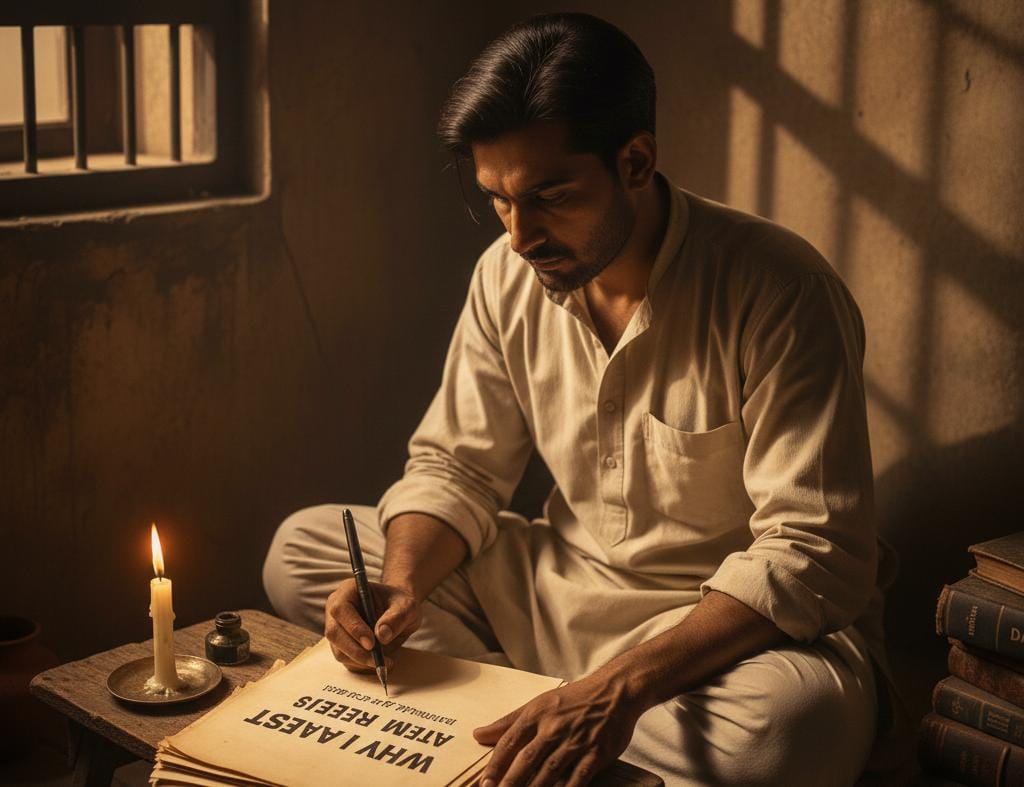
(Bhagat Singh sits on a thin mat on the cold floor. A small wooden plank serves as his desk. He has a few sheets of coarse government paper and a fountain pen. He looks at the flickering candle, then dips his pen into the inkwell. He doesn't hesitate; the thoughts have been burning in his mind for months.)
Bhagat Singh: (Voiceover/Thoughts)
"A new question has cropped up. Is it due to my vanity that I do not believe in the existence of an Omnipresent, Omniscient, and Omnipotent God? I had never imagined I would be faced with such a question."
(He writes the title in bold, sweeping strokes: "WHY I AM AN ATHEIST". He pauses, looking at the word 'Atheist' as if it is a badge of honor.)
Bhagat Singh: (Writing)
"Let us see. I have been told that I am an atheist because I am a 'celebrity,' because my name is on the lips of millions. They say I have become too proud to bow. But they do not see the study, the struggle, and the tears that led to this 'pride.'"
(He leans forward, his face illuminated by the flame. He writes faster now, the pen scratching against the paper with urgency.)
"I ask: Why did your 'God' create this world, which is a literal hell, a place of constant and bitter grief? Why did he create man with the desire for food and then give him no grain to eat? If he is the father of all, why does he sit in his high heavens and watch his children be butchered by the British?"
(He stops for a moment, glancing at the iron bars of his cell. He knows he has only days left to live. A normal man might seek the comfort of a 'Saviour,' but Singh tightens his grip on the pen.)
"No. I will not seek help from a phantom. Any man who stands for progress has to criticize every item of old faith. He has to challenge every limit of prevailing conception. Belief softens the mind; doubt strengthens it."
(He signs the page. He looks at the stack of books in the corner—Darwin, Marx, Rousseau. He realizes his life is the sacrifice, but his ideas will be the inheritance.)
"I am going to the gallows. I am going to be extinct. My life will end in a few moments, and there is no heaven waiting for me. But I am content. I am content because I have lived for a cause, and I have died for the truth I found myself."
(He blows on the ink to dry it. He closes his eyes for a second, not in prayer, but in peace. He puts the pen down. The scene fades to black as the candle finally gutters out, leaving him in total darkness—a darkness he is no longer afraid of.)
The Legacy
This essay was smuggled out of the jail and published on September 27, 1931, months after his execution. It remains one of the most powerful documents of Indian intellectual history, proving that Bhagat Singh was not just a man of action, but a man of profound thought.