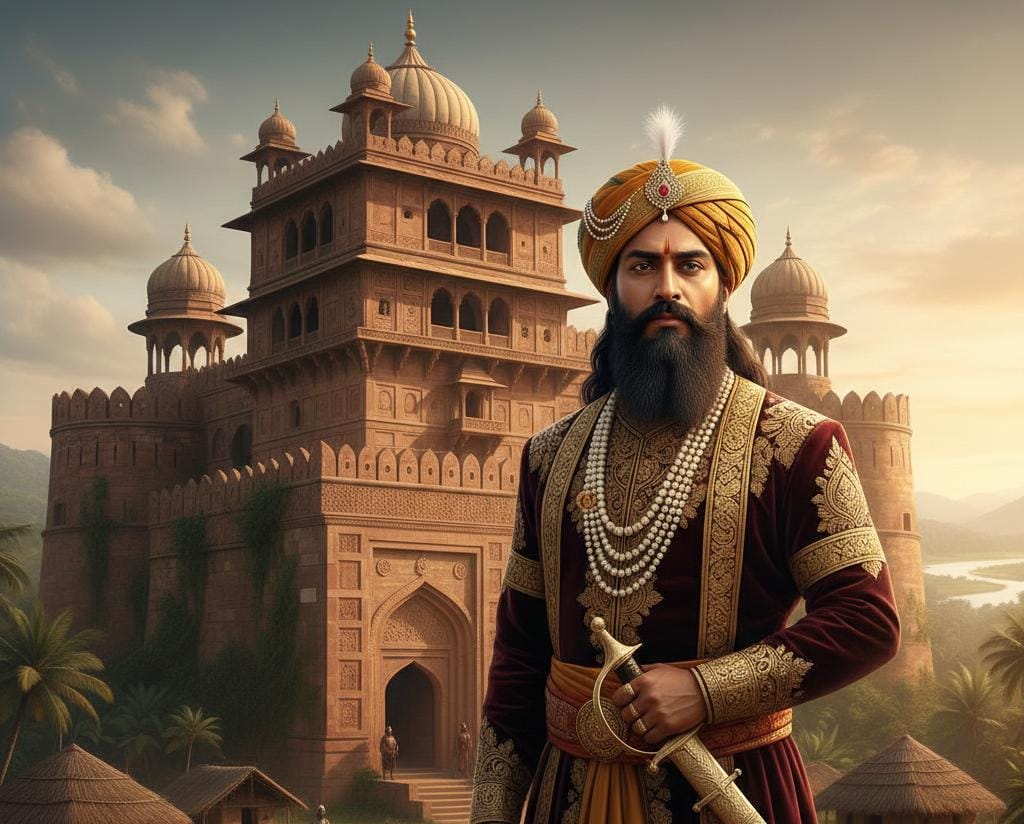
The legend of Phanimukut Rai is one of the most enchanting foundation myths of Indian history, blending the mystical world of the Nagas (serpent deities) with the earthly establishment of the Nagvanshi Dynasty of Chota Nagpur (modern-day Jharkhand).
The Serpent's Vow
The story begins not in a palace, but in the holy city of Varanasi. Pundarika Naga, a prince of the underworld (Patala), took the form of a handsome Brahmin to study the Vedas. During his time on earth, he fell in love with Parvati, the daughter of a learned priest.
They married, but Pundarika carried a secret: he could not lose his human form unless he told a lie, and he had a forked tongue that he kept hidden. He promised Parvati they would travel to the sacred shrines of the south. However, as they reached the dense, hilly forests of Jharkhand, Parvati—who was pregnant—became insistent. She demanded to know the truth behind his strange features and his mysterious origins.
Bound by the laws of his kind, Pundarika revealed his true form. He transformed into a giant hooded cobra before her eyes. Overwhelmed by the revelation and the divine energy, Parvati went into labor. She gave birth to a son but soon passed away, consumed by the intensity of the event. Stricken with grief, Pundarika Naga used his massive hood to shade his newborn son from the sun, guarding him in the middle of the wilderness.
The Discovery at the Well
A local woodcutter and a Brahmin named Janardan were passing through the forest of Sutiambe when they saw a sight that defied logic: a massive cobra protecting a crying infant. As they approached, the serpent retreated into a nearby pond, leaving the child behind.
Beside the baby lay a shining crown and a protection charm. Janardan, sensing the child was of divine or royal lineage, took him in. He named the boy Phanimukut—Phani (serpent) and Mukut (crown).
The Rise of a Leader
Phanimukut grew up in the household of the Brahmin, but he was raised alongside the children of the local tribal chiefs, particularly the Munda and Oraon tribes. He was unlike the others; he possessed an innate grace, a sharp intellect for governance, and a natural prowess in combat.
At that time, the region was governed by the Parha system, a democratic assembly of tribal heads. The most powerful leader was Madra Munda. As Phanimukut reached adulthood, the elders noticed that he was the only one capable of uniting the various warring clans and protecting them from external raids.
In a historic assembly at Sutiambe:
* The tribal chiefs recognized his superior qualities.
* They saw the "Serpent Crown" as a sign of divine right.
* Madra Munda voluntarily stepped aside, choosing Phanimukut to be the Maharaja.
The Reign of the First Nagvanshi
Phanimukut Rai was crowned in 64 AD (according to dynastic records). His coronation marked the shift from tribal chiefdom to a formal monarchy, yet he remained deeply respectful of tribal customs.
1. Building the Capital
He established his capital at Sutiambe. He invited people from different parts of India—craftsmen, scholars, and priests—to settle in his kingdom, creating a cultural melting pot. He built temples and sun-dials, some of which ruins still whisper his name today.
2. The Great Battles
His reign wasn't without conflict. The neighboring King of Keonjhar challenged the young Maharaja. Phanimukut Rai led an army of tribal warriors and defeated the invaders, securing the borders of what would become the vast Nagvanshi empire.
3. Legacy and the Sun Temple
He is credited with establishing the worship of the Sun God and maintaining a "Janapada" style of governance where the King was a protector, not a tyrant. He ruled for many decades, ensuring that the Nagvanshi bloodline would continue for nearly two thousand years, ending only with the merger of princely states in independent India.
The Symbolism of the Nagvanshis
To this day, the royal emblem of the Chota Nagpur Maharaja features a hooded cobra. The story of Phanimukut Rai is more than just a biography; it is a symbol of the synthesis between the Vedic traditions of the plains and the ancient tribal traditions of the plateau.
> Note: Historians often debate the exact dates of his reign, but in the hearts of the people of Jharkhand, Phanimukut Rai remains the "Son of the Serpent" who brought order to the wilderness.
Let’s dive deeper into one of the most pivotal and thrilling chapters of Phanimukut Rai’s life: The Great War with the King of Keonjhar and his masterful art of governance.
1. The Battle of Keonjhar: A Display of Power and Valor
Shortly after Phanimukut Rai’s coronation, dark clouds of conflict loomed over his kingdom. The King of Keonjhar (located in present-day Odisha) viewed the rising influence of this new young ruler as a threat.
* The Cause of War: The King of Keonjhar believed that a young king, chosen by tribal chiefs rather than traditional royal lineage, would not be able to withstand a trained royal army. He aimed to seize the rich forests and mineral resources of Chota Nagpur.
* The Strategy: Phanimukut Rai did not rely solely on a small palace guard. He mobilized the Munda and Oraon warriors. This war was not just between two kings; it became a struggle for the people to defend their own land.
* The Outcome: Under Phanimukut Rai’s leadership, tribal archers surrounded the Keonjhar army in the rugged hills and dense jungles. The combination of guerrilla tactics and traditional bravery decimated the invading forces. Phanimukut Rai emerged victorious, and this triumph established him as the undisputed Emperor of the region.
2. Sutiambe: Building a Cultural Hub
He transformed his capital, Sutiambe, into more than just a fortress; it became a center for art and spirituality.
* The Sun Temple: He commissioned a grand Sun Temple there. As a worshipper of the Sun, he used this as a symbol that his reign was meant to dispel darkness and bring light to the lives of his subjects.
* Welcoming Diversity: He invited scholars and priests from holy cities like Kashi (Varanasi) and Puri. He built a bridge between the 'Non-Tribal' (Sadan) and 'Tribal' communities—a social harmony that remains the foundation of Jharkhand's culture today.
3. Administrative Vision: Justice and Democracy
Phanimukut Rai’s governance was a beautiful balance between the "Parha Raja" (tribal system) and the "Maharaja" (monarchy).
* He did not dismantle the ancient tribal administrative systems (Munda-Manki system); instead, he strengthened them.
* He kept the taxation system very lenient, ensuring that the burden on farmers and hunters was minimal.
* In his court, everyone had the right to seek justice, regardless of their caste, creed, or clan.
4. Marriage and Strategic Alliances
To further consolidate his power, he married the princess of the Panchet State (near modern-day Bengal). This matrimonial alliance brought him the support of eastern kingdoms and secured the borders of his empire against future invasions.
Conclusion
The story of Phanimukut Rai teaches us that a true leader is one who honors their roots (the tribal heritage) while embracing progress (a structured state). He is still revered as the "Adi Purush (First Ancestor) of Chota Nagpur" because he laid the foundation for a glorious tradition that resisted foreign invaders and even the Mughals for centuries.
The Nagvanshi dynasty founded by Phanimukut Rai ruled over Chota Nagpur for nearly 2,000 years. Here is the story of his illustrious descendants, their encounters with the Mughals, and the eventual transition of power when the British arrived.
1. Illustrious Descendants and Shifting Capitals
After Phanimukut Rai, many powerful kings succeeded him. For security and strategic reasons, the Nagvanshis shifted their capitals several times:
* Sutiambe to Chutia: The fourth king, Pratap Rai, moved the capital to Chutia (near modern-day Ranchi).
* Khukhra, Doisa, and Palkot: Later rulers moved to Khukhra, then Doisa, and finally Palkot. Each capital left behind ruins of grand palaces and temples that still stand today.
2. Conflict with the Mughals and Raja Durjan Sal
One of the most thrilling chapters in Nagvanshi history occurred when the Mughal Empire set its sights on the region's treasures.
* The Diamonds of Shankh River: At that time, Chota Nagpur was known as 'Kokrah,' famous for diamonds found in the Shankh River. Mughal Emperor Jahangir ordered an invasion to seize these resources.
* Imprisonment at Gwalior: In 1615 AD, King Durjan Sal was captured and imprisoned in the Gwalior Fort for 12 years.
* The Diamond Test: Legend says Jahangir released Durjan Sal after the King proved his expertise by identifying a true diamond that others could not. Upon his return, he built the magnificent five-story Navratangarh Palace in Doisa, which reflects a unique blend of Mughal and local architecture.
3. Arrival of the British and the Decline (1771 AD)
By the late 18th century, the power of the Nagvanshis began to wane.
* Diwani Rights: After the Battle of Buxar in 1765, the Mughals granted the 'Diwani' (right to collect revenue) of Bengal, Bihar, and Odisha (including Chota Nagpur) to the East India Company.
* The Burden of Tax: In 1771, Maharaja Darpnath Shah accepted British suzerainty. The British imposed heavy 'Malguzari' (taxation). The King, once a protector of his people, was forced into the role of a tax collector for the British.
* Tribal Uprisings: High taxes and interference by outsiders led to massive revolts, such as the Kol Rebellion (1831) and later the Ulgulan led by Birsa Munda. These movements further weakened the monarch's central authority.
4. The Final Era and Integration with India
During British rule, the Nagvanshi kings were reduced to titular 'Zamindars.' After India's independence in 1947, the official royal powers were abolished under the Zamindari Abolition Act (1952-53), and the kingdom fully integrated into the Republic of India.
Conclusion
The journey that began with Phanimukut Rai ended with Maharaja Lal Chintamani Sharan Nath Shahdeo, the last active Maharaja of the line. Though their political power has faded, the culture of Chota Nagpur, its festivals (like Karam and Sarhul), and the majestic ruins of their forts remain a testament to this 2,000-year-old legacy.