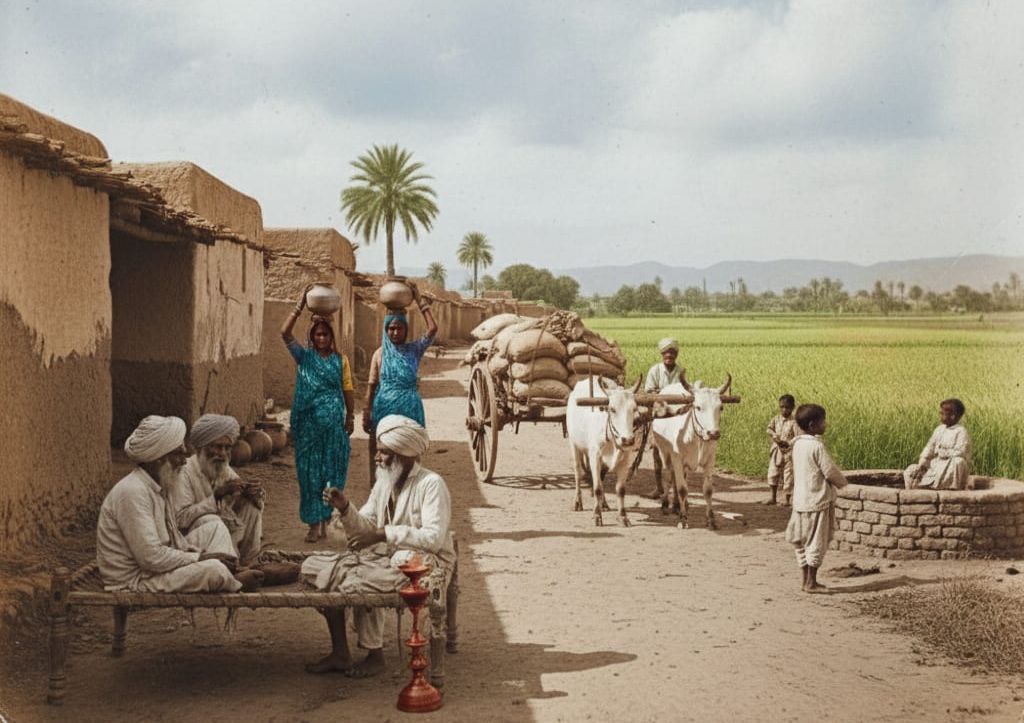
The story of Punjab is not merely the history of a piece of land; it is the biography of a crossroads. It is the tale of the "Land of Five Waters"—the Jhelum, Chenab, Ravi, Beas, and Sutlej—which carved a fertile cradle out of the rugged northern plains of the Indian subcontinent.
To tell the story of Punjab's origin, we must travel back to the dawn of memory, when the earth was still cooling and the great rivers were first finding their paths from the icy peaks of the Himalayas to the Arabian Sea.
The Age of the Rivers: The Sapta Sindhu
Long before the word "Punjab" existed—a name later coined by Persian-speaking rulers—the region was known to the ancient Aryans as Sapta Sindhu, the Land of the Seven Rivers.
Imagine a vast, verdant expanse under a sky that felt closer to the earth than it does today. The air was filled with the hymns of the Rig Veda, the oldest scripture of the Indo-Aryans, composed right here on the banks of these rivers. To the ancients, these waters weren't just resources; they were goddesses. The Saraswati (now lost to the sands of time) and the Indus were the mighty anchors of a civilization that understood the rhythm of the floods.
In this era, the foundations of the Punjabi spirit were laid: a deep connection to the soil and a resilience born from living in a land that was as generous as it was volatile.
The Bronze Dawn: Harappa and the Lost Cities
Around 3300 BCE, the first great urban heartbeat of the world began to pulse in the Punjab. In cities like Harappa, a sophisticated people rose. They were engineers of the highest order, building grid-patterned streets and drainage systems that wouldn't be rivaled for millennia.
They traded beads, cotton, and grain. They spoke a language we still cannot decode, and they worshipped figures that suggest the earliest roots of Shiva and the Mother Goddess. But Punjab’s destiny has always been one of transformation. Whether through shifting riverbeds or environmental change, the Harappans eventually faded, leaving their brick ruins to be swallowed by the silt, waiting thousands of years to be rediscovered.
The Gateway of Invaders: The Melting Pot
Because of its geography, Punjab became the "Frontier Province." Every conqueror who looked at the riches of India had to pass through the Khyber Pass and cross the five rivers of Punjab first. This constant influx turned the region into a cultural crucible.
The Persian and the Greek
In the 6th century BCE, the Persian King Darius the Great claimed the Indus valley. Then came the most cinematic moment of ancient Punjabi history: the arrival of Alexander the Great in 326 BCE.
On the banks of the Jhelum (the Hydaspes), the young Macedonian king met Raja Porus. The battle was legendary—Macedonian phalanxes against Punjabi war elephants. Though Alexander won the day, he was so impressed by Porus’s dignity that he restored his kingdom. More importantly, Alexander’s weary soldiers refused to cross the Beas River. Punjab became the limit of the known world for the Greeks, leaving behind a legacy of Greco-Buddhist art and culture that would flourish for centuries.
The Middle Ages: The Crescent and the Sword
As the centuries turned, Punjab saw the rise and fall of the Mauryas, the Kushans, and the Guptas. But the most seismic shift began in the 11th century with the arrival of Islam from the West.
From Mahmud of Ghazni to the Mughal Emperors, Punjab became the heart of imperial power. Lahore emerged as the "Paris of the East," a city of gardens, mosques, and poetry. It was during this period that the Persian language merged with local dialects to create the rich, earthy Punjabi language we know today—the language of the Sufi saints.
> "I am not a believer in the mosque, nor am I an infidel. I am not among the pure, nor among the impure." — Bulleh Shah
>
The Sufis like Baba Farid and Bulleh Shah taught a brand of Islam that was deeply mystical and inclusive, resonating with the local heartbeat and blending beautifully with the existing folk traditions.
The Birth of the Khalsa: A New Identity
The most defining chapter in the origin of modern Punjab began in 1469 in a small village called Talwandi. Guru Nanak Dev Ji was born, bringing a message of radical equality: Na Ko Hindu, Na Musalman (There is no Hindu, there is no Muslim).
The faith he founded, Sikhism, became the soul of Punjab. Over the next two centuries, under the guidance of ten Gurus, the Punjabi people transformed from humble farmers into a formidable brotherhood of saint-soldiers.
In 1699, Guru Gobind Singh Ji created the Khalsa at Anandpur Sahib. He gave the Punjabis a distinct identity, a code of honor, and the will to resist the tyranny of the later Mughal rulers. The "Lion of Punjab," Maharaja Ranjit Singh, eventually united the fractured misls (clans) in 1799 to create a sovereign Punjabi Empire that stretched from the borders of China to the mouth of the Khyber Pass.
The Scar of 1947: A Land Divided
The modern "origin" of Punjab as we see it on maps today is a story of heartbreak. In 1947, when the British Empire retreated, a line was drawn through the heart of the five rivers.
The Partition split Punjab into West (Pakistan) and East (India). Millions were displaced, and the rivers ran red with the blood of a communal madness that defied the centuries of shared culture. Yet, true to the "Chardi Kala" (eternal optimism) of the Punjabi spirit, the people rebuilt.
Today, Punjab exists as two halves of a single soul—one centered in Lahore and the other in Amritsar—separated by a border but united by a common tongue, a common music, and a history that stretches back to the very beginning of civilization.
The Essence of the Story
The origin of Punjab is not a single event, but a continuous cycle of rebirth. It is:
* The purity of the Vedic hymns.
* The wisdom of the Harappan architects.
* The bravery of Porus and the Khalsa.
* The spirituality of the Sufis and the Gurus.
Punjab is more than a geography; it is a temperament—resilient, loud, hospitable, and unyielding.