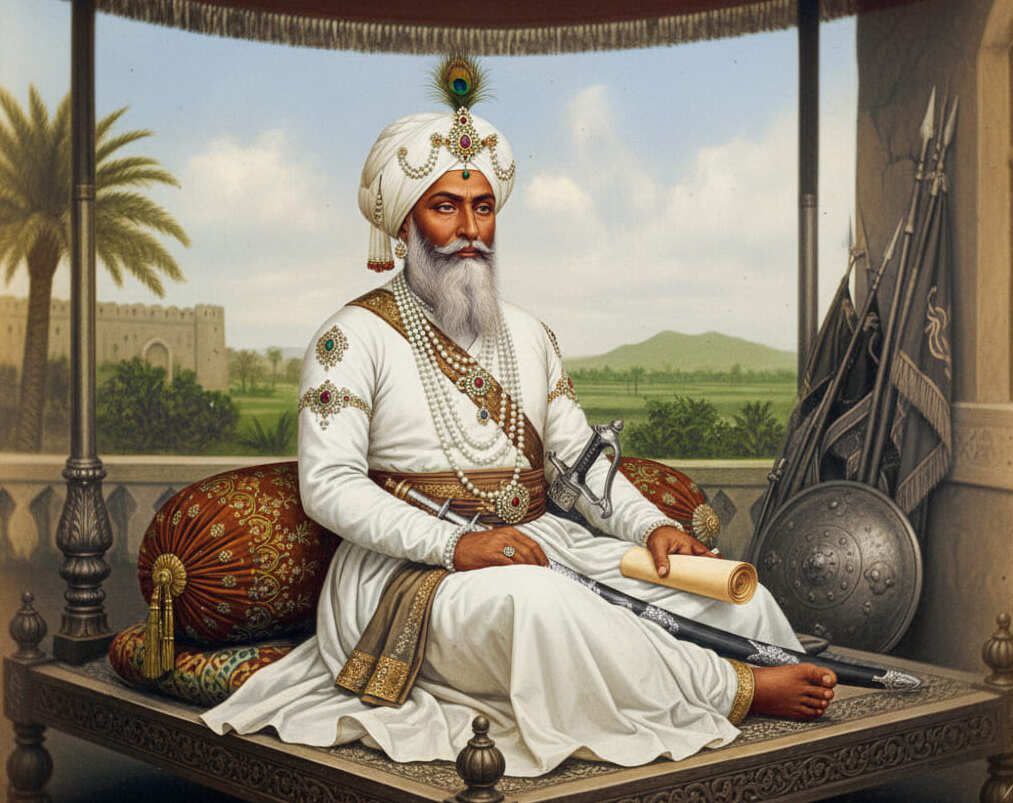
Let’s journey into the most glorious and golden era of Punjab’s history—the reign of Sher-e-Punjab, Maharaja Ranjit Singh.
Imagine the end of the 18th century. Punjab was fractured into small warring clans called Misls. The land was bleeding from constant internal conflicts and relentless invasions by Afghan raiders. In this era of darkness, a 19-year-old youth rose to power, transforming a scattered Punjab into a vast and formidable empire.
Maharaja Ranjit Singh: Founding an Empire
Ranjit Singh was only 12 years old when his father passed away. A childhood bout of smallpox had cost him the sight in one eye, but his vision for his people was clearer than anyone else's. He realized that without unity, Punjab would never be safe.
In 1799, he captured Lahore and made it his capital. In 1801, on the day of Vaisakhi, he was proclaimed 'Maharaja.' However, his greatness lay in his humility: he never struck coins in his own name, but in the name of Guru Nanak (the Nanakshahi coins). He didn't see himself as a king, but as a "Servant of the Khalsa Panth."
A Unique Rule: Where Equality Reigned
The court of Maharaja Ranjit Singh was one of the most secular and inclusive in world history. His most trusted Foreign Minister was a Muslim (Fakir Azizuddin) and his top military commander was a Brahmin (Diwan Mokham Chand).
Legend has it that the Maharaja would often roam the streets in disguise to check on the well-being of his subjects. In an era of brutal punishments, he notably never awarded the death penalty. He served the Harmandir Sahib in Amritsar and covered it with gold, giving birth to the name "The Golden Temple." Simultaneously, he donated massive amounts of gold to the Kashi Vishwanath temple, showing his deep respect for all faiths.
The Invincible Army: Sarkar-e-Khalsa
Ranjit Singh modernized his military by hiring French and Italian generals who had served under Napoleon. His army, the Fauj-i-Khas, became one of the most powerful fighting forces in Asia. He didn't just push the Afghan raiders out of Punjab; he chased them back into their own territories, like Peshawar and the Khyber Pass—becoming the first Indian ruler in centuries to do so.
His legendary General, Hari Singh Nalwa, struck such fear into the hearts of invaders that his name became a symbol of Punjabi grit. It was during this golden era that the world-famous Koh-i-Noor diamond graced the crown of Punjab.
The End of an Era
When the Maharaja passed away in 1839, it felt as if the sun had set on Punjab. Internal infighting for the throne weakened the state, and eventually, in 1849, the British Empire annexed Punjab through a series of betrayals and wars.
For the people of Punjab, the reign of Maharaja Ranjit Singh remains the "Golden Age" because, for the first time, Punjabis were masters of their own destiny on their own soil.
These are two of the most iconic stories in Punjabi folklore—one of legendary strategic wit and the other of raw, unmatched courage.
1. The Story of the Koh-i-Noor: The Mountain of Light
The journey of the Koh-i-Noor to Punjab is a tale of shifting power and a Maharaja’s sharp intuition.
By 1813, the diamond was in the possession of Shah Shuja, the exiled King of Afghanistan. He had fled his country and was seeking refuge in Lahore. Maharaja Ranjit Singh, knowing the Shah carried the most famous diamond in history, offered him protection—but at a price.
The Shah was hesitant to part with the stone, which had been looted from Delhi by Nadir Shah decades earlier. He tried to trick the Maharaja by sending a high-quality glass imitation first. However, Ranjit Singh’s experts immediately saw through the ruse.
Finally, the Maharaja visited Shah Shuja in person. After an hour of tense silence, the Shah realized he had no choice. He placed the diamond before Ranjit Singh.
> The Maharaja asked, "What is the value of this stone?"
> The Shah’s wife famously replied, "If a strong man were to throw four stones—one North, one South, one East, one West—and a fifth stone into the air, and the space between them were filled with gold, all that would not equal the value of the Koh-i-Noor."
>
Ranjit Singh wore the diamond on his arm during state functions, making it the symbol of the Sarkar-e-Khalsa’s sovereignty. It remained in Punjab until the British took it in 1849 as part of the Treaty of Lahore.
2. The Legend of Hari Singh Nalwa: The "Tiger-Slayer"
If Ranjit Singh was the brain of the Empire, Hari Singh Nalwa was its sword. He was the most feared General of his time, and his name is still legendary in the North-West Frontier.
How he got the name "Nalwa"
His name was originally Hari Singh Uppal. One day, while out on a hunt, a tiger suddenly lunged at him. Before anyone could react, the tiger had its claws on him. Without reaching for his gun, Hari Singh grabbed the tiger’s jaws with his bare hands and broke its neck. The Maharaja, witnessing this feat of superhuman strength, compared him to the legendary King Nala (known for his bravery), and thus he became "Nalwa."
The Terror of the Afghans
For centuries, invaders had come through the Khyber Pass to loot India. Hari Singh Nalwa changed history by reversing that flow. He built forts at the mouth of the pass, like Jamrud, and conquered Peshawar.
He was so terrifying to the opposition that Afghan mothers would reportedly use his name to quiet their children, saying, "Huriya aa gaya" (Hari Singh is coming).
His Final Stand
In 1837, during the Battle of Jamrud, Nalwa was mortally wounded. Even as he lay dying, he knew that if the Afghan army realized he was dead, they would charge and crush the Sikh forces. He ordered his men to hang his body from the ramparts of the fort as if he were still alive and watching. For days, the Afghan army stayed back, terrified of the mere sight of the "Silent General," allowing Sikh reinforcements to arrive and save the fort.
3. The Mystery of Harappa: The City of the Bronze Age
Let’s step back 4,500 years. If you walked through the streets of Harappa (near modern-day Sahiwal, Punjab), you wouldn't feel like you were in the ancient world; you’d feel like you were in a modern city.
A Masterpiece of Planning
While the rest of the world lived in mud huts, Punjabis in Harappa lived in two-story brick houses. They had:
* Indoor plumbing: Every house had a bathing area and a latrine.
* The World’s First Drainage: Covered sewers ran beneath the streets—a level of hygiene Europe wouldn't achieve for another 3,000 years.
* Standardized Weights: Their trade was so precise that they used uniform weights and measures across thousands of miles.
The Great Mystery
Unlike the Egyptians or Mesopotamians, the Harappans left no statues of grand kings or scenes of bloody wars. They seemed to be a society of traders and artisans. They wore jewelry made of carnelian and gold, and children played with clay whistles and pull-toys.
The biggest mystery remains their script. We have thousands of seals with beautiful carvings of unicorns and bulls, topped with strange symbols. To this day, no one has been able to read what the Harappans wrote. When the rivers shifted or the climate changed around 1900 BCE, they abandoned their cities, leaving the origins of Punjab's urban genius buried in the dust.