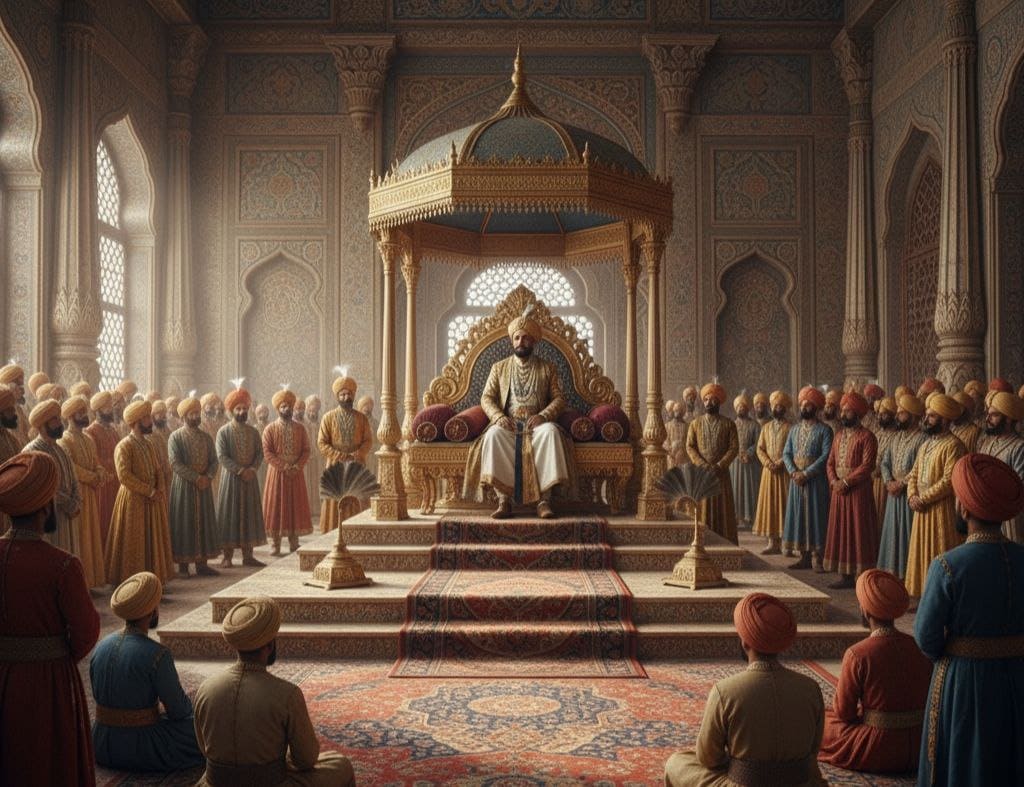
The sun hung low over the dusty plains of Agra, casting long, amber shadows across the bustling courtyard of the Diwan-i-Khas. Inside, the air was thick with the scent of rosewater and the hushed whispers of courtiers. But at the center of the room, seated upon a modest yet elegant throne, Jalal-uddin Muhammad Akbar—the Third Mughal Emperor—was not interested in poetry or conquest today.
He was interested in numbers.
Beside him stood a man whose mind was a labyrinth of ledgers and logic: Raja Todar Mal. This is the story of how these two men reimagined the very foundation of an empire, shifting it from a system of chaotic guesswork to a scientific marvel known as the Zabti System.
Chapter I: The Chaos of the Old Ways
To understand Akbar’s revolution, one must understand the mess he inherited. In the early years of his reign, the empire’s revenue was a gamble. Tax collectors (Amils) would look at a field, guess its yield, and demand a share.
If the rains failed, the peasants starved while the tax collectors still demanded their pound of flesh. If the harvest was a bounty, the state often missed out because it had no way of knowing how much was actually grown. Corruption was the only thing that grew consistently.
Akbar realized that a stable empire could not be built on shifting sands. "A king who does not know the pulse of his soil," Akbar once remarked to Todar Mal, "is like a captain who does not know the depth of the sea."
Chapter II: The Measuring String and the Bamboo Rod
In 1570, Akbar gave Todar Mal a mandate: Measure everything.
Before this, officials used hemp ropes to measure land. But hemp stretched when it was wet and shrank when it was dry—a perfect tool for dishonest officials to cheat farmers.
Todar Mal introduced the Tanab, a measuring rod made of bamboo joined by iron rings. It was inflexible, honest, and precise.
The surveyors fanned out across the Indo-Gangetic plain. They didn't just measure the size of the fields; they classified the soil into four distinct categories based on fertility:
* Polaj: Land cultivated every year (the gold standard).
* Parauti: Land left fallow for a year or two to recover its strength.
* Chachar: Land left fallow for three to four years.
* Banjar: Uncultivated land, often salty or rocky.
By categorizing the land, Akbar ensured that a farmer with rocky soil wasn't taxed the same as a farmer with a lush, riverside plot.
Chapter III: The Ten-Year Truth (Dahshala)
Measurement was only half the battle. Prices fluctuated. One year, wheat might be expensive; the next, a glut in the market would make it worthless.
Todar Mal’s masterstroke was the Dahshala System, implemented around 1580. He ordered a massive data-collection project. For ten years (1570–1580), the state recorded the exact yield and the prevailing local prices for every single crop in every district.
They then took the average of these ten years. This "average" became the basis for the state's demand. The government’s share was fixed at one-third of the average produce.
This brought something the Indian subcontinent hadn't seen in centuries: Predictability. A farmer knew exactly what he owed, regardless of whether the market price spiked or dipped that year.
Chapter IV: The Rise of the Zabti System
This entire process—measurement, classification, and ten-year averaging—was called the Zabti System. It was a contract between the Emperor and the peasant (the Ryot).
To make it official, two documents were exchanged:
* The Patta: A document given by the state to the farmer, detailing the land he held and the tax he was obligated to pay.
* The Qabuliyat: A "deed of agreement" signed by the farmer, acknowledging his obligation.
Akbar also insisted that taxes be paid in cash, not kind. This forced the economy to monetize, encouraging trade and the growth of market towns (Mandis) across the empire.
| Land Category | Cultivation Frequency | Tax Burden |
|---|---|---|
| Polaj | Annually | High (Standard 1/3) |
| Parauti | Every 1-2 years | Moderate |
| Chachar | Every 3-4 years | Low (to encourage revival) |
| Banjar | Rarely | Minimal (to encourage clearing) |
Chapter V: The Human Element
Akbar wasn't just a cold mathematician. He knew that nature was fickle. He issued standing orders to his provincial governors (Subahdars):
> "In times of drought or flood, the hand of the tax collector must be stayed. Provide the peasant with Taccavi (emergency loans) to buy seeds and cattle. If the crop fails, the tax must be remitted."
>
He saw the peasant as the "treasure house" of the empire. If the farmer flourished, the Mughal throne was secure. If the farmer broke, the throne would topple.
Chapter VI: The Legacy of the Ledger
By the time of Akbar’s death in 1605, the Mughal Empire was the wealthiest entity on Earth, accounting for nearly 25% of the world's GDP. This wasn't just because of diamonds or silk; it was because of the humble ledger of Todar Mal.
The system wasn't perfect—local Zamindars (landlords) still found ways to squeeze the poor—but it provided a level of administrative sophistication that even the British Raj would later study and adapt three centuries later.
The story of Akbar’s revenue system is a story of how a warrior-king put down his sword and picked up a measuring rod, proving that the true strength of a kingdom lies not in what it takes, but in how it measures what it leaves behind.
The Pillars of the System: The Men Behind the Numbers
Simply making rules wasn't enough; to implement them on the ground, Akbar created a robust administrative framework. In every village and district, there was a chain of officials:
1. The Amilguzar (District Protector)
The Amilguzar was the chief revenue officer of a district. His job wasn't just to collect tax, but to look after the farmers like a father figure. Akbar’s instructions were that the Amilguzar should "behave like a friend to the farmers" and ensure that agricultural loans (Taccavi) were provided on time.
2. The Patwari (Village Accountant)
The Patwari was the most important link at the village level. He kept the map of every field, records of the soil type, and the history of crop yields from previous years. Even today, the word 'Patwari' is used in many parts of India with the same sense of responsibility.
3. The Muqaddam (Village Headman)
He was the village chief who acted as a bridge between the government and the farmers. In exchange for helping with tax collection, he received a small share of the produce.
Difference Between the Delhi Sultanate and Akbar’s System
Before Akbar, rulers like Alauddin Khalji and Sher Shah Suri also attempted land reforms, but Akbar’s system went much further. Here are the key differences:
1. Guesswork vs. Reality
* Sultanate Period: Relied mostly on Batai (sharing the crop after harvest) or Kankut (estimating the yield by looking at the standing crop). This left a lot of room for corruption.
* Akbar: The Zabti and Dahshala systems eliminated guesswork. Everything was based on ten years of written data and precise measurement.
2. Mode of Payment
* Sultanate Period: Taxes were often collected in kind (grain), which was a headache for the state to transport and store safely.
* Akbar: Akbar prioritized cash payments. This increased the circulation of coins in the empire and led to a boom in trade.
3. Flexibility
* Sultanate Period: Tax rates often changed according to the Sultan's war needs.
* Akbar: Akbar stabilized the rates. The farmer knew in advance what he had to pay, allowing him to plan for the future.
The Role and Challenge of the Zamindars
Although Akbar tried to establish direct contact with the farmers, the Zamindars still existed in between. These were local powerful figures who often maintained their own small armies. Akbar did not eliminate them; instead, he made them part of the administration. In exchange for assisting in tax collection, they were given 'Nankar' (allowances or tax-free land).
This was the balance that gave Akbar’s reign its stability—scientific calculation on one hand, and respect for local influence on the other.
The golden age of Mughal architecture was not built solely on the vision of artists, but on the precision of the Zabti system. The wealth flowing from the fields of Punjab, Bengal, and Gujarat provided the massive capital required to turn stone into poetry.
Here is how the land revenue system laid the foundation for the Mughal architectural legacy.
From Soil to Sandstone: Financing an Empire
When Akbar’s revenue reforms took hold, the imperial treasury (the Khazana-i-Amira) began to overflow. Historians estimate that Akbar’s annual revenue was roughly 17.5 million pounds sterling—a staggering sum for the 16th century.
This surplus allowed Akbar to move beyond the utilitarian forts of his predecessors and create a new aesthetic:
1. The Creation of Fatehpur Sikri
Nowhere is the link between revenue and art more visible than in Fatehpur Sikri. Built entirely of red sandstone, this city was a "political statement in stone."
* The Cost: The construction of the palace complex, the Buland Darwaza, and the Jama Masjid required thousands of skilled laborers, stone-cutters, and elephants.
* The Source: The revenue from the fertile Doab region (the land between the Ganges and Yamuna) directly funded the wages of these craftsmen.
2. Standardization: The Imperial Yardstick
Interestingly, the same obsession with measurement that gave us the Tanab (the bamboo measuring rod) also influenced architecture. Akbar standardized the Ghaz (the imperial yard).
* Just as land was measured with precision, the dimensions of the Humayun’s Tomb and the gates of Agra Fort were calculated using these standardized units, ensuring perfect symmetry and mathematical harmony.
3. The "Cash Economy" and the Arts
Because Akbar insisted that taxes be paid in cash, farmers had to sell their surplus in markets. This created a boom in trade. The wealth generated from this trade allowed the nobility (the Mansabdars) to also commission grand gardens, tombs, and mosques, spreading the "Mughal Style" across the subcontinent.
A Comparison: Where the Money Went
| Project | Primary Function | Symbolic Meaning |
|---|---|---|
| Fatehpur Sikri | Imperial Capital | The stability and wealth of the empire. |
| Humayun’s Tomb | Dynastic Monument | The legitimacy of the Mughal line. |
| Agra Fort | Military/Residential | The strength and protection of the state. |
| Canals and Serais | Infrastructure | Reinvesting revenue to boost more trade. |
The Sunset of the System
As the years passed, the very wealth that built the Taj Mahal (under Akbar's grandson, Shah Jahan) began to strain the system. Later emperors increased the tax demand from 1/3 to 1/2 to fund even more ambitious projects and endless wars.
When the balance between what the land could give and what the state took was broken, the empire began to fracture. But during Akbar’s time, the system was a perfect circle: the soil fed the treasury, the treasury fed the craftsmen, and the craftsmen built a legacy that still stands today.