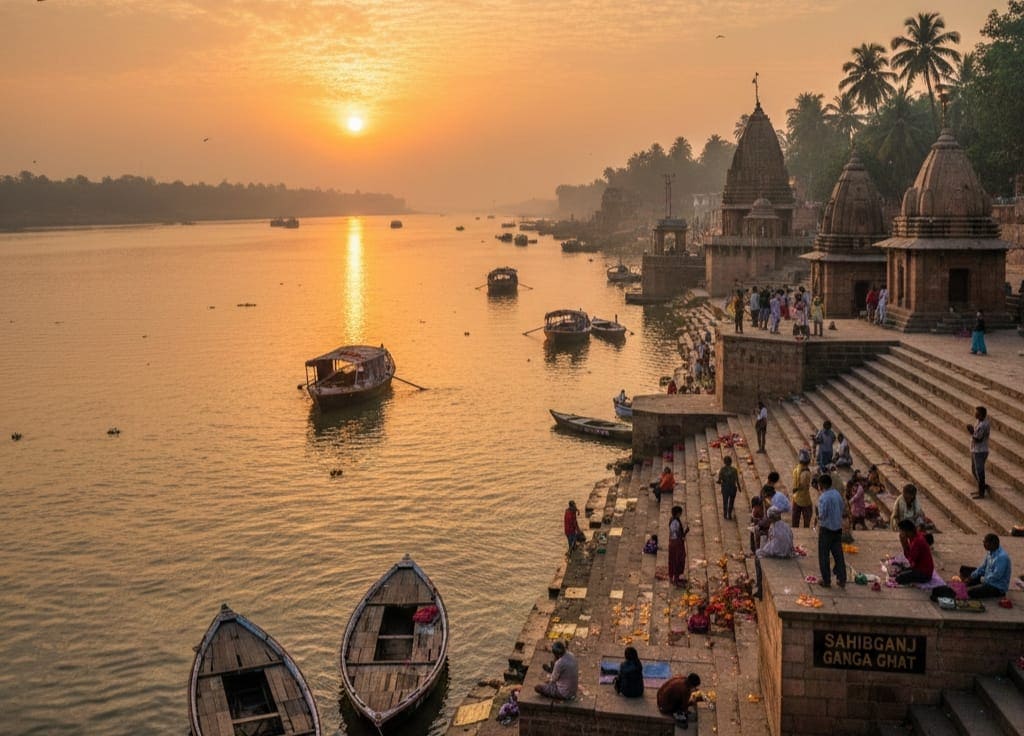
The sun does not simply rise in Sahibganj; it negotiates with the mist.
In this singular corner of Jharkhand—the only patch of the state where the Ganges deigns to flow—the morning begins with a silver light reflecting off a river so wide it feels like a horizontal sky. To understand Sahibganj is to understand the geography of grace. Jharkhand is a land of rocky plateaus, dense sal forests, and mineral-rich earth. It is a land of red soil and iron hearts. But here, at the northeastern tip, the rugged Rajmahal Hills bow down to the water, allowing the Ganga to brush past for a brief, eighty-kilometer embrace.
This is the story of Sahibganj, the "City of Lords," where the stones are older than the Himalayas and the water carries the prayers of a billion souls.
The Ancient Sentinel: The Rajmahal Hills
Long before the first human stepped onto these banks, the earth here screamed in fire. The Rajmahal Traps—the volcanic formations that cradle the city—are a geological record of the Jurassic era. If you walk along the hills today, you aren't just walking on earth; you are walking on a graveyard of giants. Fossilized plants, millions of years old, are etched into the stone, reminding every passerby that Sahibganj was a witness to the dawn of time.
As the Ganga enters from Bihar, it finds these hills standing like silent sentinels. In other places, the river is a wanderer, shifting its course across flat plains. But here, the basalt rocks of the Rajmahal range provide a firm boundary. The river is squeezed, deepened, and forced into a majestic curve. This geographic quirk made Sahibganj more than just a scenic stop—it made it a fortress.
The Gateway of Empires
History has a way of flowing where the water goes. Because Sahibganj sits at the "Teliagarhi Pass"—a narrow strip between the hills and the river—it became known as the "Gateway to Bengal."
Imagine the dust of a thousand horses. Any king who wished to conquer the riches of Bengal had to pass through this needle’s eye. The Mughals knew it. The Afghans knew it. The British craved it.
* Sher Shah Suri paced these banks, his eyes on the throne of Delhi.
* Akbar’s generals fought bloody battles in the mud of the monsoon.
* The Santal Rebellion of 1855, led by the legendary Sidhu and Kanhu, ignited in the nearby villages of Bhognadih. The hills of Sahibganj echoed with the beat of drums (the nagada) as the local tribes rose against the oppression of the British East India Company.
The river saw it all. It washed away the blood of the fallen and carried the ships of the victors. It was the silent witness to the transition from the sword to the steam engine.
The British Footprint and the Steam Whistle
When the British arrived, they saw Sahibganj not as a spiritual site, but as a strategic hub. They built the railway—the loop line—that connected Calcutta to the rest of India.
The city transformed. Grand bungalows with high ceilings and red-tiled roofs sprouted along the banks. The "Sahibs" (officers) gave the town its name. The air, once filled only with the scent of wet earth and jasmine, was now thick with the coal smoke of steam engines. Sahibganj became a bustling port and a railway nerve center.
The St. Mary’s Church, with its quiet dignity, still stands as a reminder of that era, its bell tolling over a town that was rapidly becoming a melting pot of Bengali intellect, Bihari grit, and tribal resilience.
Life at the Ghats: The Soul of the City
To live in Sahibganj is to live by the rhythm of the ghats.
At Bijli Ghat or Manihari Ghat, the world is a kaleidoscope. In the pre-dawn dark, the bells of the Shiva temples begin their rhythmic clanging. The Pandas (priests) set up their wooden platforms under massive umbrellas.
But Sahibganj’s relationship with the Ganga is different from Varanasi or Haridwar. Here, it is more intimate, less crowded by the weight of commercialized religion. It is a working river. You will see fishermen casting nets from narrow wooden boats (nauka), their muscles glistening like the scales of the Hilsa fish they seek. You will see the massive ferries—the lifelines—carrying trucks, cattle, and thousands of people across to Manihari in Bihar.
The river here is wide—so wide that during the monsoon, the opposite bank disappears. It becomes an ocean of silt-colored water, fierce and unpredictable. When the Ganga rises, the city holds its breath. When she recedes, she leaves behind the fertile silt that feeds the orchards of Rajmahal.
The Fragrance of the Land
If Sahibganj had a scent, it would be a mix of Mangoes and China Rose.
The region is famous for its orchards. The Fazli and Langra mangoes of Rajmahal are legendary—heavy, sweet, and smelling of pure sunshine. In the summer heat, the city slows down. People sit under the shade of banyan trees, eating sliced mangoes sprinkled with salt and chili, while the hot wind (loo) ruffles the surface of the river.
Beyond the fruit, there is the spiritual fragrance of Moti Jharna. High up in the hills, a natural spring cascades down the rocks. It is a place of pilgrimage and peace, where the water is said to be as pure as a pearl (Moti). It is the hills' way of offering their own tribute to the valley below.
The Modern Pulse
Today, Sahibganj is a city in transition. It is no longer just a colonial relic or an ancient pass. With the construction of the massive Multi-Modal Terminal and the upcoming bridge over the Ganga, it is reclaiming its title as a gateway.
Yet, despite the roar of trucks and the progress of concrete, the soul of the city remains tied to the water. In the evenings, the youth of Sahibganj gather at the riverfront. They sit on the embankments, scrolling through phones, but frequently looking up to watch the sunset turn the Ganga into a river of liquid gold.
They know what the rest of Jharkhand does not: the feeling of a cool river breeze on a humid July night. They know the sound of the water lapping against the stones, a sound that has not changed since the days of the dinosaurs or the era of the Mughals.
The Eternal Flow
As the sun sets behind the Rajmahal Hills, casting long, purple shadows over the city, Sahibganj settles into a familiar hum. The evening Aarti begins. Small leaf-boats with flickering lamps are set adrift.
Each lamp is a wish, a memory, or a prayer. They float past the old ruins of the Rajmahal fort, past the modern railway tracks, and into the dark expanse of the great river.
Sahibganj remains a beautiful anomaly. It is the only place where the rugged, mountainous spirit of Jharkhand meets the fluid, eternal grace of the Mother Ganga. It is a city where history doesn't just sit in books; it flows.