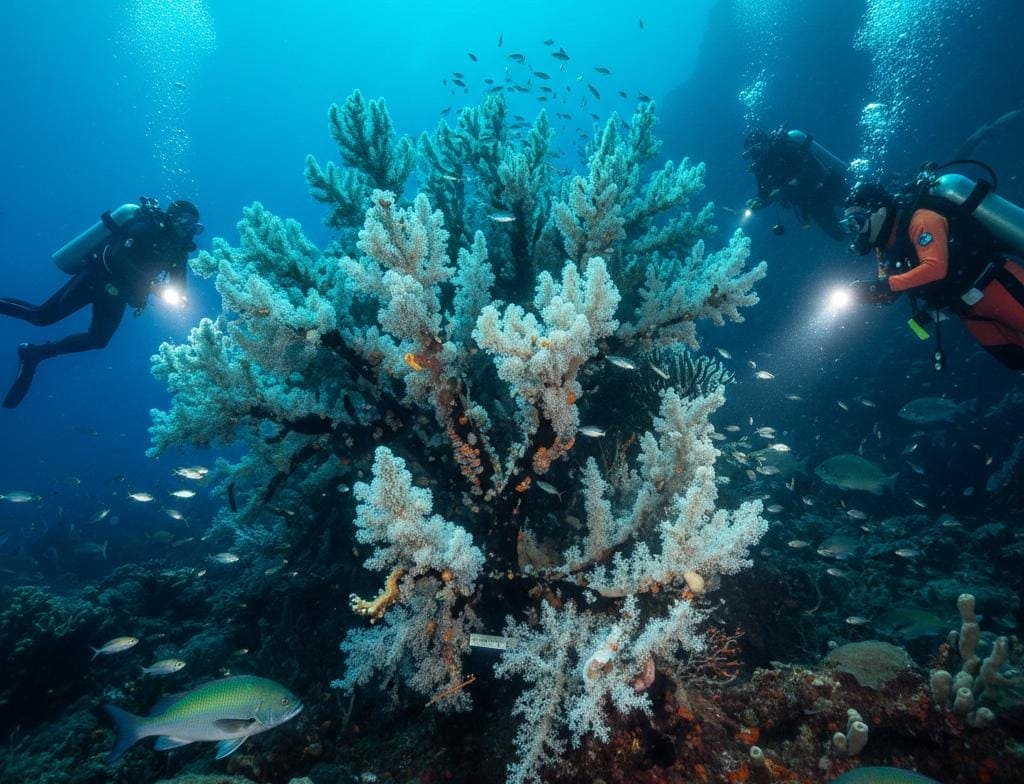
In January 2026, marine scientists made a stunning discovery in the waters of New Zealand. Researchers from Te Herenga Waka—Victoria University of Wellington identified a massive black coral colony in the Fiordland region that is estimated to be between 300 and 400 years old.
Measuring over 4 meters (13 feet) tall and 4.5 meters (15 feet) wide, it is believed to be the largest black coral ever recorded in New Zealand's territorial waters.
The Ghostly Giant of Fiordland
Despite being called "black coral," the living organism actually appears white or colorful. The name refers to the distinctive jet-black, antler-like skeleton found beneath its living tissue. This particular specimen was found during a deep-sea dive in the remote and pristine fjords of the South Island, a region known for its unique marine "deep-water emergence," where deep-sea species can be found in much shallower depths than usual.
Key Facts About the Discovery
* Scientific Name: Antipathella fiordensis.
* Dimensions: Roughly the size of a small van (4m x 4.5m).
* Estimated Age: 300–400 years, meaning it likely began growing in the 1600s or 1700s.
* Protection: It is a fully protected species under New Zealand's Wildlife Act.
Why This Discovery Matters
Finding a coral of this size and age is more than just a record-breaking event; it is a vital indicator of ocean health.
* Ecological Hub: Large, ancient corals act as "underwater forests." They provide essential habitat, shelter, and breeding grounds for a vast array of fish and invertebrates.
* Climate Record: Because corals grow slowly over centuries, their skeletons act as a biological archive, trapping chemical data that can tell scientists about ocean temperatures and conditions from hundreds of years ago.
* Conservation Urgency: The discovery highlights the fragility of these ecosystems. Black corals are extremely slow-growing and vulnerable to physical damage from fishing gear (like bottom trawling) or anchoring.
> "It's by far the largest black coral I've seen in my 25 years as a marine biologist," said Professor James Bell, who led the research team. "Most black corals we come across are small... finding this one was really cool."
>
The discovery has prompted calls for better mapping of the Fiordland seabed to ensure these ancient giants are not accidentally destroyed by human activity.