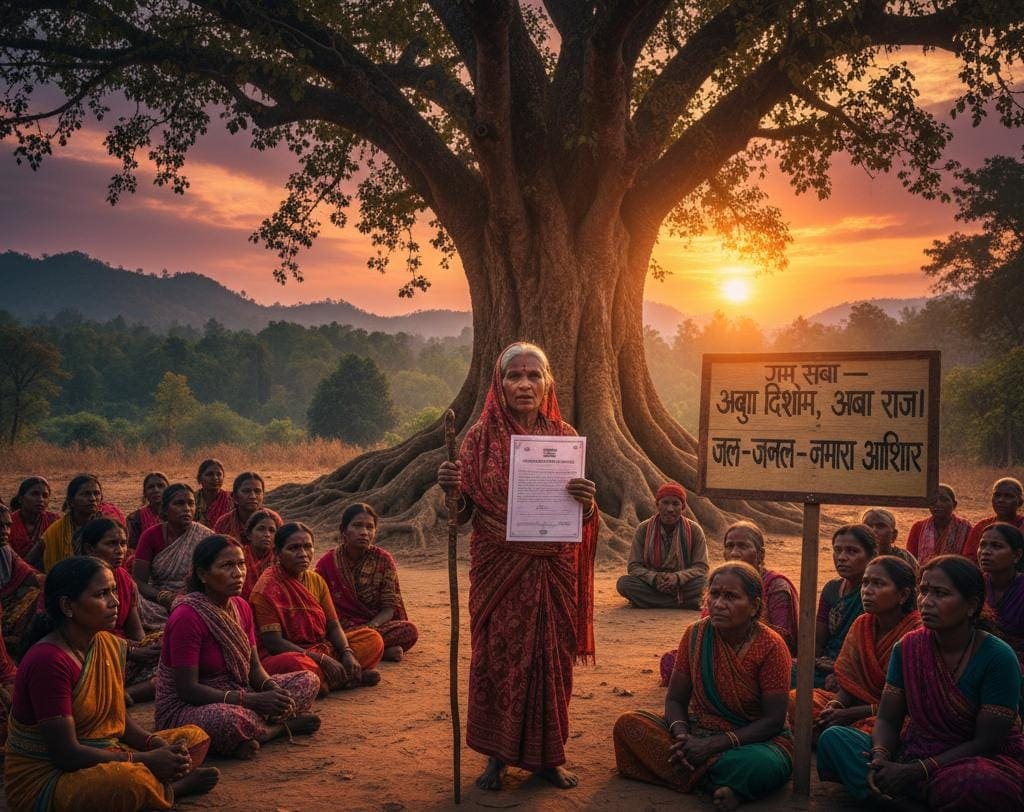
In a historic move, Jharkhand has finally notified the PESA (Panchayat Extension to Scheduled Areas) Rules in January 2026. This comes nearly 25 years after the state was carved out of Bihar in 2000, fulfilling a long-standing demand of the tribal population for genuine self-governance.
Article: A New Era for Tribal Sovereignty in Jharkhand
The implementation of PESA rules in Jharkhand is more than just a legal notification; it is a restoration of "Abua Dishom, Abua Raj" (Our Village, Our Rule). Applying fully to 13 districts (including Ranchi, Khunti, and West Singhbhum) and partially to 3 others, these rules shift the center of power from bureaucratic offices to the Gram Sabha (Village Assembly).
Key Highlights of Jharkhand’s PESA Rules:
* Supreme Authority of Gram Sabha: The Gram Sabha is now the primary decision-making body for village development, social justice, and resource management.
* Management of Natural Resources: Tribal communities now have legal control over Jal, Jangal, and Zameen (Water, Forest, and Land), including the rights over Minor Forest Produce (MFP) like Tendu leaves and Mahua.
* Customary Law Protection: The rules formally recognize traditional tribal governance systems such as the Manki-Munda and Majhi-Pargana systems.
* Safeguards Against Land Alienation: No land in Scheduled Areas can be acquired for development projects without prior consultation with the Gram Sabha.
While the move has been hailed as "historic" by the state government, some activists remain cautious, urging that the rules must be implemented "in letter and spirit" to ensure that the district administration does not override village-level decisions.
What is PESA? (The "Constitution within the Constitution")
The Panchayat (Extension to Scheduled Areas) Act, 1996 is a central law that extends the provisions of the 73rd Constitutional Amendment (Panchayati Raj) to the Fifth Schedule Areas of India. These are regions with a predominant tribal population that require special protections to preserve their unique culture and prevent exploitation.
Core Provisions of the PESA Act:
* Direct Democracy: Unlike regular Panchayats where elected representatives make decisions, PESA empowers the entire village (Gram Sabha) to approve plans and projects.
* Mandatory Reservation: At least 50% of seats in Panchayats at all levels in Scheduled Areas must be reserved for Scheduled Tribes (STs). Additionally, the Chairperson position at all levels is strictly reserved for STs.
* Conflict Resolution: Gram Sabhas are empowered to resolve local disputes using traditional customary laws rather than relying solely on the formal police/judicial system for minor issues.
Why is PESA Important to a State?
For any state with a significant tribal population (like Jharkhand, Chhattisgarh, or Odisha), PESA is the "Gold Standard" of decentralized governance for several reasons:
* Prevents Exploitation: By giving Gram Sabhas control over minor minerals and water bodies, it prevents external contractors from stripping local resources without benefiting the community.
* Social Harmony: It regulates the sale of intoxicants (liquor) and controls money-lending to STs, which are historically the two biggest causes of tribal indebtedness and social decay.
* Environmental Stewardship: Tribal communities are the natural guardians of forests. PESA empowers them to protect their habitat legally, which is crucial for ecological balance.
* Identity Preservation: It prevents the "mainstreaming" of tribal culture into a monolithic structure, allowing them to thrive while maintaining their distinct languages, rituals, and social codes.