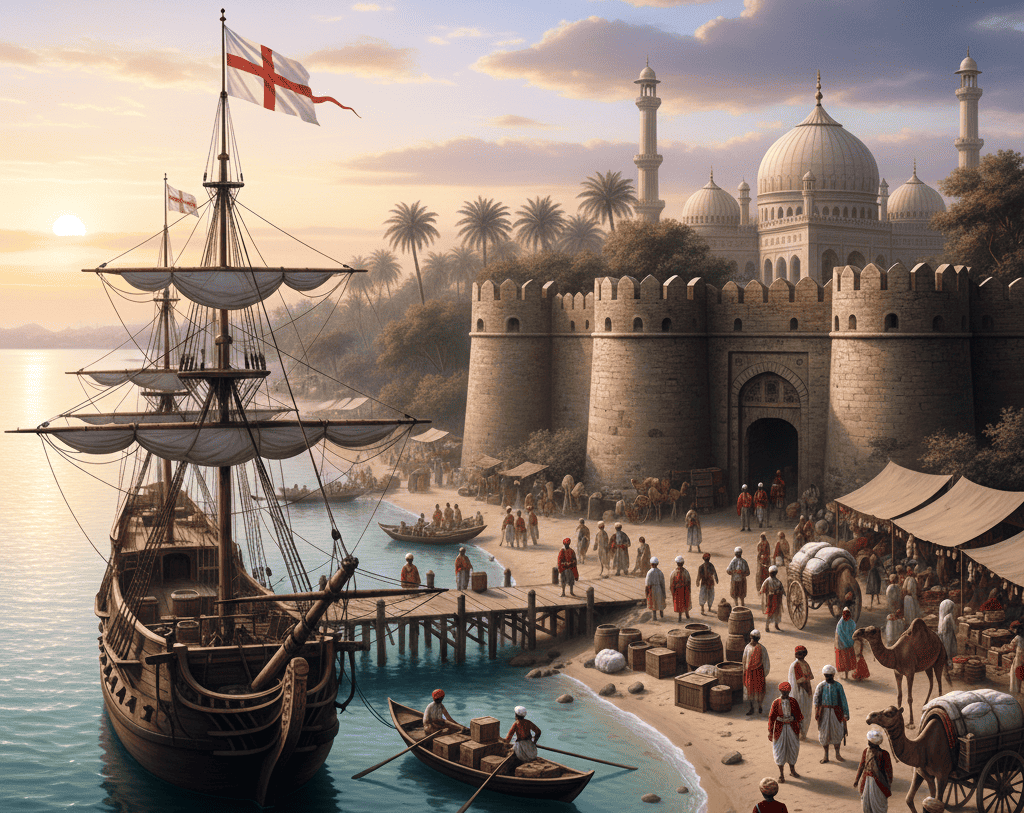
The year 1600 stands as a monumental pivot in Indian history, altering the politics and geography of not just the Indian subcontinent, but the entire world. This was the year a group of ambitious London merchants laid the foundation for a company that would evolve into the world’s most powerful "private army" and "sovereign ruler."
By the late 16th century, the Portuguese and the Dutch had seized control of the lucrative spice trade. Spurred by their success, a group of London merchants, known as the 'Adventurers,' sought a monopoly from Queen Elizabeth I to trade with the East.
On December 31, 1600, the Queen signed a Royal Charter, granting the 'Governor and Company of Merchants of London Trading into the East Indies' exclusive rights to trade in the East Indies for an initial period of 15 years.
The Company’s first ship, the Hector, led by Captain William Hawkins, reached the port of Surat in Gujarat in 1608. Hawkins traveled to the court of the Mughal Emperor Jahangir. Fluent in Turkish, he managed to impress the Emperor; however, due to Portuguese intrigue at the court, he was initially unable to secure trade concessions.
Success finally came in 1615 when Sir Thomas Roe, an ambassador from King James I, arrived at Jahangir’s court. He successfully obtained an official farman (imperial decree) to establish a factory (trading post) in Surat.
Initially, the British were interested only in spices, silk, cotton textiles, and indigo. Slowly, they established strongholds along the Indian coastline:
Madras (1639): The establishment of Fort St. George.
Bombay (1668): Acquired by King Charles II as part of a dowry from the Portuguese, who then leased it to the Company.
Calcutta (1690): Founded by Job Charnock by merging the villages of Sutanuti, Gobindapur, and Kalikata.
By the mid-18th century, the Mughal Empire had begun to fragment. The Company seized this opportunity to exert influence.
Battle of Plassey (1757): Under the leadership of Robert Clive, the Company defeated Siraj-ud-Daulah, the Nawab of Bengal. This marked the first political foundation of British rule in India.
Battle of Buxar (1764): After defeating the combined forces of Mughal Emperor Shah Alam II, the Nawab of Awadh, and Mir Qasim, the Company obtained 'Diwani Rights' (the right to collect taxes), making them the de facto rulers of Bengal, Bihar, and Odisha.
The Company’s policies were driven purely by profit, which caused devastating damage to the Indian economy:
Drain of Wealth: Indian raw materials were shipped to England at low prices, while finished goods were sold back to India at high prices.
Land Revenue Systems: Systems like the 'Permanent Settlement' and 'Ryotwari' burdened farmers with insurmountable debt.
Imperial Expansion: Through Lord Wellesley’s 'Subsidiary Alliance' and Lord Dalhousie’s 'Doctrine of Lapse', several Indian princely states (such as Jhansi and Awadh) were annexed.
In 1857, Indian soldiers (sepoys) revolted against the Company’s maladministration and religious interference. Although the uprising was suppressed, it shook the British government in London to its core.
In 1858, the British Parliament passed the 'Government of India Act', under which:
The East India Company’s rule was abolished.
Governance of India was transferred directly to the British Crown (Queen Victoria).
The Governor-General was henceforth designated as the 'Viceroy'.
The history of the East India Company is one of exploitation, yet it left behind systems that shaped modern India:
Railways and Telegraph: Though introduced for trade and military logistics, these became India’s lifeline.
Administrative Structure: The foundation of the Indian Civil Service (ICS) was laid during the Company era.
Education: Macaulay’s Minute of 1835 led to the spread of English education in India.
The story of the British East India Company is unique in world history—it is the tale of how a small trading firm, through cunning, military might, and the policy of "divide and rule," enslaved a vast subcontinent. It was a period that shattered the Indian economy but also sparked the consciousness of a modern nation.