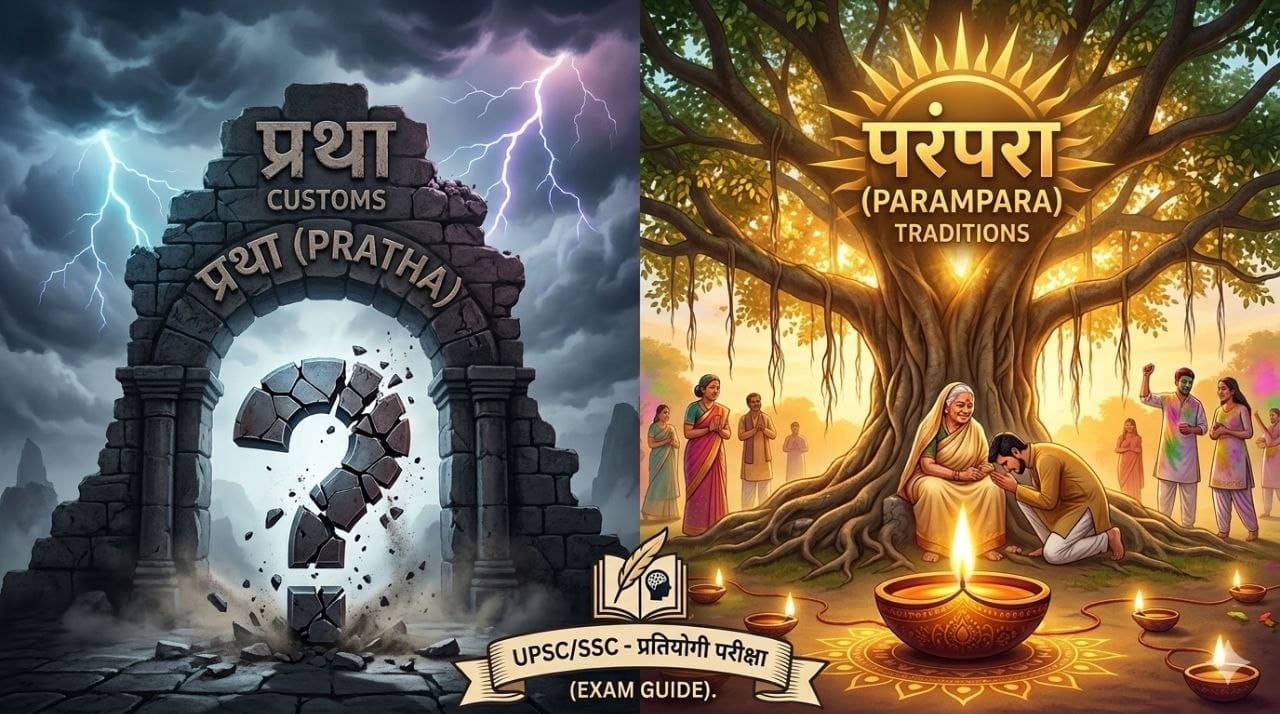
Dear students, welcome to today’s special session!
If you are preparing for the UPSC Civil Services, SSC, or any State PCS exam, you must have frequently encountered the terms 'Customs' and 'Traditions' in the syllabus of Indian Society and Modern Indian History.
While we often use these terms interchangeably in daily conversation, from a sociological standpoint, they are worlds apart. Recently, a short educational video went viral on social media, beautifully breaking down this fundamental difference and concluding with a pivotal historical question.
In this dedicated article, we will go far beyond a simple summary of that video. We will dissect the topic so deeply that you will never miss an MCQ or lose marks in a Mains answer on this subject. Let's stop rote learning and start understanding.
In simple terms, a Custom refers to specific practices, behaviors, or rules followed by a society or a specific group for a certain period.
Customs usually originate out of a specific circumstance, geographical necessity, or an immediate social need. However, as time passes and those underlying conditions change, people often continue to follow them blindly out of habit. This is precisely where a regular social custom degrades into a Social Evil (कुप्रथा).
Temporary Nature: Customs can evolve, change, or completely fade away over time. This adaptability is their primary feature.
Lack of Logic: Most deep-seated customs tend to be highly conservative. If you ask a community, "Why are we doing this?", they rarely have a scientific or logical explanation. The standard response is almost always: "Because this is how it has always been done in our community."
Eradication via Law: Because static customs can become highly regressive and violate fundamental human rights, governments and administrations often have to step in with strict legislations to abolish them.
The viral video concluded with an incredibly vital question: "Who abolished the practice of Sati?" Let’s analyze this in detail, as it remains a perennial favorite across competitive exams.
What began under specific regional conditions in ancient times turned into a horrific social evil by the 18th and 19th centuries, where a widow was burned alive on her husband's funeral pyre.
Who abolished it? Raja Ram Mohan Roy, often hailed as the maker of Modern India, waged a relentless crusade against this inhuman practice. Due to his pioneering efforts, the then British Governor-General, Lord William Bentinck, passed the Bengal Sati Regulation (Regulation XVII) on December 4, 1829, making the practice completely illegal and a punishable offense.
Exam Note: Note down this exact date and regulation in your registry!
Originating primarily during the medieval period to protect women amidst foreign invasions, this custom later turned into a massive barrier to women's freedom, health, and education. It was not an inherent tradition, but an imposed social custom. Today, with rising education and awareness, this custom is on the verge of vanishing.
In ancient times, a father voluntarily gifted wealth to his daughter at the time of marriage, known as 'Stridhan' (women's property). Over time, this degenerated into a coercive custom where the groom's family demanded mandatory wealth. To eradicate this, the Government of India enacted the Dowry Prohibition Act, 1961.
Now, let’s look at Tradition. The word implies a deep cultural transmission—values, knowledge, beliefs, and rituals that are consciously handed down from one generation to the next.
Traditions form the backbone of our Culture. They do not arise from a fleeting, immediate need; rather, they embody generations of accumulated experience, deep philosophy, and the holistic art of living.
Generational Transfer: Traditions do not change easily. They are deeply embedded in our upbringing, value systems, and cultural identity.
Positivity and Social Cohesion: True traditions are designed to unite society rather than divide it. They keep individuals grounded in their roots.
Flexibility: Genuine traditions are rarely rigid or cruel. They naturally adapt to changing eras while keeping their core spiritual or moral essence perfectly intact.
Let’s look at a few core traditions that have been part of our civilization for centuries and remain entirely relevant today:
Respecting Elders (Charan Sparsh): The tradition of touching the feet of parents, teachers, and elders to seek blessings carries profound psychological and social weight. It systematically curbs individual ego and fosters deep humility.
The Institution of Marriage: While many modern cultures look at marriage as a legal civil contract that can be dissolved at will, Indian tradition views marriage as a Sacrament (पवित्र संस्कार)—one of the 16 core Samskaras. It marks the union of not just two individuals, but two families.
Festivals: Our diverse festivals—such as Diwali, Holy, Eid, Christmas, and Gurpurab—are not just holidays. They are traditions that periodically restore brotherhood, joy, and collective harmony. If Diwali represents the tradition of the victory of good over evil, Holi is the tradition of dissolving past grievances and embracing one another.
In your Civil Services Mains General Studies papers, a question is often posed: Is every custom inherently bad? The answer is a definitive No.
However, when a custom loses its contemporary relevance and starts exploiting a section of society (such as women or marginalized communities), its eradication becomes vital for social progress.
The Conceptual Analogy: A Tradition is like a flowing river—constantly refreshing and life-giving. A regressive Custom, when stagnant, becomes like a choked pond that breeds social disease over time.
During the 19th-century Indian Renaissance, our great social reformers did not seek to destroy Indian traditions; they sought to eradicate regressive customs.
| Reformer | Core Contribution | Target Social Custom |
| Raja Ram Mohan Roy | Championed women's rights and rationality | Sati Pratha |
| Ishwar Chandra Vidyasagar | Paved the way for the Hindu Widows' Remarriage Act, 1856 | Ban on Widow Remarriage |
| Jyotirao & Savitribai Phule | Pioneered women's education and backward caste upliftment | Untouchability & Gender Segregation |
By striking down these outdated customs, they successfully protected the pristine, core traditions of Indian civilization.
My dear students, always remember these three core conclusions for your upcoming exams:
Takeaway 1: Practices that are localized, temporary, rigid, and lack structural logic are Customs (e.g., Sati, child marriage, female foeticide). They are corrected through education and stringent law.
Takeaway 2: Values that define our civilizational identity, unite communities, and pass smoothly across generations are Traditions (e.g., Atithi Devo Bhava, community festivals, honoring elders). Preserving them is our collective duty.
Takeaway 3 (High-Yield Fact): The practice of Sati was legally abolished in 1829 by Governor-General Lord William Bentinck, heavily driven by the relentless efforts of Raja Ram Mohan Roy.
Never study History and Sociology as isolated, watertight compartments. The moment you bridge the two, you unlock the deep analytical clarity required to ace the UPSC and SSC exams. Stay rooted in your traditions, but never follow an outdated custom with your eyes closed. That is the hallmark of an enlightened citizen and a successful civil servant.
Keep studying, keep moving forward!