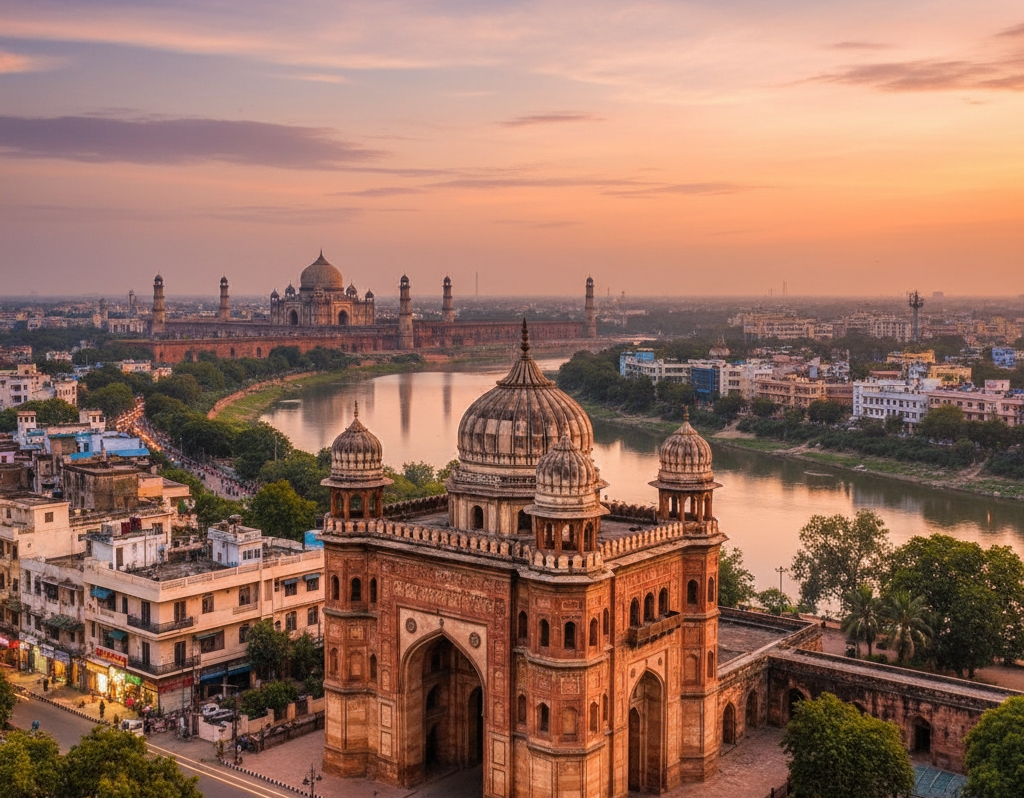
The period of the Nawabs of Awadh in the 18th and 19th centuries symbolizes the rise and fall of the Awadh state, which emerged as an independent regional power with the weakening of the Mughal Empire.
The rule of the Nawabs of Awadh began in 1722 AD when Saadat Khan Burhan-ul-Mulk was appointed the Subedar (Governor) of Awadh by the Mughal Emperor, and it lasted until 1856 when the British deposed the last Nawab, Wajid Ali Shah.
List and Analysis of the Prominent Nawabs of Awadh (Lucknow)
1. Saadat Khan Burhan-ul-Mulk (1722 – 1739 AD)
* Original Name: Mir Muhammad Amin Musavi.
* Reign: 1722 to 1739 AD.
* Analysis:
* Founder: He was the founder of the Awadh state. He took advantage of the Mughal Empire's weakness to establish Awadh as an autonomous state.
* Administration: He was an efficient administrator and military strategist. He successfully suppressed local rebellions and reformed the revenue administration, strengthening the state's financial position.
* Politics: He adopted a strategy of reducing the influence of the Jagirdars (landholders) to consolidate his own power.
* Death: He died in the aftermath of Nadir Shah's invasion (1739). According to some historians, he committed suicide by taking poison.
* Contribution: He made Faizabad his first capital, which later became an important seat of Awadh.
2. Safdarjung (Abul Mansur Khan) (1739 – 1754 AD)
* Original Name: Abul Mansur Muhammad Muqim Khan.
* Reign: 1739 to 1754 AD.
* Analysis:
* Successor: He was Saadat Khan's son-in-law and successor.
* Mughal Wazir: He was appointed as the Wazir (Prime Minister) of the Empire by the Mughal Emperor Ahmad Shah in 1748, which increased Awadh's prestige and power.
* Military and Political Conflict: His reign saw continuous conflict with the Bangash Pathans of Farrukhabad and the Maratha Confederacy.
* Contribution: He developed Faizabad as a military headquarters. The Safdarjung's Tomb in Delhi, named after him, is a significant architectural legacy.
3. Shuja-ud-Daula (1754 – 1775 AD)
* Reign: 1754 to 1775 AD.
* Analysis:
* Political Role: He allied with Ahmad Shah Abdali in the Third Battle of Panipat (1761).
* Battle of Buxar (1764): He fought against the British East India Company alongside Mir Qasim (the deposed Nawab of Bengal) and the Mughal Emperor Shah Alam II, but was defeated.
* Treaty of Allahabad (1765): This defeat forced him to sign a treaty with the British, bringing Awadh under British influence. He had to pay a large indemnity, and a British force was stationed in Awadh for its protection, the expense of which the Nawab had to bear.
* Contribution: He developed Faizabad into a full capital city and built several magnificent buildings there.
4. Asaf-ud-Daula (1775 – 1797 AD)
* Reign: 1775 to 1797 AD.
* Analysis:
* Capital Shift: He shifted the capital of Awadh from Faizabad to Lucknow. With this, Lucknow became the centre of the Nawabi rule and its prosperity began.
* Architecture and Culture: His reign is known as the Golden Age of Lucknow's art and culture. He provided unprecedented patronage to architecture.
* Major Constructions: He built grand and colossal monuments like the Bara Imambara (which includes the Bhool Bhulaiya maze) and the Rumi Darwaza.
* Administration: British interference continued to increase during his rule. He signed the Treaty of Faizabad in 1775, which further strengthened the relationship between the Nawab and the British East India Company.
* Social Sentiment: He was known for his generosity and the saying: 'Jisko na de Maula, usko de Asaf-ud-Daula' (One whom even God does not give, Asaf-ud-Daula gives), reflecting his charitable nature.
5. Saadat Ali Khan II (1798 – 1814 AD)
* Reign: 1798 to 1814 AD.
* Analysis:
* British Influence: He became the Nawab with British support and, in return, granted significant financial and territorial concessions to the British.
* Territorial Concessions: Under the Treaty of 1801, he ceded nearly half of the Awadh state's territory to the British, which reduced Awadh's geographical boundaries and power.
* Administration: He improved the financial condition of his state.
6. Ghazi-ud-Din Haidar Shah (1814 – 1827 AD)
* Reign: 1814 to 1827 AD.
* Analysis:
* Title of King: He was the first ruler of Awadh to assume the title of 'Badshah' (King) instead of 'Nawab Wazir' in 1819, at the encouragement of the British. This step symbolically marked his independence from the Mughal Emperor but actually symbolized his increasing dependence on the British.
* Architecture: He constructed structures like Mubarak Manzil and Shah Manzil within the Moti Mahal complex.
7. Wajid Ali Shah (1847 – 1856 AD)
* Reign: 1847 to 1856 AD.
* Analysis:
* Last Ruler: He was the last Nawab (King) of Awadh.
* Art and Culture: He was a great patron of art, music, dance, and literature. He wrote several books under the pen name 'Akhtar Piya'. Artists received huge patronage in his court, and Lucknow became a major centre for classical music and dance. He particularly encouraged the Kathak dance form.
* Qaiserbagh: He initiated the construction of the magnificent Qaiserbagh palace complex.
* Deposition: Lord Dalhousie annexed Awadh in 1856 on the charge of misgovernance (under the Doctrine of Lapse policy, though often cited as misgovernance). Wajid Ali Shah refused the British offer to remain a 'titular king' and was exiled to Calcutta, where he later died.
* 1857 Revolt: The annexation of Awadh created immense resentment among the public and soldiers, becoming one of the major causes of the Revolt of 1857. His wife, Begum Hazrat Mahal, played a significant role against the British authority in Lucknow during the revolt.
Conclusion
The rule of the Nawabs of Lucknow (Awadh state) politically weakened due to the increasing influence of the British. However, this era left an indelible mark on Indian history for the Ganga-Jamuni Tehzeeb (a blend of Hindu-Muslim culture), splendid architecture, exquisite music, dance, and the rich literary atmosphere it fostered.