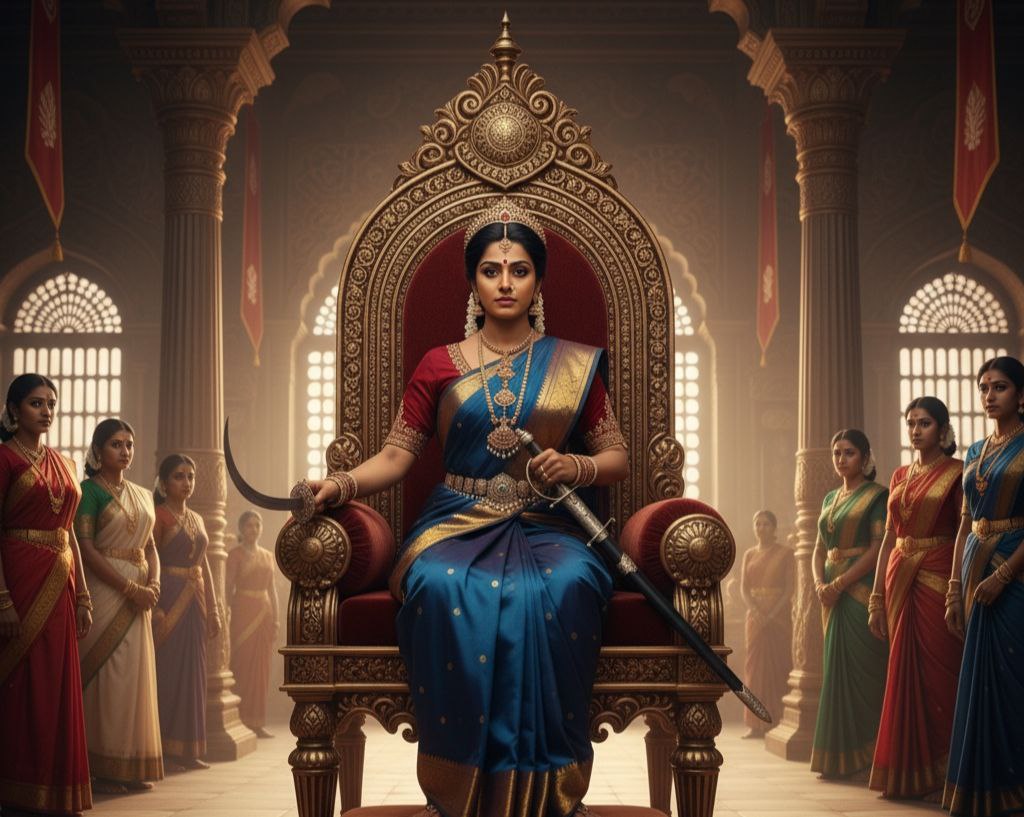
Rani Velu Nachiyar (1730–1796) is celebrated as 'Veeramangai' (Brave Woman) and is historically significant as the first Indian queen to wage war against the British East India Company (EIC) and emerge victorious, nearly a century before Rani Lakshmibai of Jhansi.
The Birth of a Warrior Princess
Rani Velu Nachiyar was born on January 3, 1730, in Ramanathapuram (Ramnad) in present-day Tamil Nadu. Her parents were King Chellamuthu Vijayaragunatha Sethupathy and Queen Sakandhimuthathal. As the couple's only child and with no male heir, she was raised and trained more like a prince than a princess, a crucial factor in shaping her destiny.
Education and Training
Velu Nachiyar received an exceptional education befitting a future ruler. She was not only a scholar but also a proficient linguist, mastering French, English, and Urdu, which would later prove invaluable in diplomacy and espionage against the EIC. Crucially, she was rigorously trained in the arts of warfare, which included:
* Horse riding and Archery.
* The use of traditional war weapons.
* Silambam (a form of martial art using a bamboo staff).
* Valari (a traditional throwing weapon similar to a boomerang, for which her later commanders, the Marudhu brothers, were famously skilled).
This comprehensive training instilled in her a deep knowledge of strategy, combat, and leadership, preparing her for the extraordinary challenges ahead.
Marriage, Kingdom, and Tragedy
At the age of 16, Velu Nachiyar married King Muthuvaduganatha Periyavudaya Thevar of Sivaganga and became its queen. She bore him a daughter, Vellachi Nachiyar. Velu Nachiyar shared a close relationship with her husband, acting as his "friend, philosopher, and guide" in the administration of the kingdom.
The Attack on Kalaiyar Kovil (1772)
The peace of Sivaganga was shattered by the expansionist policies of the British East India Company and their ally, the Nawab of Arcot (Muhammad Ali Khan Walajah). The Poligars (feudal chieftains) of Sivaganga, including Muthuvaduganatha, refused to pay tribute to the Nawab, leading to inevitable conflict.
In 1772, the EIC forces, led by Colonel Joseph Smith, and the Nawab's army launched a brutal attack on Sivaganga. The decisive battle took place at the Kalaiyar Kovil Temple, a vital strategic and religious center. In the ensuing clash, King Muthuvaduganatha Periyavudaya Thevar was tragically killed. The kingdom of Sivaganga was seized by the invading forces.
Exile and The Eight-Year Vow
The assassination of her husband and the fall of her kingdom did not break Velu Nachiyar; it forged her into a determined revolutionary. She escaped the battlefield with her young daughter and her loyal commanders, the Marudhu Brothers (Vellai Marudhu and Chinna Marudhu).
For the next eight years (1772–1780), Velu Nachiyar lived in exile, primarily taking refuge in the Virupakshi fortress in Dindigul, which was under the protection of the local chieftain, Gopala Nayaker. During this period, she was driven by a single, powerful vow: to avenge her husband's death and reclaim her kingdom.
Forging Alliances and a Rebel Army
Her time in exile was not spent in hiding, but in meticulous planning and preparation. Velu Nachiyar realized that to defeat the mighty British, she needed more than just courage; she needed strategic alliances and a formidable army.
* Alliance with Hyder Ali: Her most crucial diplomatic move was seeking the help of Hyder Ali, the formidable Sultan of Mysore and a major adversary of the British. Velu Nachiyar's fluency in Urdu helped her communicate directly with Hyder Ali. Impressed by her determination and mastery of languages, and seeing an opportunity to weaken the EIC, Hyder Ali granted her a safe haven, a significant contingent of soldiers, and military aid, including weapons and training. He is said to have gifted her 5,000 infantry and 1,000 cavalry.
* The 'Udaiyaal' All-Woman Army: Velu Nachiyar established an all-woman army unit known as 'Udaiyaal' (named after a loyal shepherdess who was killed while trying to protect a well that supplied drinking water to the Queen’s hiding place). This groundbreaking move showcased her visionary leadership, training these women in combat for a decisive battle.
* The Marudhu Brothers: Her loyal lieutenants, the Marudhu Brothers, served as her chief military advisors and commanders-in-chief, instrumental in organizing and leading her forces.
The Great Reclamation (1780)
After eight years of preparation, planning, and gathering intelligence, Velu Nachiyar launched her counter-attack in 1780. She coordinated her forces, comprising her own army, Hyder Ali’s troops, and the support of local Poligars, for a swift and powerful campaign to reclaim Sivaganga.
The Suicide Mission of Kuyili
The British advantage lay in their superior weaponry and a massive ammunition depot located inside the Sivaganga fort. Velu Nachiyar knew that destroying this depot was essential for her victory.
This led to one of the most heroic and innovative acts in the history of the Indian resistance. Velu Nachiyar's personal bodyguard and the commander of the 'Udaiyaal' army, Kuyili, devised a daring plan.
* Kuyili and her unit found the location of the main British arsenal.
* On the day of the attack, Kuyili reportedly doused herself in oil (or ghee, as per some accounts) used in the lamps inside the fort.
* She then walked into the ammunition storage depot and set herself on fire, sacrificing her life to ignite and destroy the entire stock of British gunpowder and weapons.
This act of self-immolation, sometimes cited as the first human bomb in history, crippled the EIC's military power in the region and paved the way for the ultimate victory.
Victory and Coronation
With the British forces severely weakened and demoralized by the surprise attack and the destruction of their supplies, Velu Nachiyar's army launched the final assault. The EIC and the Nawab's forces were defeated, and Sivaganga was finally recaptured.
In 1780, Rani Velu Nachiyar was crowned the Queen of Sivaganga, successfully reinheriting her husband's kingdom. She stands as a unique figure in Indian history for her victory over the British.
Reign and Legacy
Rani Velu Nachiyar reigned over Sivaganga for approximately ten years (c. 1780–1790).
Administration and Succession
Her reign was marked by stable administration, with the Marudhu Brothers playing a powerful role as her chief ministers (Vellai Marudhu as Commander-in-Chief and Chinna Marudhu as Minister).
In 1790, due to health reasons or a desire for a peaceful transition, she stepped down from active rule. She was succeeded by her daughter, Vellachi Nachiyar, but the administration of the kingdom largely remained in the capable hands of the Marudhu Brothers.
Rani Velu Nachiyar passed away on December 25, 1796, leaving behind a legacy that would inspire countless freedom fighters.
Historical Significance
Rani Velu Nachiyar's story is an essential chapter in India's struggle for independence:
* Pioneer of Resistance: She holds the distinction of being the first queen to militarily challenge and defeat the British East India Company in India.
* Strategic Genius: Her eight years of detailed planning, successful diplomacy with Hyder Ali, and the innovative use of an all-woman army and guerrilla warfare tactics demonstrate her extraordinary strategic mind.
* Symbol of Tamil Pride: She is revered in Tamil culture as Veeramangai and her tales are celebrated in folk songs and legends, ensuring her place as a powerful symbol of courage and resistance against colonial oppression.
The Government of India issued a commemorative stamp in her honour in 2008, formally recognizing her invaluable contribution to the nation's history.