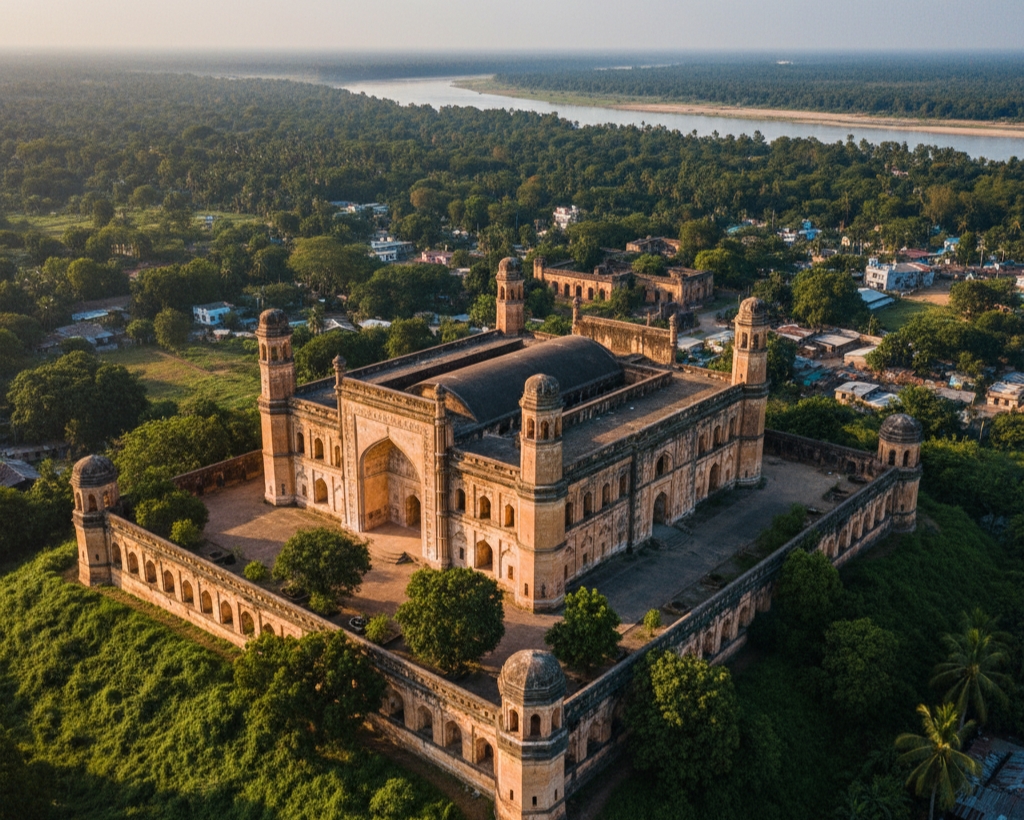
The Saga of the Jami Masjid, Rajmahal (Akbari Masjid)
Prologue: The Shifting Sands of Power
The story of the Jami Masjid in Rajmahal is not merely the tale of a stone and brick structure; it is the history of the Mughal Empire's most tumultuous eastern frontier, Bengal, encapsulated in a single, monumental edifice. It is a story of political necessity, strategic brilliance, cultural synthesis, and the transient nature of imperial capitals.
The stage is set in the late 16th century. The powerful Sultanate of Bengal, long a thorn in the side of the Delhi rulers, had finally fallen to the mighty armies of the Mughal Emperor Akbar. In 1576, the decisive Battle of Rajmahal marked the end of the Karrani Dynasty and the firm establishment of Mughal authority over the province of Bengal Subah. However, consolidating this vast, fertile, and often rebellious territory required more than just military victory; it required a strategic, administrative heart.
The old Bengali capital of Gaur (or Lakhnauti) had fallen prey to an epidemic following a shift in the course of the mighty Ganga River, rendering it unsafe and depopulated. The Mughals needed a new seat of power—a city that was strategically defensible, politically central, and logistically sound. Their eyes fell upon Rajmahal.
Chapter I: The Architect of the Capital - Raja Man Singh
The person responsible for this monumental shift was not a Mughal prince but one of Emperor Akbar's most trusted and formidable generals: Raja Man Singh I of Amber (Jaipur). A brilliant Rajput commander and statesman, Man Singh was appointed the Governor (or Subahdar) of Bengal and Bihar. Between 1592 AD and 1595 AD, he made the fateful decision to move the capital of Bengal from the decaying Gaur to the burgeoning settlement of Rajmahal.
Man Singh understood the strategic geography perfectly. Rajmahal was positioned at the narrow Teliagarhi Pass, the "Gateway of Bengal," controlling all movement along the Ganges and the land route between North India and Bengal. It was defensible and afforded excellent riverine connectivity.
To cement the new imperial presence, Man Singh renamed the town Akbarnagar, in honor of his sovereign, and launched an ambitious building program, transforming the rustic settlement into a grand Mughal capital. Among the palaces, official buildings (Baradari), gardens, and fortifications, the most paramount and defining structure he commissioned was the Jami Masjid (The Friday Mosque).
The construction of a grand Jami Masjid was the signature act of establishing an imperial capital. It was not just a place of prayer; it was a visible declaration of sovereignty, a symbol of the Badshah's (Emperor's) presence, and the central point of the new socio-political life.
Chapter II: The Crown of Akbarnagar (1595-1605 AD)
The Jami Masjid, often referred to as the Akbari Masjid in Rajmahal, is traditionally dated to the period between 1595 AD and 1605 AD, concurrent with Man Singh's tenure as governor. The chosen site was a high land, strategically overlooking the surrounding area, known by the Arabic name "Hadaf," meaning "the target of archery butts." This elevated position lent the structure both dignity and a dominating presence.
The Architectural Fusion:
The construction was a powerful act of architectural synthesis, representing the "intermixture of architectural style in Mughal Bengal" that defined the region's artistic output.
* Imperial Mughal Grandeur: The mosque was built on an enormous, oblong plan, with the total complex originally measuring approximately 76.20 \text{ meters} \times 64.00 \text{ meters}. Its material was predominantly brick, covered entirely in thick plaster (stucco), a common technique in Bengal that allowed for intricate, yet durable, ornamentation.
* The Central Nave and Pistaq: The most striking Mughal feature is the large central pistaq (high arched screen) entrance, leading into a massive central corridor or nave covered by a barrel-vault. This element recalls the monumental scale seen in imperial mosques, and the long barrel-vaulting specifically shows an influence from the earlier Jaunpur architectural style.
* Bengali Sultanate Echoes: Integrating local tradition, the exterior angles of the mosque feature tall octagonal corner towers, a hallmark of the previous Bengali Sultanate architecture. However, these indigenous elements are surmounted by cupolas in the Mughal pattern, signifying the successful overlay of imperial authority onto local forms.
* The Courtyard and Gateways: The complex featured a spacious courtyard (sahn) enclosed by a high compound wall with decorative arched recesses on the inner side. Access was provided by three grand gateways: on the north, south, and the main entrance on the east, complete with a porch.
* The Prayer Chamber: The main liwan (prayer hall) on the west side was a massive structure. From the outside, it appears to be two-storied due to the visual effect of large windows and a continuous horizontal parapet below them. The western wall, which contains the qibla (direction of prayer) and the mihrabs (prayer niches), was intricately decorated with floral designs and geometric patterns picked out in stucco work.
A scholar of the time reportedly described the architecture as a building of “vastly more taste and far surpasses any of the buildings in Gaur…”—a high compliment that underscored the Mughal ambition to eclipse the glory of the former Sultans.
Chapter III: The Golden Age and the Royal Viewer
For a brief, intense period, the Jami Masjid stood at the center of the political, economic, and cultural life of the largest province of the Mughal Empire. The city of Akbarnagar throbbed with life. The court convened nearby, and the main street, the Mangalhat, became a bustling commercial hub.
The mosque was a monument not just to faith but to imperial organization. The design included features that catered to the Mughal hierarchy:
* The Upper Galleries (Zanana): It is traditionally said that the structure included dark rooms or enclosures on the first floor, with small holes. These were likely zanana enclosures or screened-off areas, allowing the Mughal noblewomen and members of the royal harem to observe the court proceedings or participate in prayers without being seen, a common feature in imperial Mughal architecture.
* The Royal Procession: The Subahdar, Raja Man Singh, and later Mughal governors, would lead the Jumma (Friday) prayers, a public affirmation of their religious and temporal authority. The main eastern gate was the point of entry for this grand procession.
The Jami Masjid was thus more than a building; it was a theater for the exercise of Mughal power in Eastern India.
Chapter IV: The Capital's Flight and the Mosque's Decline
Rajmahal's golden age was, however, tragically short-lived.
* The First Shift (1607 AD): The city's initial strategic advantages began to wane. In 1607 AD, the new Governor, Islam Khan, shifted the capital from Rajmahal further east to Dacca (Dhaka, now in Bangladesh). This move was necessitated by the need to more effectively manage the hostile local chieftains (the Baro Bhuiyans) and to better control the vast, waterlogged delta that was Bengal's heartland. Akbarnagar, with its magnificent Jami Masjid, became a secondary administrative center.
* The Brief Return (1639 AD): The city experienced a renaissance when Prince Shah Shuja, son of Emperor Shah Jahan and Governor of Bengal, moved the capital back to Rajmahal in 1639 AD. He resided in the Singhi Dalan Palace on the banks of the Ganges. During this period, the Jami Masjid would have regained some of its lost glory, witnessing royal patronage once more.
* The Final Fall (1707 AD onwards): This second tenure as capital was also temporary. Following the instability after the death of Aurangzeb and the rise of the independent Nawabs of Bengal, the capital was moved yet again, permanently this time, to Murshidabad by Murshid Quli Khan around 1707 AD.
With the definitive loss of its capital status, Akbarnagar began its slow, inevitable decay. The grand buildings, including the Jami Masjid, were left exposed to the ravages of nature, the shifting course of the Ganga, and the neglect that follows a loss of patronage.
Chapter V: The Scars of Time and Colonial Records
The mosque suffered significant damage over the centuries. Local records and archaeological surveys suggest that parts of its vast structure collapsed. The northern and southern portions, including some of the surrounding enclosure walls, fell into ruin. The elements, coupled with the dense jungle that often reclaimed abandoned cities in Bengal, buried much of its history.
It was during the colonial period that the mosque was brought back into the historical limelight by British surveyors and antiquarians.
* Buchanan Hamilton's Sketch: The famous British surveyor, Francis Buchanan-Hamilton, visited Rajmahal in 1810-1811 and created detailed sketches and measured drawings of the mosque. These early records proved invaluable, preserving a visual testament to the monument's original form and scale before further deterioration.
These historical records confirmed that what remained was still an architectural wonder, a magnificent synthesis of Indo-Islamic styles.
Chapter VI: The Legacy in Modern Jharkhand
Today, the Jami Masjid stands not in Bengal, but in the Sahibganj district of Jharkhand, a poignant reminder of the fluid borders and shared history of the region.
What remains is a powerful relic. The Archaeological Survey of India (ASI) has recognized its immense historical value and has declared it a Centrally Protected Monument since 1915, initiating necessary conservation and restoration work.
* The Present Structure: The current remains, though reduced from the original dimensions, still command attention. The massive prayer hall, its barrel-vaulted ceiling, the elegant pistaq entrance, and the beautiful stucco floral designs on the mihrab wall continue to draw scholars and tourists.
* The Cultural Significance: The mosque, along with the nearby ruins like the Baradari and Shah Shuja’s Palace, forms the core of Rajmahal's historical identity. It represents the height of Mughal influence in the region and the unique architectural school that flourished under Raja Man Singh.
* A Symbol of Syncretism: The very foundation of the mosque—built by a Hindu Rajput Raja (Man Singh) for the Mughal Emperor (Akbar) in a newly established capital—makes it a powerful symbol of the Mughal policy of syncretism (Sulah-i-Kul). It stands as a physical testament to the era when imperial loyalty and administrative necessity transcended religious divides in the service of a grand vision for the empire.
The Jami Masjid of Rajmahal is a silent chronicler—a monumental story in brick and plaster—of an age of empire, a flashpoint of history, and the enduring architectural genius that once transformed a small village on the Ganges into the majestic Akbarnagar, the capital of Mughal Bengal.