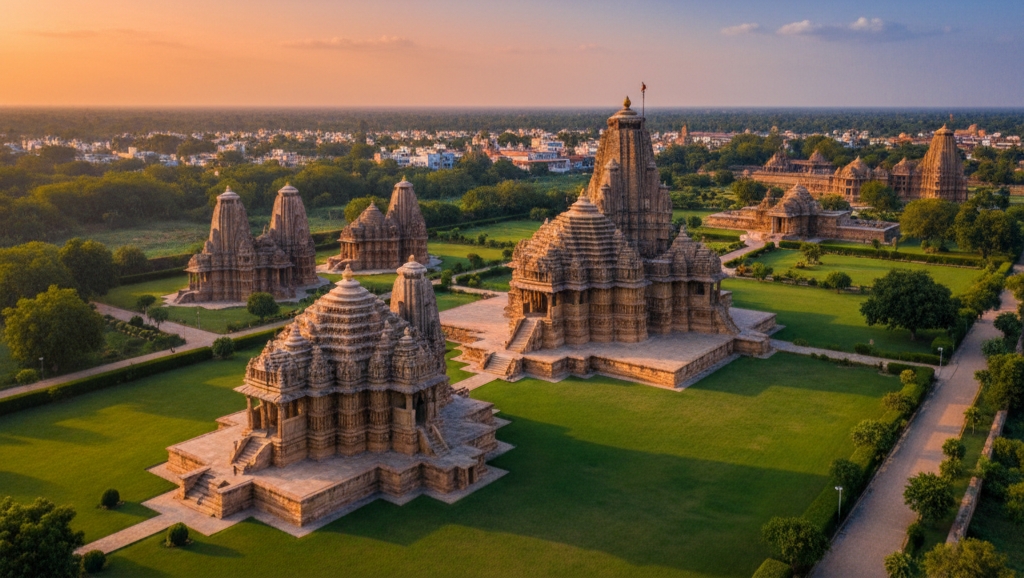
The Enigmatic Splendor of Khajuraho ????️
The Khajuraho Group of Monuments, located in the state of Madhya Pradesh, India, stands as one of the most remarkable examples of Indian art and architecture. A UNESCO World Heritage Site, it is globally renowned for its intricate, explicit, and evocative sculptures that adorn the temple walls. Built between 950 and 1050 CE by the Chandela dynasty, Khajuraho represents a brief yet brilliant flowering of Hindu and Jain religious art, leaving behind a legacy that continues to fascinate and perplex historians and visitors alike.
The Rise of the Chandela Dynasty
The story of Khajuraho is inextricably linked to the Chandela rulers, a dynasty of Central India who initially served as vassals of the Pratiharas of Kannauj. They eventually established their own sovereign kingdom, ruling over the region of Jejakabhukti (modern Bundelkhand).
Founding and Patronage
The temples were built during the dynasty's peak. The name Khajuraho itself is believed to derive from the Sanskrit word 'Kharjura-vahaka' (the bearer of dates) or 'Kharjura-pura' (date-palm city), referring to a prominent date palm grove or an ancient gate adorned with two golden date palm trees.
* King Yashovarman (circa 925–950 CE) is credited with building the Lakshmana Temple , one of the most magnificent and earliest surviving temples, marking the beginning of the great construction phase.
* The work continued most intensely under his successor, King Dhanga (circa 950–1002 CE), who commissioned some of the most celebrated temples, including the Vishwa-natha Temple.
* The final major burst of construction occurred under King Vidyadhara (circa 1003–1035 CE), who is associated with the grandest of all: the Kandariya Mahadeva Temple.
The Chandela rulers were devout patrons of the arts and had a cosmopolitan approach to religion, which is reflected in the diverse nature of the temples, dedicated primarily to Hindu deities (Shiva, Vishnu, Surya) and Jain Tirthankaras.
Architectural Marvel: The Nagara Style
The temples of Khajuraho are masterpieces of the Nagara style of temple architecture, specifically the Central Indian variant. They showcase a highly developed and sophisticated architectural schema.
Key Features
* Elevated Platform (Jagati): The temples are often built on a high platform, providing a grand base and separation from the ground.
* Harmonious Plan: Most of the larger temples follow a similar plan, progressing axially from east to west:
* Ardhamandapa (Entrance Porch)
* Mandapa (Main Hall)
* Maha-Mandapa (Great Hall)
* Antarala (Vestibule)
* Garbhagriha (Sanctum Sanctorum, housing the primary deity)
* Shikhara (Spire): The sanctuaries are crowned by a tall, tapering Shikhara , symbolizing Mount Meru, the mythical cosmic mountain. The Kandariya Mahadeva Temple boasts an impressive cluster of subsidiary Shikharas surrounding the main one, giving it a majestic, mountainous appearance.
* Sculptural Bands: The exterior walls are decorated in horizontal bands of sculptures, known as bhittis, featuring a plethora of deities, mythical creatures, and the famous erotic figures.
The Meaning Behind the Sculptures
While Khajuraho is most famous for its erotic carvings (which constitute only about 10% of the total sculptures), the vast majority depict various aspects of life, mythology, and spiritual practice.
Categories of Carvings
* Deities and Mythological Scenes: These include images of gods and goddesses (like Shiva, Vishnu, Brahma, and their consorts), celestial beings (Apsaras, Gandharvas), and episodes from Hindu epics and Puranas.
* Court and Daily Life: Carvings depict kings, warriors, musicians, dancers, and various scenes of everyday Chandela life, including hunting, teaching, and rituals.
* The Sura-Sundaris (Celestial Maidens): These exquisitely carved female figures are characterized by their graceful postures (tribhanga) and expressive faces. They are shown applying makeup, dancing, holding children, or simply looking out, often representing the ideal feminine beauty.
* The Erotic Sculptures: These mithuna (coupling) sculptures depict various explicit and acrobatic sexual positions. Their presence has sparked countless debates and theories:
* Tantric Practices: The Chandelas may have been influenced by Tantric Shaivism, where the union of the male and female principles (Purusha and Prakriti or Shiva and Shakti) is seen as a path to spiritual liberation (Moksha). The erotic acts symbolize the cosmic union.
* Auspiciousness (Mangala): Erotic depictions were traditionally seen as auspicious and protective, warding off evil spirits and the 'evil eye.'
* Educational Purpose: They might have served as visual guides to the Kama Sutra, instructing youths about dharma (righteous conduct), artha (economic prosperity), and kama (pleasure) before entering married life, as per the Hindu Purusharthas (goals of human life).
* Boundary Symbolism: Many of the most explicit carvings are located on the outer wall joints, symbolizing the transition from the material, profane world outside to the spiritual, sacred space within the Garbhagriha.
The Grand Temple Complexes
Out of an estimated 85 original temples, only about 20-25 survive today, clustered into three main geographical groups: Western, Eastern, and Southern.
Western Group (The Most Famous)
This group contains the largest and most impressive temples, predominantly Hindu.
* Kandariya Mahadeva Temple: The largest and most elaborate temple, dedicated to Shiva. Its name means "The Great God of the Cave." It is renowned for its sheer scale (over 30 meters high) and the approximately 900 detailed carvings on its interior and exterior.
* Lakshmana Temple: Dedicated to Vishnu, it is architecturally significant as one of the earliest examples of the mature Chandela style. It houses a magnificent Vaikuntha Vishnu image.
* Vishwa-natha Temple: Dedicated to Shiva, it is known for its excellent proportions and delicate carvings.
Eastern Group
This group includes both Hindu and Jain temples, reflecting the Chandelas' religious tolerance.
* Parshvanatha Temple: The largest and finest of the Jain temples, dedicated to the Tirthankara Parshvanatha. The carvings here are renowned for their delicate and sensitive Sura-Sundaris, though they generally lack the explicit erotic content of the Hindu temples.
* Javari Temple: Dedicated to Vishnu, it is smaller but beautifully proportioned and adorned.
Southern Group
Located slightly further away, this group includes some later constructions.
* Duladeo Temple: Dedicated to Shiva, it is known for its graceful sculptures and is considered one of the last major temples built in Khajuraho.
* Chaturbhuja Temple: Dedicated to Vishnu, it houses a colossal image of four-armed Vishnu and is notable for having no erotic sculptures whatsoever.
Decline and Rediscovery
After its zenith in the 11th century, the importance of Khajuraho waned.
The Retreat
* The Chandela capital eventually shifted to Mahoba and later Kalinjar.
* The rise of Islamic sultanates in North India posed a military threat. Although Khajuraho was never completely destroyed, the temples were neglected after the 13th century.
* As the jungle slowly encroached, the temples were mostly lost to memory, known only to local villagers and ascetics. The jungle's isolation arguably saved the monuments from the widespread iconoclasm that affected other parts of India.
The Reawakening
The temples remained hidden for centuries until they were rediscovered by the British.
* In 1838, a British surveyor, T.S. Burt, was guided to the site by a local guide. His report, along with subsequent documentation by General Alexander Cunningham, brought the forgotten temples to the attention of the world.
* Cunningham, later the founder of the Archaeological Survey of India, systematically documented and cataloged the temples, initiating the process of clearance and preservation.
Today, Khajuraho is a testament to the sophisticated artistic and spiritual achievements of a medieval Hindu dynasty. The temples are not just a collection of stone structures but a philosophical statement carved in rock, exploring the full spectrum of human experience—from the mundane to the spiritual, the sensual to the sublime—ultimately aiming for the liberation embodied in the divine within the Garbhagriha.