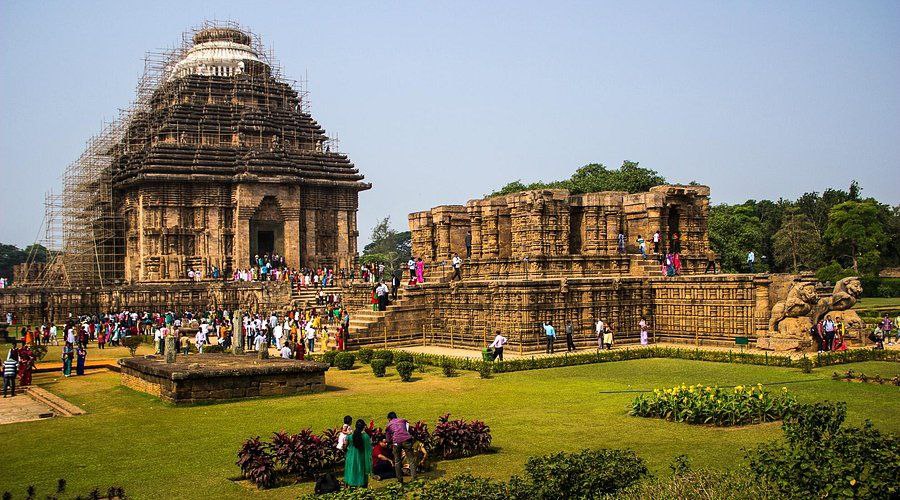
The Sun Temple of Konark, often called the "Black Pagoda," is not merely a structure of stone; it is a monumental poem written in the language of architecture. Standing on the shores of the Bay of Bengal in Odisha, India, it represents the absolute zenith of the Kalinga school of temple design.
To understand why and how this temple was made, one must travel back to the 13th century, an era of imperial grandeur, naval power, and deep spiritual devotion.
1. The Why: The Purpose of the Chariot
The temple was commissioned around 1250 CE by King Narasimhadeva I of the Eastern Ganga Dynasty. While several factors converged to inspire its creation, they can be categorized into three main pillars:
A Monument to Victory
King Narasimhadeva I was a formidable warrior, known as Langula (the one with a tail, likely referring to his royal insignia). He was one of the few Hindu kings of the era who didn't just defend his territory but took the fight to the invaders. He successfully defeated the forces of the Mamluk dynasty of Bengal.
* Symbol of Power: Historians believe the temple was a "Victory Monument" (Jaya Stambha). By building a temple of such impossible scale, he sought to proclaim the strength and stability of the Eastern Ganga Empire.
* Divine Right: By dedicating this colossal structure to the Sun God, Surya—the source of all life and light—he was effectively linking his earthly sovereignty with celestial authority.
The Spiritual Legacy: The Legend of Samba
The choice of location—Konark—was not accidental. According to the Puranas, the area was known as Arka Kshetra (The Zone of the Sun).
* The Healing of Samba: Legend tells of Samba, the son of Lord Krishna, who was cursed with leprosy. After twelve years of severe penance at the confluence of the Chandrabhaga River and the sea, Surya (the Sun God) appeared and cured him.
* The First Temple: In gratitude, Samba built a temple to Surya. King Narasimhadeva I likely chose this sacred ground to build a more magnificent version of that original shrine, continuing a lineage of sun worship that had existed for centuries.
2. The How: Engineering the Impossible
The construction of Konark is a marvel of medieval engineering. It took 1,200 artisans approximately 12 years to complete.
The Chariot Design
The temple is not shaped like a traditional building; it is a colossal stone chariot.
* The 24 Wheels: Carved into the platform of the temple are 24 massive stone wheels (12 pairs). These are not just decorative; they are sundials. The shadows cast by the spokes can still be used to calculate the exact time of day to within minutes.
* The 7 Horses: The chariot is pulled by seven galloping horses, representing the seven days of the week and the seven colors of the rainbow.
* The 12 Months: The 12 pairs of wheels represent the 12 months of the Hindu calendar.
Material and Logistics
The builders used three types of stone: Chlorite (for door frames and deities), Laterite (for the foundation and invisible core), and Khondalite (for the main structure).
* Moving Mountains: These stones were not found locally. They were transported via the river system on massive rafts and pulled to the site using elephants and rollers.
* Iron Dowels: In an era before modern mortar, the stones were held together using a system of interlocking grooves and heavy iron dowels. This created a structure so stable it has survived centuries of coastal weather and seismic activity.
3. The Story of Dharmapada: A Sacrifice in Stone
No history of Konark is complete without the legend of Dharmapada, the 12-year-old boy who saved 1,200 lives.
As the story goes, the main architect, Bishu Maharana, and his 1,200 craftsmen had spent 12 years building the temple. However, they faced a crisis: they could not fix the Kalasha (the crowning stone) atop the temple. The King, frustrated by the delay, issued an ultimatum—if the temple was not finished by morning, all 1,200 artisans would be executed.
Dharmapada, the son Bishu Maharana had never met (having left for work before the boy was born), arrived at the site. Using his brilliance, the child figured out the engineering solution that had eluded the masters. He climbed to the top and fixed the Kalasha.
However, the artisans feared the King’s wrath—if he found out a 12-year-old child had succeeded where they failed, their lives would still be at risk. To protect his father and the 1,200 workers, Dharmapada jumped from the temple top into the sea, sacrificing himself to ensure the glory of the temple remained untarnished.
4. The Decline: Why is it in Ruins?
Today, the main sanctum (Vimana) is gone, and only the assembly hall (Jagamohana) remains.
* The Magnet Theory: Legend says a massive magnet was placed at the top of the temple to hold the iron beams in place. This magnet supposedly interfered with the compasses of passing European ships, leading sailors (who called it the "Black Pagoda") to remove it, causing the temple to lose its structural integrity.
* Invasions: Historical records suggest the temple was desecrated by invaders in the 15th and 17th centuries, leading to the removal of the main deity. Once a temple is no longer in "active worship," it often falls into neglect.
* Nature: The soft Khondalite stone was susceptible to the salty, corrosive winds of the Bay of Bengal, which slowly ate away at the intricate carvings.
Summary Table: Quick Facts
| Feature | Detail |
|---|---|
| Builder | King Narasimhadeva I (Eastern Ganga Dynasty) |
| Era | 13th Century (c. 1250 CE) |
| Architectural Style | Kalinga Style (Nagara subset) |
| Main Symbolism | Chariot of the Sun God (Surya) |
| Location | Konark, Odisha (Coastal India) |
| Total Wheels | 24 (Representing time and months) |
The Sun Temple of Konark remains a testament to what human imagination can achieve when fueled by faith and imperial ambition. Even in its ruined state, it stands as a reminder that the "language of stone" can indeed outlast the language of man.
Let’s dive deeper into the two mysteries that continue to amaze tourists and scientists worldwide.
1. Time Calculation via the Konark Wheels (Sundial Science)
The 24 wheels carved at the base of the temple are not just artworks; they are incredibly precise sundials. Each wheel is approximately 9.8 feet in diameter and consists of 8 major spokes and 8 minor (thinner) spokes.
How to Tell Time:
* Major Spokes: The 8 major spokes divide the 24 hours of a day. The time between two major spokes represents 3 hours (known as one Pahar).
* Minor Spokes: The space between a major spoke and the adjacent minor spoke represents 1.5 hours (90 minutes).
* Precision: Around the edge of the wheel, there are carvings shaped like small beads. The 90-minute interval is further divided by 30 beads, meaning each bead represents 3 minutes.
How is it calculated?
When you place a finger or a thin stick at the center of the wheel (the hub), the shadow cast on the rim indicates the exact time. Even today, these sundials can tell the time with minute-level accuracy.
2. Carvings on the Walls and Social Life
The walls of Konark can be described as "History written on Stone." The carvings are generally categorized into three main themes:
A. Erotic Sculptures
Like Khajuraho, Konark is famous for its erotic art. Several philosophical reasons are attributed to this:
* Tantric Influence: During that era, Tantric traditions were prevalent in Odisha, where Kama (desire/sex) was considered a path toward spiritual liberation.
* The Test of Spirituality: It was believed that a devotee must leave all worldly desires and lust outside before entering the inner sanctum (approaching the Divine). This is why these carvings are only on the exterior walls.
* Symbol of Procreation: Since the Sun is the source of all life, these sculptures celebrate creation and the continuity of existence.
B. Royal and Daily Life
The walls depict scenes from the life of King Narasimhadeva I:
* The King is shown holding court, leading his army, and receiving blessings from his gurus.
* Depictions of thousands of elephants, horses, and soldiers showcase the military might of the time.
* Women are shown cooking, combing their hair, and playing musical instruments, providing a vivid glimpse into 13th-century Odia society.
C. Evidence of Foreign Trade
One very interesting carving depicts a Giraffe. Since giraffes are not native to India, this serves as historical evidence that Odisha’s merchants had trade links with Africa and that the King received exotic gifts from overseas.
3. Another Architectural Marvel: Iron Beams
It is fascinating to note that no concrete or cement was used in the construction. To join the massive stones, copper plates and enormous iron beams were used. Some of these beams are over 35 feet long. Scientists still study how such pure iron—which has remained rust-free for over 700 years—was forged without modern welding technology.
Let’s explore the British intervention and the sacred geometry behind its construction.
1. Why is the Temple Filled with Sand?
If you visit Konark today, you will notice that you cannot enter the Jagamohana (the main Assembly Hall). This is because it is completely filled with sand and sealed with a wall.
The British Rescue Mission (1901–1903)
By the late 19th century, the temple was in a state of near-collapse. The main tower (Vimana) had already fallen, and the Assembly Hall was under threat.
* Preventing Collapse: In 1901, the British Lieutenant-Governor of Bengal, Sir John Woodburn, realized that the heavy stone roof of the Hall would collapse inward because the interior pillars could no longer support the weight.
* The Solution: To prevent this, the British engineers decided to fill the entire interior of the hall with sand. They drilled holes in the ceiling and poured sand in until the structure was packed solid from the inside.
* The Result: This "sand-packing" acted as an internal support, holding up the walls and roof. The entrance was then walled up to keep the sand in place.
The Modern Dilemma: Today, the Archaeological Survey of India (ASI) is working on a plan to remove the sand. Over the last century, the sand has settled, leaving a gap at the top, and some experts fear the weight of the sand is actually pushing outward against the walls.
2. Vastu Shastra: The Sacred Geometry of Konark
The Sun Temple was not built randomly; it was designed according to the strict rules of Vastu Shastra and Shilpa Shastra (the ancient Indian sciences of architecture and sculpture).
Alignment with the Sun
The most incredible feature of the temple’s design is its solar alignment.
* The Morning Sun: The temple is positioned in such a way that the first rays of the rising sun would pass through the main entrance, cross the assembly hall, and strike the central diamond or the forehead of the Sun God's idol in the inner sanctum.
* Equinox Accuracy: During the spring and autumn equinoxes, the sun rises exactly in the center of the temple's main gateway.
The Power of 12 and 7
The numbers used in the design are mathematically significant:
* The 12 Pairs of Wheels: Represent the 12 months of the year and the 12 zodiac signs.
* The 7 Horses: Represent the 7 days of the week and the 7 meters of Sanskrit prosody (Chhandas).
The Foundation
The foundation of the temple uses a "box" technique. Massive stone blocks were placed in layers, and the gaps were filled with sand to create a shock-absorbent base. This is one reason why the temple survived many earthquakes that leveled other structures in the region.
3. The Iron Beams: Medieval Metallurgy
As mentioned before, the use of iron in Konark was revolutionary.
* Rust Resistance: Like the famous Iron Pillar of Delhi, the beams at Konark have shown incredible resistance to corrosion despite being located right on the salty sea coast.
* Magnetic Balance: Local legends persist that the iron beams worked in tandem with a massive Lodestone (magnet) at the top. This magnet supposedly kept the idol of Surya "levitating" in mid-air through magnetic repulsion—a feat that would have been a pinnacle of ancient engineering if true.
Summary Table: Preservation and Science
| Feature | Purpose / Fact |
|---|---|
| Sand Filling | Used by the British in 1903 to prevent the roof from collapsing. |
| Solar Alignment | The first rays of the sun were designed to hit the main idol's feet/forehead. |
| Lodestone Legend | A 52-ton magnet was said to be the "keystone" of the structure. |
| Iron Purity | The iron used is almost 99% pure, preventing it from rusting for 750 years. |
The Sun Temple of Konark is a bridge between the spiritual past and the scientific future. It shows that ancient Indians were not just great artists, but master mathematicians and astronomers.