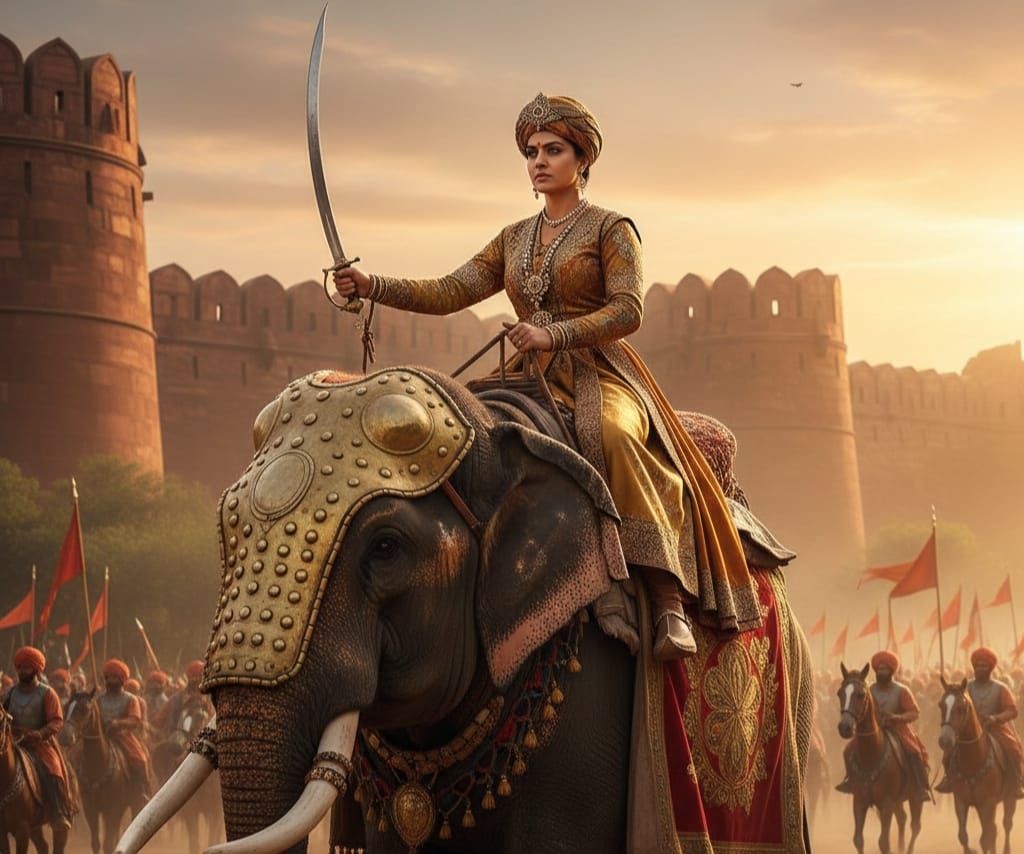
The winds of the 13th century blew harsh and cold across the plains of North India, carrying the scent of dust, horse sweat, and the shifting loyalties of men. In the heart of Old Delhi, within the red sandstone walls of the Quila Rai Pithora, a revolution was brewing—not one led by a usurper or a foreign invader, but by a daughter.
This is the story of Razia Sultan, the first female monarch of the Delhi Sultanate, a woman who traded the veil for a sword and the zenana for a throne.
The Sultan’s Choice
It began with Sultan Iltutmish, a man who had risen from a slave to the master of Hindustan. He had many sons, but as he watched them grow, his heart grew heavy. They were consumed by wine, poetry, and the easy life of the court. None possessed the "iron in the blood" required to hold a fractured empire together.
However, there was Razia.
While her brothers lounged in silken gardens, Razia stood by her father’s side during administrative meetings. She watched how he balanced the volatile "Forty" (Chahalgani)—the elite corps of Turkish nobles who held the real power. Iltutmish saw in her a sharp, tactical mind and a soul that didn't flinch at the sight of steel.
In 1231, while departing for a military campaign in Gwalior, Iltutmish did the unthinkable: he left Razia in charge of Delhi.
When he returned, he found the city thriving and the administration seamless. He summoned his scribes and commanded them to draft a decree naming Razia his heir. The nobles gasped. "A woman to lead the faithful?" they whispered. Iltutmish silenced them with a single look: "My sons are given over to the pleasures of youth. Not one of them has the fitness to rule. Razia is better than twenty such sons."
The Shadow of the Throne
But the world was not ready. When Iltutmish died in 1236, the Turkish nobles immediately discarded his will. They crowned his son, Ruknuddin Firuz, a man whose only talent was spending the royal treasury on elephants and dancers.
The empire began to crumble. Ruknuddin's mother, Shah Turkan, took the reins of power and began a reign of terror, executing rivals and plunging Delhi into chaos.
Razia knew she had one chance. In a masterstroke of psychological warfare, she dressed in flaming red robes—the traditional color of those seeking justice—and appeared before the common people during the Friday prayers at the Quila-i-Kuhna Mosque.
She didn't speak to the nobles; she spoke to the people.
"Judge me not by my gender," she cried, "but by my father’s legacy. If I fail to bring peace, you may take my head."
The commoners, moved by her courage and desperate for order, rose in a massive wave. They stormed the palace, deposed Ruknuddin, and for the first time in Islamic history, a woman was lifted onto the throne by the will of the people.
The Reign of the Monarch
Razia was not a "Sultana" (a term usually reserved for the wife of a Sultan). She insisted on being addressed as Sultan Razia.
She shed the traditional female attire, casting aside the purdah. She appeared in public wearing the quba (tunic) and kulah (hat) of a man. She rode at the head of her armies, led battles from the back of an elephant, and conducted open court where anyone could approach her for justice.
She was brilliant, but she was surrounded by wolves. The "Forty" nobles hated her—not just because she was a woman, but because she was effective. She began appointing non-Turks to high positions to break the Turkish monopoly on power. Her closest confidant was Jamal-ud-Din Yaqut, an Abyssinian slave who rose to be the Master of the Stables.
The nobles whispered of a scandalous romance between the Queen and the African slave, using these rumors to poison the minds of the conservative public. Whether it was love or merely deep trust, Yaqut was the only man Razia could truly rely on.
The Fall and the Fortress
The rebellion finally ignited in the province of Bhatinda. The Governor, Malik Altunia, a childhood friend of Razia, rose in revolt.
Razia marched to meet him. But the conspiracy was deep. During the battle, her loyal Yaqut was murdered before her eyes, and Razia was captured and thrown into the dark dungeons of Fort Qila Mubarak.
The nobles in Delhi quickly crowned her half-brother, Bahram Shah. But Altunia, realizeing he had been used as a pawn by the Delhi nobles and denied his fair share of the spoils, had a change of heart.
In a twist of fate, the captor and the captive struck a deal. Razia married Altunia. Together, they raised a new army to reclaim her throne.
The Final Sunset
The march back to Delhi was a desperate gamble. In October 1240, the forces of Razia and Altunia met the Sultanate’s army. They were outnumbered and exhausted. The battle was a bloodbath, and Razia’s forces were routed.
Fleeing for their lives, Razia and Altunia reached the jungles near Kaithal. There, according to legend, they were betrayed. While resting under a tree, they were attacked and killed by a group of bandits (or perhaps assassins sent by Bahram Shah).
The woman who had defied an empire died in the dirt of a lonely forest.
Legacy of the Red Robe
Razia Sultan ruled for only three years, six months, and six days. But in that brief flash of time, she proved that authority was not a matter of birth or gender, but of character.
Today, her grave lies in a quiet, narrow lane of Old Delhi—unassuming and weathered by time. Yet, her story remains a towering monument to the spirit of a woman who refused to stay behind the curtain when the world needed a leader.
Razia Sultan's reign is not just a tale of bravery, but a masterclass in political chess and the struggle for absolute power. Let’s dive deeper into the two most critical aspects of her life that immortalized her in history:
1. Razia’s Conflict with the 'Chahalgani' (The Forty)
Iltutmish had created a corps of 40 Turkish slave officers known as the 'Chahalgani.' While they were meant to be the Sultan’s most loyal servants, after Iltutmish's death, they began to see themselves as 'Kingmakers.'
Razia’s Strategy: "Divide and Rule"
Razia knew that as long as these 40 Turkish nobles remained united, her throne would never be secure. She acted with great cunning:
* Promoting Non-Turks: To balance the administration, she began appointing Tajiks and local Indian Muslims to high-ranking positions.
* The Appointment of Yaqut: Appointing Jamal-ud-Din Yaqut as Amir-i-Akhur (Master of the Royal Stables) was a direct slap in the face to the Turkish nobility. Historically, this prestigious position was reserved only for Turks.
* Sowing Discord: When the nobles first rebelled, Razia chose diplomacy over immediate bloodshed. She sent secret messages to different factions within the rebel camp, making them doubt each other's loyalty. The rebellion collapsed from within due to mutual suspicion.
2. Military Leadership and Battlefield Prowess
Razia was not merely a ruler; she was a skilled commander. In the 13th century, a woman appearing on the battlefield was almost unthinkable.
Transformations on the Battlefield
* Royal Attire: Razia discarded female clothing because it hindered horse riding and swordsmanship. She adopted the tunic and cap of a soldier to blend in with her troops and lead from the front.
* The Elephant as a Command Post: Razia often rode an elephant during battle. This was not just a symbol of her bravery; it allowed her a panoramic view of the battlefield, enabling her to give clear instructions and maintain morale.
* The Ranthambore Campaign: Early in her reign, she sent forces to suppress the rebellion at Ranthambore and successfully re-established control, sending a clear message that the throne of Delhi was no longer in weak hands.
3. Razia and Yaqut: Love or Diplomacy?
Historians have long debated the nature of the relationship between Jamal-ud-Din Yaqut and Razia.
* Court Propaganda: Contemporary historians like Minhaj-us-Siraj hinted at a deep intimacy. However, many modern historians believe this was a smear campaign orchestrated by the 'Chahalgani' to tarnish her character.
* Political Necessity: Yaqut was Razia's most trusted confidant precisely because he was an outsider to the 'Chahalgani.' His loyalty was solely to her—an invaluable asset for a Queen surrounded by conspirators.
Let’s explore how she managed to hold a medieval empire together while breaking every social rule of the time.
1. The Military Genius of Razia
Razia wasn't just a figurehead; she was a tactical commander who understood that military power in the 13th century was as much about psychology as it was about swords.
The "Visible" Commander
In medieval warfare, if a leader fell or disappeared from view, the army would usually flee in panic. Razia used this to her advantage. By discarding the veil and riding an elephant in the center of the fray, she made herself the unmissable anchor of her army. Her presence signaled to her soldiers that their Sultan was sharing their risks, which inspired a level of fanatic loyalty that her brothers could never achieve.
Intelligence and Espionage
Razia excelled at "pre-emptive strikes." Before marching her army, she used a network of spies (mostly non-Turks) to understand the grievances of the local peasantry. By addressing their needs or promising lower taxes, she often ensured that the local population would not support the rebel governors she was marching against.
2. Social Life in the Delhi Sultanate
The society Razia ruled was a complex tapestry of cultures, religions, and rigid hierarchies.
The Indo-Islamic Fusion
This was a time when Persian culture was blending with Indian traditions. In the bustling markets (bazaars) of Delhi, one would hear a mix of Persian, Arabic, Turkish, and the early forms of Hindustani.
* Architecture: Razia contributed to the city's infrastructure, commissioning schools, libraries, and public wells. She wanted Delhi to be a center of learning, not just a military garrison.
* Religious Tolerance: While the ruling elite were Muslims, the vast majority of the subjects were Hindus. Razia followed her father's pragmatic approach—she focused on stability over forced conversion. She knew that to protect the borders from the looming Mongol threat, she needed a unified home front.
The Role of Women
Razia was a massive anomaly. The Zenana (women’s quarters) was the standard for noblewomen, where life was lived behind latticed screens. By stepping out into the "Man's World," Razia challenged the social fabric. While she didn't necessarily start a feminist movement in the modern sense, she proved that the "Right to Rule" was based on Aql (intellect) and Adl (justice), not gender.
3. The Mongol Shadow: The Silent Threat
One reason Razia was so strict with her nobles was the terrifying threat from the Northwest: The Mongols.
Genghis Khan’s successors were already knocking at the doors of India. Razia knew that a divided Sultanate would be devoured by the Mongol hordes. Her military focus was always on keeping the Northwestern frontier (modern-day Punjab and Pakistan) heavily fortified. Her downfall didn't come from foreign invaders, but from the internal "cancer" of the Chahalgani who valued their own power over the safety of the empire.
The Final Mystery: Her Grave
Even in death, Razia is a subject of mystery. There are three different locations claimed to be her burial site:
* Delhi (Mohalla Bulbul-i-Khana): The most widely accepted site.
* Kaithal (Haryana): Where she was reportedly killed.
* Tonk (Rajasthan): Where some local legends say she escaped and lived out her days.
The fact that her final resting place is debated shows how she lived—a woman who could never be easily pinned down by the walls of history.