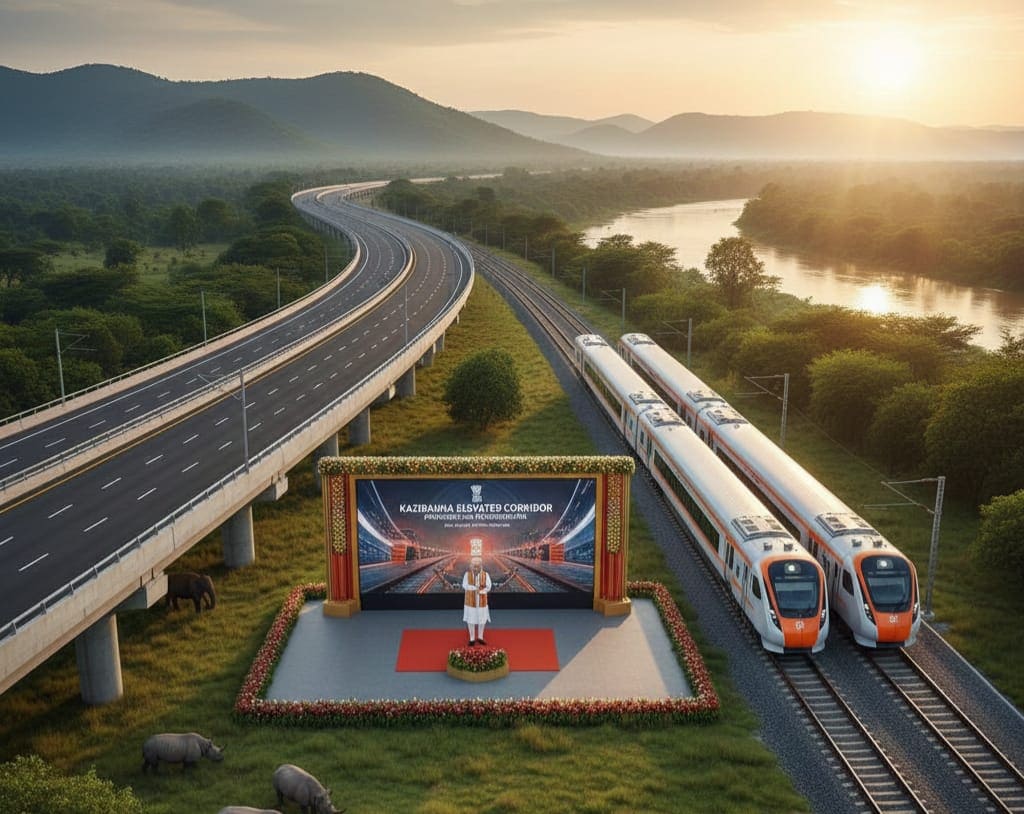
On January 18, 2026, Prime Minister Narendra Modi marked a historic milestone for Northeast India by laying the foundation stone for the ₹6,957 crore Kaziranga Elevated Corridor. This project, along with the flagging off of two new Amrit Bharat Express trains, signals a major shift in how India balances high-speed infrastructure with environmental conservation.
The Project at a Glance
The Kaziranga Elevated Corridor is not just a road; it is a specialized ecological bridge. Stretching across the Kaliabor-Numaligarh section of NH-715, the project includes:
* **35 km of Elevated Sections: Designed specifically to allow wildlife (including rhinos, elephants, and tigers) to pass safely underneath.
* **86 km Total Length: Upgrading the existing two-lane highway to a four-lane facility.
* Bypasses & Connectivity: New bypasses at Jakhalabandha and Bokakhat will decongest local towns while improving the route to Upper Assam (Dibrugarh and Tinsukia).
In tandem, the Prime Minister flagged off two Amrit Bharat Express trains:
* Kamakhya (Guwahati) to Rohtak
* Dibrugarh to Gomti Nagar (Lucknow)
How Beneficial is This?
From a developmental and environmental standpoint, these projects are highly significant for several reasons:
1. End of the "Monsoon Crisis"
For decades, the monsoon season in Kaziranga has meant tragedy. As the Brahmaputra overflows, animals are forced to cross the highway to reach the higher ground of the Karbi Anglong Hills. Many are killed by speeding vehicles. By elevating 35 km of the highway, we effectively remove the "kill zone," allowing animals to migrate naturally while traffic flows uninterrupted above.
2. Strategic Connectivity to Upper Assam
The corridor is the lifeline to Upper Assam and Arunachal Pradesh. Expanding this stretch to four lanes will reduce travel time between Guwahati and Dibrugarh by at least an hour. This is a massive win for the tea, oil, and coal industries, which rely on this highway for logistics.
3. Social Inclusion through Amrit Bharat
While Vande Bharat serves the premium segment, the Amrit Bharat Express is designed for the "common man." These non-AC, push-pull trains provide modern amenities (LED lighting, CCTV, mobile charging) at affordable rates. They bridge the gap between the Northeast and the Hindi heartland, making travel easier for students, laborers, and small traders.
My Point of View
This initiative represents a sophisticated evolution in Indian infrastructure—what I’d call "Compassionate Engineering." For too long, "development" and "environment" were seen as rivals; one had to lose for the other to win. The Kaziranga Corridor proves they can coexist. By spending ₹6,957 crore on an elevated design rather than a cheaper ground-level road, the government is putting a literal price on biodiversity.
However, the success of this project will depend on strict execution timelines (it is slated for a 36-month completion) and ensuring that the construction phase itself does not overly disturb the park's sensitive ecosystem. If executed well, this will become the global gold standard for building highways through UNESCO World Heritage sites.