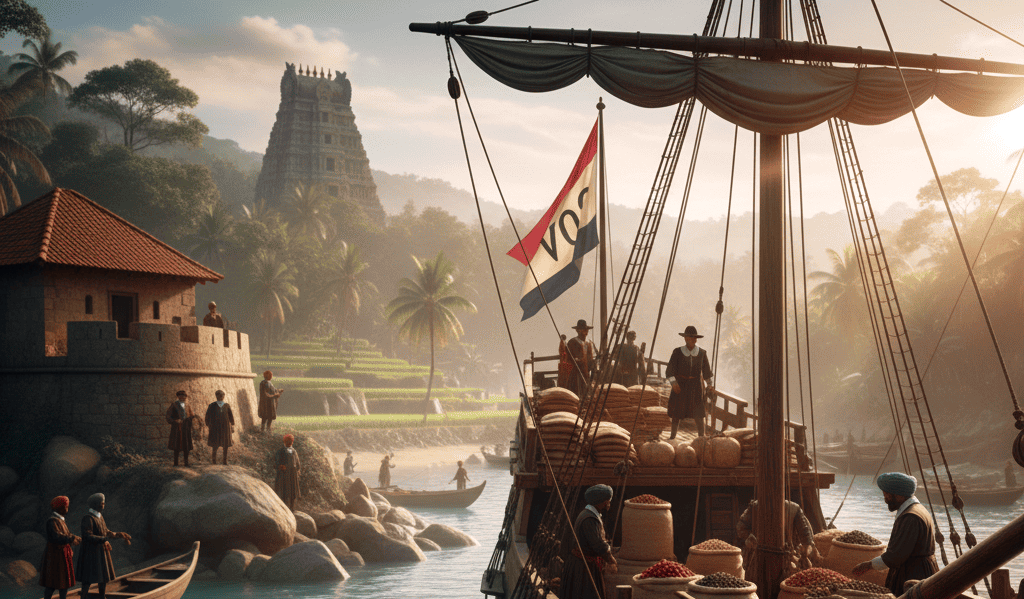
When we discuss the arrival of European powers in India, the name of the Dutch (people of the Netherlands) is often overshadowed by the Portuguese and the British. However, the reality is that in the 17th century, the Dutch East India Company, known as the VOC (Vereenigde Oost-Indische Compagnie), was the wealthiest and most powerful commercial entity in the world.
By the end of the 16th century, Dutch merchants realized that instead of competing individually, it would be more effective to unite against the Portuguese. On March 20, 1602, the Dutch Parliament merged several trading companies to form the 'Dutch East India Company' (VOC).
This company possessed unique characteristics:
The World’s First Public Company: It sold stocks (shares) to the general public.
Sovereign Powers: The company was granted the right to sign treaties, wage wars, and mint its own coins.
Monopoly: It was granted a 21-year monopoly to trade east of the Cape of Good Hope.
The primary goal of the Dutch was the "Spice Islands" of Southeast Asia (Indonesia). However, to acquire the textiles needed to trade for those spices, they established several commercial hubs in India.
Masulipatnam (1605): The Dutch established their first factory on the coast of Andhra Pradesh.
Pulicat (1610): This became their headquarters, where they built 'Fort Geldria'.
Chinsurah (1653): This became their major center for trade in Bengal.
Cochin (1663): They defeated the Portuguese to gain control over the Malabar Coast.
The Dutch introduced a new business model to India. Unlike the Portuguese, who focused almost exclusively on spices, the Dutch made Coromandel Textiles (Indian cotton clothes) the backbone of their trade.
They would buy cotton cloth from India, take it to Indonesia to trade for spices, and then sell those spices at massive profits in Europe. They also heavily exported silk, opium, and indigo from Surat, the Coromandel Coast, and Bengal.
The Dutch navy was far more modern and faster than the Portuguese fleet at the time. Between 1605 and 1663, the Dutch ousted the Portuguese from Indonesia, Sri Lanka, and most parts of South India. In 1641, they captured the strategically vital port of Malacca, which effectively broke the back of the Portuguese Empire.
The greatest challenge to the Dutch emerged in the form of the British East India Company. As the British grew more powerful in India, conflict became inevitable.
Battle of Bedara (1759): A decisive battle took place in Bengal between the British and the Dutch. The British (under Robert Clive) handed the Dutch a crushing defeat.
Impact: Following this loss, Dutch political ambitions in India collapsed. They were restricted solely to trade and gradually handed over all their centers to the British.
Although the Dutch presence did not last as long as the British, their influence remains:
Numismatics: The 'Pagoda' coins they minted were highly famous in contemporary trade.
Indo-Dutch Architecture: Dutch cemeteries and old buildings can still be seen in Kochi and Pulicat today.
Cartography: The highly accurate maps of the Indian coastline prepared by the Dutch were utilized for centuries.
In 1799, the Dutch East India Company was officially dissolved. The story of the Dutch teaches us how a single company, through sheer commercial acumen and naval power, captured the world's largest trade route. Had they prioritized India over Indonesia, the history of the Indian subcontinent might have been entirely different.