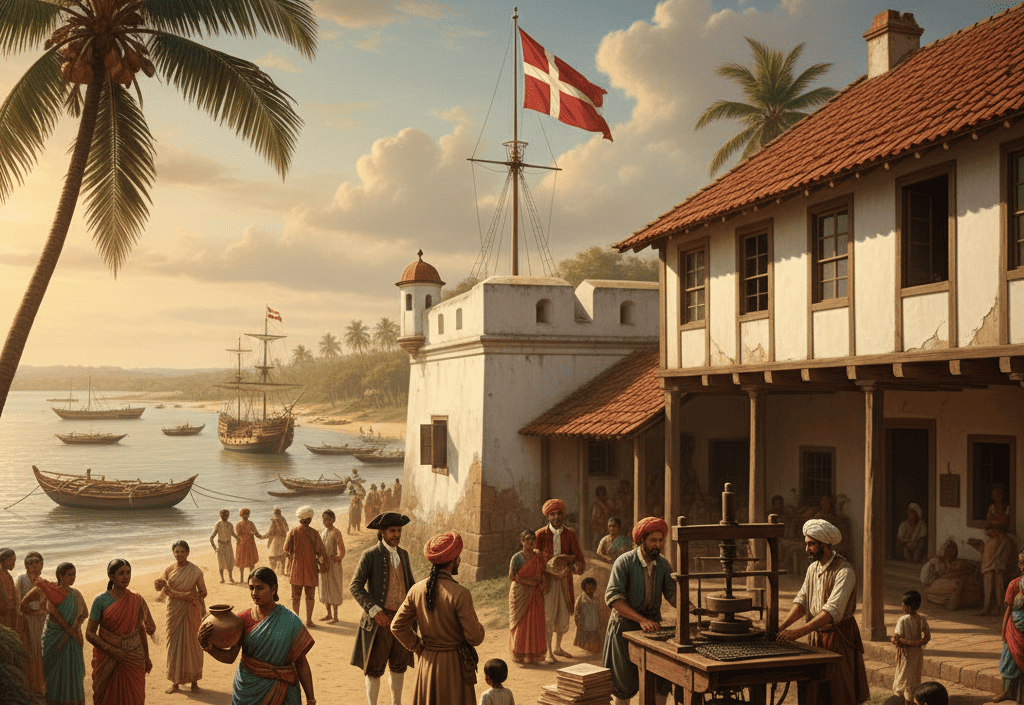
Observing the early successes of the Dutch and British companies, King Christian IV of Denmark granted a royal charter to the first 'Danish East India Company' in 1616. His objective was to secure a share of the lucrative spice trade in the East.
However, the Danish expedition faced significant struggles to reach India. After a grueling sea voyage and treacherous weather, they finally arrived on the southeastern coast of India.
The Danes established two primary settlements on the eastern coast of India, which became the nerve centers for their trade and missionary activities:
Tranquebar (Tharangambadi): In 1620, Danish commander Ove Gjedde negotiated a treaty with the Nayak ruler of Tanjore to establish a settlement at Tharangambadi (meaning "place of the singing waves") in Tamil Nadu. Here, they built Fort Dansborg, which remains the second-largest Danish fort in the world outside of Denmark.
Serampore: In 1755, they established their second major settlement at Serampore on the banks of the Hooghly River in Bengal, naming it 'Frederiksnagore'.
Danish merchants primarily traded in cotton textiles, indigo, opium, and spices. Since their military strength was significantly less than that of the British or the Dutch, they often functioned as a 'neutral' power. When other European nations were at war, Danish ships were frequently used to transport goods safely across the seas.
The greatest achievement of the Danish era was not commerce, but education and printing.
The First Printing Press: In 1706, the Danish missionary Bartholomäus Ziegenbalg arrived in Tranquebar. He established India's first major printing press there and printed the first translation of the Bible into the Tamil language.
The Serampore Trio: Scholars such as William Carey, Joshua Marshman, and William Ward turned Serampore into a center for Indian journalism and modern education.
Serampore College (1818): This is the oldest modern degree-granting college in Asia, founded with a charter granted by the Danish King.
The Danish Company faced frequent financial crises. Denmark's domestic situation deteriorated during the Napoleonic Wars, and the British had consolidated their position in India so strongly that it became impossible for smaller companies to survive.
Ultimately, in 1845, Denmark sold all its Indian settlements (Tranquebar and Serampore) to the British East India Company for 1.25 million rupees and bid a permanent farewell to India.
The history of the Danish East India Company is not one of wars and conquests, but of peaceful trade and the dissemination of knowledge. Even today, the streets of Tranquebar reflect Danish architecture, reminding us of the time when Scandinavian merchants wove their dreams along the coasts of Bengal and Tamil Nadu.