Among the European powers that arrived in India, the French were the last to enter the fray, yet they proved to be one of the most influential and formidable rivals. The history of the French East India Company—or 'Compagnie des Indes Orientales'—is not merely a tale of trade, but a saga of French prestige and the ambition to carve out a vast empire in the heart of India.
While the Portuguese, Dutch, and British had already established their grip on Indian trade, Jean-Baptiste Colbert, the famous minister to King Louis XIV, founded the French East India Company in 1664.
Unlike the British Company, which was run by private merchants, the French Company was entirely dependent on state support and government control. Its purpose was to challenge the Dutch and British monopolies and fly the French flag in the East.
The French established their first factory in Surat in 1668. Soon after, they created several vital centers on both the eastern and western coasts:
Puducherry (Pondicherry): Founded in 1673 by François Martin, this became the headquarters of the French Empire in India and was later known as the 'Paris of the East.'
Chandannagar: Located on the banks of the Hooghly River in Bengal, this served as their primary commercial hub in the north.
Mahe, Yanam, and Karikal: These coastal enclaves also came under French administration, forming a strategic network.
French influence reached its zenith when Joseph François Dupleix was appointed Governor of Pondicherry. Dupleix was the first European to conceive the technique of using internal disputes between Indian rulers to expand colonial territory—a strategy that the British later mastered and used to conquer the subcontinent.
He intervened in the politics of local nawabs and, with his disciplined European-style army, created a massive sphere of influence across South India.
The struggle for supremacy in India led to three major conflicts between the British and the French, known as the 'Carnatic Wars':
First War: The French successfully captured Madras, forcing the world to recognize their military prowess.
Second War: Dupleix's ambitions clashed with the tactical brilliance of Robert Clive, and French influence began to wane.
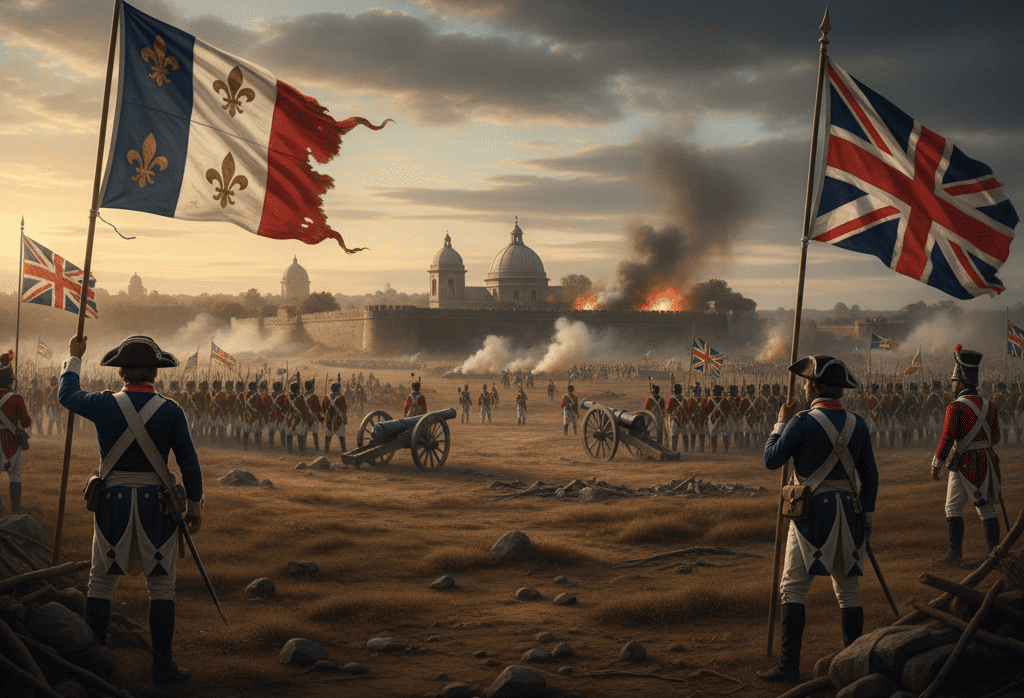
Third War (Battle of Wandiwash, 1760): This was the decisive turning point. The British handed the French a crushing defeat, effectively ending the dream of a French Empire in India forever.
Strict Government Control: The Company had to wait for approval from Paris for even minor decisions, whereas the British Company operated with significant autonomy.
Naval Weakness: The British Royal Navy was vastly superior to the French fleet, allowing them to cut off French supply lines.
European Preoccupations: France was frequently embroiled in continental wars in Europe, which diverted soldiers and resources away from the Indian campaign.
After the Treaty of Paris in 1763, the French were allowed to keep their settlements (Pondicherry, Chandannagar, etc.) but were forbidden from maintaining an army. They transitioned back into a purely commercial power.
Even after India gained independence in 1947, these French enclaves remained under Paris. It was only after peaceful negotiations that they were integrated into the Indian Union in 1954. Today, Puducherry remains famous for its distinct French culture, architecture, and cuisine.
The history of the French East India Company proves that an empire is built not just on bravery and resources, but on administrative freedom and naval supremacy. Although they did not rule all of India, they left behind a 'Mini Europe' in Puducherry, whose beauty continues to enchant visitors to this day.