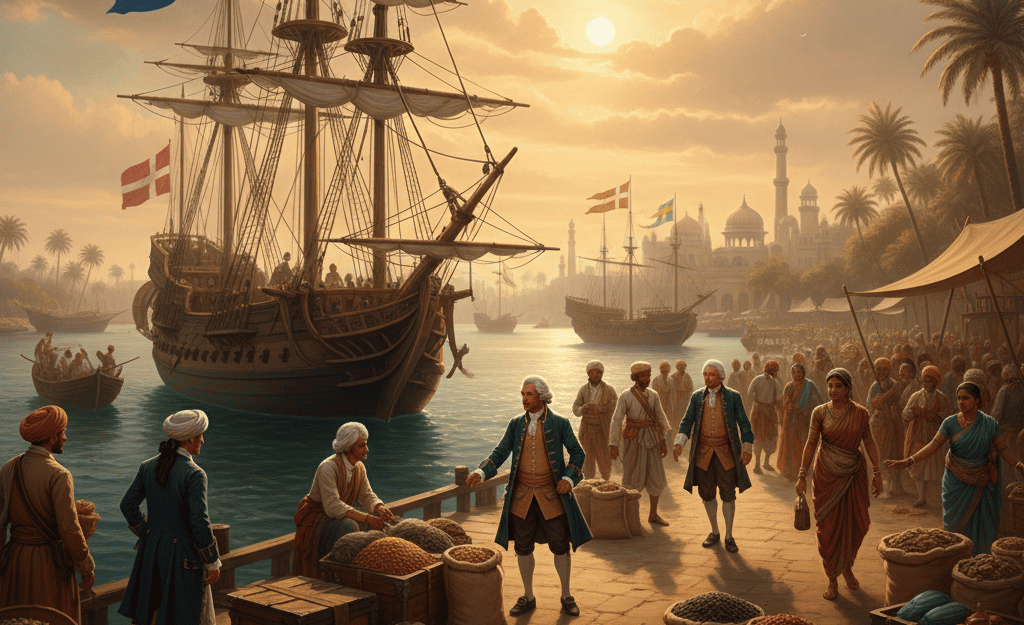
When the Ostend Company (Belgium) was forced to shut down due to intense diplomatic pressure from the British and Dutch, its experienced merchants and mariners looked toward Sweden. On June 14, 1731, King Frederick I of Sweden granted a royal charter to this new company.
Headquartered in Gothenburg, the company had a unique mandate: while it had the exclusive right to trade, it was responsible for its own protection and was given no military support from the Swedish state outside of Scandinavia.
The Swedish strategy was fundamentally different from its European rivals. Knowing they could not compete with the massive navies of Britain or the Netherlands, they adopted a different approach:
No Territorial Ambitions: They made no attempt to seize land or build fortifications in India.
Strict Neutrality: While the British and French were busy fighting each other, Swedish ships remained neutral, allowing them to continue trading even during major conflicts.
Smuggling and Resale: They purchased goods in India and China and sold them through "clandestine" channels in other parts of Europe (often off the coasts of England and Scotland) to bypass the British monopoly.
Although the company’s primary focus was the China trade (Canton) and tea, India was a crucial link in their operations.
Surat: Swedish ships frequently docked at Surat to purchase high-quality Indian textiles and spices.
Malabar Coast: This was their primary source for black pepper and cardamom.
The Silver Cargo: Unlike other nations that tried to trade manufactured goods, Swedish ships brought vast quantities of silver, which was highly preferred by Indian merchants.
More than 80% of the company's income came from the tea trade. In the 18th century, Europe's thirst for tea was so great that the Swedish company became a major competitor to the British and Dutch giants.
Beyond commerce, these ships were floating laboratories. Many disciples of the famous scientist Carl Linnaeus traveled on these vessels to study the flora and fauna of India and China, bringing back botanical knowledge that changed science forever.
Between 1731 and 1760, the company achieved record-breaking profits. The entire economy of Gothenburg and its grand architecture were built largely on the wealth generated by this Eastern trade.
However, by the late 18th century, circumstances shifted:
The Napoleonic Wars: Conflict in Europe made sea routes increasingly dangerous.
British Dominance: The British lowered taxes on tea, making the Swedish "smuggling" model less profitable.
Economic Depression: The company struggled to adapt to the changing global economy and eventually went bankrupt, closing its doors in 1813.
Today, the "East India House" in Gothenburg (now a museum) serves as a grand reminder of this era. For India, their legacy is cultural and scientific. The detailed journals, sketches, and botanical samples they produced provide a unique, non-imperialistic window into 18th-century Indian society and nature.
The story of the Swedish East India Company proves that trade doesn't always require guns and forts. A smaller power can challenge global giants through cleverness, neutrality, and a deep understanding of market demands—in this case, tea and silver.