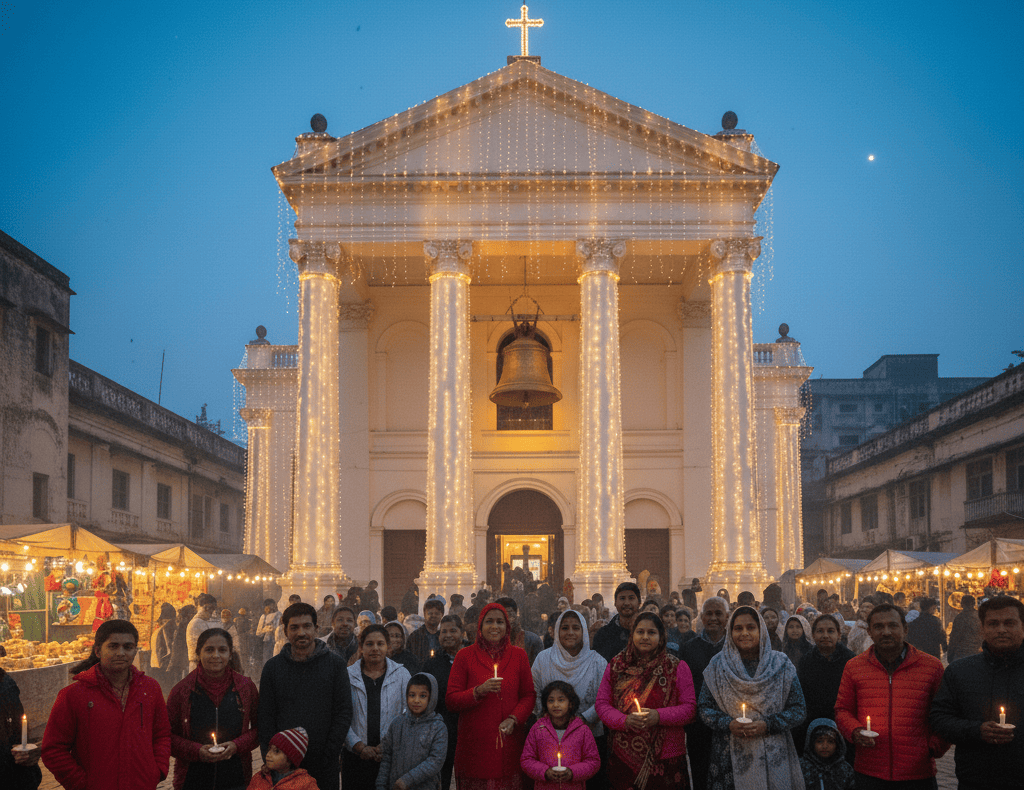
Nestled in the bustling heart of Old Patna, Padri Ki Haveli (also known as St. Mary's Church) stands as a silent witness to three centuries of Bihar's colonial, religious, and social transformation. It is not just the oldest church in Bihar; it is a monument to resilience, having survived wars, earthquakes, and the passage of empires.
The story of the church begins in 1713, when the Capuchin missionaries arrived in Patna. At the time, Bihar was a vital hub for trade, and the Mughal influence was still palpable.
The name "Padri Ki Haveli" literally translates to "The Mansion of the Padre." It was initially a small chapel, but as the Christian community grew—consisting of traders, local converts, and European officials—the need for a grander structure became evident.
The current structure we see today was designed by the Venetian architect Tirretto in 1772.
Style: The church is a classic example of Neoclassical architecture.
Dimensions: It stands 70 feet long, 40 feet wide, and 50 feet high.
The Facade: Unlike the ornate Gothic cathedrals of Europe, Padri Ki Haveli features a more restrained, stately look with towering pillars and a grand pediment that reflects the architectural trends of the late 18th century.
One of the most significant artifacts within the premises is a massive foundation bell.
The Gift: It was presented to the church by Bahadur Shah, the son of the Maharaja of Nepal, in 1782 as a token of appreciation for the medical help and goodwill provided by the missionaries.
Symbolism: The bell represents the cross-cultural and diplomatic ties that the mission held even beyond the borders of Bihar.
The Haveli has not had a peaceful existence. It has been at the center of several historical "storms":
The Siege of 1763: During the conflict between Nawab Mir Qasim and the British East India Company, the church was ransacked.
The 1857 Uprising: During the first war of Indian Independence, the church suffered damage as Patna became a site of significant anti-colonial activity.
The 1934 Earthquake: This devastating seismic event leveled much of North Bihar. While the church sustained heavy damage, it was meticulously restored, preserving its original dimensions and spirit.
A little-known but deeply spiritual fact about Padri Ki Haveli is its connection to Mother Teresa. In 1948, she came to Patna to receive basic medical training at the Holy Family Hospital, which was then located within the Padri Ki Haveli complex. It was here that she transitioned from being a teacher to a nurse, preparing for her life’s work in the slums of Kolkata.
The interior of the church is designed to evoke a sense of solemnity and vastness.
| Feature | Description |
| The Altar | Elaborately decorated, holding relics and scriptures from the 18th century. |
| The Pews | Original woodwork that has survived decades of use. |
| The Inscriptions | Latin and English inscriptions on the floor and walls mark the graves of influential missionaries and officials. |
Today, Padri Ki Haveli is more than a place of worship for the Catholic community. It is a heritage site that attracts historians and tourists alike. During Christmas, the church is beautifully illuminated, drawing people of all faiths from across Patna, symbolizing the syncretic culture of the city.
"The stones of Padri Ki Haveli don't just hold up a roof; they hold the memories of a Bihar that was the melting pot of the world."
Location: Patna City (near Gulzarbagh).
Established: 1713 (Original), 1772 (Current structure).
Architect: Tirretto.
Key Landmark: The Large Bell gifted by the Prince of Nepal